
Online Water Polo Betting in Great Britain - What It Costs and Where to Find It
 Available in US
Water polo sits in an odd corner of the British sportsbook. It is not one of the headline sports the marketing departments throw Super Boosts at, but it does surface as a fixture list on most licensed operators around the Olympic cycle, the World Aquatics Championships and the European championships. This page is about what that actually means for someone betting in Great Britain: which bookmakers offer it, what markets they price, how the odds are built, and what the welcome offers cost once the wagering is taken into account. The sport itself is a closed shop — four quarters, seven in the water per side, men’s event at the Olympics since 1900 and women’s since Sydney 2000 — but the betting on it follows the same mechanics as anything else on the slip.
*Current as of 27 October 2026 · Licence status verified against the Gambling Commission’s public register.*
The Legal Frame: Water Polo Betting Inside Great Britain
There is no statutory list of permitted sports for British betting. The Gambling Act 2005 gives the Gambling Commission the power to license categories of gambling activity, not individual markets, and water polo falls squarely under “remote general betting standard (real events)” — the same category that covers Premier League football and Wimbledon. Every operator that takes remote bets from customers in Great Britain needs a Commission licence, regardless of where the company itself is incorporated, and the relevant sections of the Act are 33 and 36 as amended by the Gambling (Licensing and Advertising) Act 2014. A Curaçao or Malta licence alone is not enough.
The Commission’s public register is the whole test. It can be searched by business name, trading name, domain or account number, and the entry lists the licensee, the licence categories, the trading domains and any associates. A British punter who wants to confirm a brand is licensed can do so in a minute. What the register does not do is rank operators, certify their odds or endorse their offers. A licence means the operator has passed the fit-and-proper test, segregates customer funds, takes part in GAMSTOP and submits to the Commission’s enforcement. It does not mean the welcome bonus is generous, or that water polo prices are sharp.

Northern Ireland is the exception that bites once. The Gambling Act 2005 covers England, Scotland and Wales only; Northern Ireland runs on its own older regime and a Commission licence does not extend there. For punters in Great Britain, every brand reviewed below is licensed, but the same cannot be assumed if the punter is sitting in Belfast.
Minimum age is 18 across the board, and since 7 May 2019 every licensed remote operator has had to verify name, address and date of birth before the customer can deposit, gamble or even claim a free bet. There is no anonymous play. The verification is not optional, and an offshore site that lets a punter deposit without it is one that is not operating under the Act.
Safer Gambling: What the Commission Requires and What the Punter Controls
The Commission’s player-protection framework sits on three pillars: self-exclusion, deposit limits and vulnerability checks. Every licensed operator takes part in all three.
GAMSTOP is the national multi-operator self-exclusion scheme and a mandatory licence condition for online operators since 31 March 2020. A punter who registers with GAMSTOP is blocked from every participating brand for the chosen period — six months, one year, five years, or five years with auto-renewal. After the minimum period the exclusion stays in place for a further seven years unless the customer asks GAMSTOP to remove it. It covers online sites and apps; the high-street betting shops use a separate scheme. An offshore site that is not in GAMSTOP is not bound by any of this, which is the cleanest reason to check the register before opening an account.
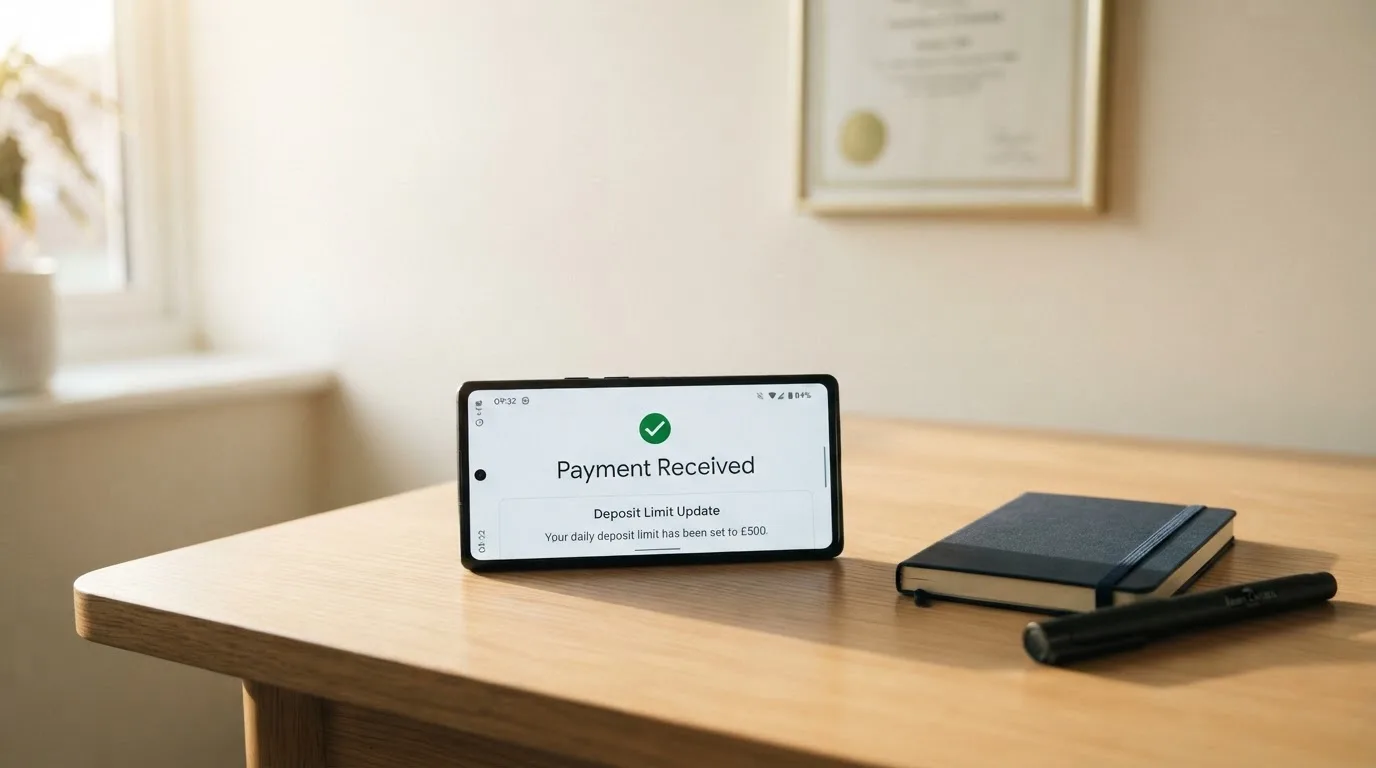
Deposit limits are the customer’s tool, not a state ceiling. There is no statutory cap on stakes or deposits in British sports betting. Operators must offer a deposit limit on a fixed time frame under the Remote Technical Standards, but the limit is one the punter sets for themselves: a £100 weekly cap, a £500 monthly cap, whatever the punter chooses. The Commission’s staged package announced for 2026 has been pushed back — the first phase has applied since 31 October 2025 and the second was postponed to 30 September 2026 — but neither phase imposes a state-set ceiling.
Financial vulnerability checks apply when a customer’s deposits minus withdrawals exceed £150 in a rolling 30-day period, since 28 February 2025. They are a public-record check (bankruptcy, county court judgments, the like), not an income check, not a credit reference check, and they trigger once the threshold is crossed. They are not the same as the “affordability checks” that have been discussed in the press; those are the financial risk assessments that the Commission has announced in a staged plan, with no start date. The state of the field is “announced, staged, no start date,” and that is the framing to use.
Where to get help if gambling stops being fun: GamCare runs the National Gambling Helpline; GambleAware funds treatment and education; the NHS runs gambling clinics; Gamblers Anonymous runs groups. Every licensed operator links to these from its safer-gambling page. Fitzwilliam Sports, for instance, links directly to GambleAware, GAMSTOP and Gamblers Anonymous from its footer, which is the pattern to expect.
Bonus Mechanics: What a “Free Bet” Actually Costs
The marketing language around sports betting promotions is built to obscure. A “£40 in free bets” headline is not £40 in cash; it is four tokens that pay out the profit only, with the stake usually not returned. A “100% bonus” is a bonus that carries a wagering requirement before the bonus money becomes withdrawable cash. The mechanics are the same regardless of the sport, so the points below apply as much to a water polo accumulator as to a Premier League single.
The stake-not-returned rule. A free bet priced at £10 on a winner at odds of 3.00 pays £20 profit — not £30. The £10 stake is forfeit. This is the standard across the British market and the operator’s own terms will say so. The only exception is a small number of stake-returned offers, and the marketing will say so in those cases. The cost of that rule, on average, is captured by the free-bet-value calculation: a free bet is worth its face value times (odds minus 1) divided by odds times the market’s payout share, so a £10 free bet at 3.00 in a market with a 95% payout share is worth about £12.67 on average — which is what it pays back across many such bets, never what any single bet wins.
Wagering requirements. When a bonus is paid as cash credit rather than as a free bet, the operator will ask the punter to “turn over” a multiple of the bonus before withdrawal is allowed. The promotion rules in force since 19 January 2026 cap this at 10x: a £10 bonus at 50x would have meant £500 of bets; under the cap no more than £100 of qualifying bets is needed. The cap is the law, not the operator’s choice. Mixed-product promotions — an offer that ties betting to casino, bingo or lottery spend — are banned entirely under the same rules. So “bet on football to unlock free spins” is no longer a legal promotion in Great Britain.
Minimum odds and expiry. Most welcome offers specify a minimum price for the qualifying wager (Coral’s £20 at minimum odds of 2.0 is the cleanest current example) and a deadline (Coral’s seven days to claim and seven days to use the free bets). Bets below the minimum price do not count toward the offer, and unused free bets expire on the clock. A punter who leaves the bet to the final day and finds the price has drifted will lose the qualifying stake without triggering the free bets.
Boosted odds and acca insurance. A “Super Boost” or “Price Boost” is a one-off enhanced price on a specific outcome: the stake is paid in cash, the winnings are paid in cash, and the offer has no wagering requirement. An “acca insurance” refunds a losing accumulator as a free bet or as cash credit if exactly one leg loses — which is not the same as a refund, since the stake on the winning legs is gone.
The cleanest way to read any offer is the small print: the stake-returned rule, the wagering multiple, the minimum price, the expiry, and any cap on free-bet winnings. The arithmetic on the rest of this page treats these as the cost of doing business, not as a gift.
Bet Types and Odds: How Water Polo Markets Are Built
Water polo betting offers the same market shapes as any other team sport with a small fixture list. The shapes are limited, the prices are wider than football, and the in-play product is thinner — but the mechanics are familiar to anyone who has bet on handball, ice hockey or basketball.
Outright winner. The most common market, especially during the Olympics, the World Aquatics Championships and the European championships. The punter backs one of two teams (or, in a tournament, the field). The price reflects the gap between the teams: a heavy favourite in a Croatia-versus-weak-side match might sit at 1.10 to 8.50; an even quarter-final might be 1.90 against 1.90. Outrights are settled when the tournament is decided, and ante-post bets on a tournament that is months away are settled at the start-of-day price on the day of the event unless the operator’s terms say otherwise.
Handicap. The handicap line is how the bookmaker squares up a mismatch. A -2.5 goal handicap on the favourite means the favourite must win by three or more for the bet to land; a +2.5 line on the underdog pays out if the underdog wins or loses by two or fewer. Handicap markets are popular in tournament play because the favourite-versus-underdog price on the outright is often too short to be interesting.
Total goals. Over/under a goal line set by the bookmaker, typically in the 14.5 to 18.5 band for men’s internationals. A punter who thinks the match will be tight takes the under; a punter who expects an early rout takes the over. The line moves with the betting, and the price on each side reflects the action as much as the model.
Quarter and half totals. Water polo’s four quarters (and the half-time line) open up period markets where the bookmaker prices the score for each quarter or the first half. These are popular in-play markets because the period structure is short, predictable and easy to follow on a live tracker.
In-play betting. Most licensed British bookmakers offer in-play markets on water polo during the bigger fixtures. The price moves goal by goal, the bookmaker may suspend pricing during a power play or after a timeout, and the cash-out button lights up as the match develops. In-play on water polo is not as deep as in-play on football, but the bigger tournaments carry live markets across most of the ten brands reviewed below.
Bet builders and accumulators. A bet builder combines several markets from the same match into a single price — winner, handicap, total goals, first goal. An accumulator (an “acca”) combines legs across several matches. Both multiply the odds into one price, and both can be combined: an accumulator of bet builders. The price is built from the same payout share as a single market, so the bookmaker’s edge compounds across the legs. BetMGM’s welcome offer, for instance, splits its free bets into accumulator-shaped tokens (two football accumulators of four or more selections, two sports multiples of two or more), which is a steer about what the operator wants the punter to do with them.
The Margin Behind the Price
The bookmaker’s margin is what makes the odds worse than the “true” probability of the outcomes would imply. On a two-way market with decimal odds of 1.90 against 1.90, the payout share is 1 ÷ (1/1.90 + 1/1.90) = 0.95, so the margin is 5%. On a tighter two-way at 1.85 against 1.85, the payout share is about 92.5% and the margin is 7.5%. On a typical three-way 1X2 football market at 2.10 / 3.40 / 3.50, the margin comes out around 5% to 6%.
What that means in plain language: the margin is the slice of every pound bet that the bookmaker keeps on average. A 5% margin means the operator keeps about 5pence on every pound across all bets on that market, in the long run. Punters who shop around for the best odds are doing the same thing as supermarket shoppers who compare unit prices — buying the same good at a smaller markup. The arithmetic shows up clearly on water polo, where the operator’s price list is short and the difference between 1.85 and 1.90 on the outright winner is the difference between a 7.5% margin and a 5% margin. A punter who places a £100 outright at 1.90 is paying £5 of expected cost across many such bets; the same bet at 1.85 is paying £7.50.
The lesson generalises. Every market on every sport carries a margin, and a punter who is choosing between two bookmakers on the same fixture is choosing between two margins. The arithmetic of the margin reveals the real cost, and it is what the headline price never tells you on its own.
The Sport: What the Calendar Looks Like
Water polo’s international calendar runs through three anchor events. The men’s tournament has been held within the World Aquatics Championships roughly every two to four years since 1973, the women’s was added in 1986, and both sexes are on the Olympic programme (men since Paris 1900, women since Sydney 2000). Outside those anchor events there is the European championship (held every two years under European Aquatics), the FINA Water Polo World Cup series and a thicket of national leagues (the strongest in Hungary, Croatia, Italy, Spain and Serbia) that show up on licensed British bookmakers mostly as outright winner markets during the play-offs.
The club scene is where the in-play product is thinnest. The national leagues run during the European winter and the Olympic summer, but the British bookmakers tend to price the league outright rather than individual matches, and the in-play offer is limited to the bigger European competitions. For a punter who wants in-play markets on water polo, the realistic calendar is the Olympics, the World Aquatics Championships and the European championships; everything else is a price on a futures blog.
What makes the calendar worth knowing is the price cycle. Outrights on the next Olympic tournament open twelve to eighteen months ahead of the Games, the price drifts as the form becomes clear, and the ante-post market closes at the start of competition. A punter who wants the best price on a long shot backs early; a punter who wants the best price on the favourite waits for the field to take shape. Both are bets on information — the question is whose information arrives first.
The Comparison: Ten Licensed Bookmakers Reviewed
The ten brands below all hold a Gambling Commission remote licence for general betting on real events, are listed on the Commission’s public register, and take part in GAMSTOP. The order is the spec’s, not a ranking. Each card carries the licence number, the licence holder, and what the operator’s own terms state on the subject key. The point of the card is what the operator actually offers, not what the welcome banner says.
| Brand | Gambling Commission remote licence number and licence holder | What the operator’s own terms state on the key’s subject |
|---|---|---|
| Fitzwilliam Sports | Remote licence 048760-R-335434-009, Commission account 48760; licence holder SBKI Limited | Self-describes as a Dublin bookmaker with capped membership; welcome offer described as a “High Stakes Welcome” subject to compliance criteria |
| Spreadex | Remote licence 008835-R-104580-022, Commission account 8835; licence holder Spreadex Limited | Combines fixed-odds and spread betting in one app, with one-click, auto and partial cash out, a Bet Builder across fixed odds or spreads, and live streaming of UK and Irish horse racing, greyhounds, tennis, NFL and selected football |
| Coral | Remote licence 054743-R-330863-014, Commission account 54743; licence holder LC International Limited | Sports welcome offer: £40 in free bets on a £20 qualifying bet at minimum odds of 2.0 (1/1); free bets issued within 7 days and expire 7 days after issue |
| Betfair | Remote licence 039439-R-319330-013, Commission account 39439; licence holder PPB Counterparty Services Limited | Offers in-play betting, Bet Builder, free live streaming of UK and Irish horse racing and football in the app, and a 90 Minute Payout market |
| BetVictor | Remote licence 039576-R-319370-028, Commission account 39576; licence holder BV Gaming Limited | Best Odds Guaranteed on UK and Irish horse racing, enhanced live race streaming, BetFinder for finding racing bets and Smart Stats |
| QuinnBet | Remote licence 061011-R-335683-004, Commission account 61011; licence holder QuinnBet (Gibraltar) Limited | Best Odds Guaranteed on Irish and UK horse racing from 10:00am daily on singles, multiples and system bets, capped at £150 per customer per race |
| Geoff Banks | Remote licence 054095-R-330366-010, Commission account 54095; licence holder GB Sports Advisors Limited | App offers live in-play prices and ante-post prices on future events |
| NetBet | Remote licence 039170-R-319343-032, Commission account 39170; licence holder Netbet Enterprises Limited | Daily Boosts, Profit Boosts and free bet offers; Bet Builder with instant dynamic odds; sports stats for major leagues |
| Kalooki Sportsbook | Remote licence 057730-R-333396-005, Commission account 57730; licence holder Kalooki Sportsbook Limited | GAMSTOP member; name, address and date of birth verified before a customer can deposit or gamble |
| BetMGM | Remote licence 039198-R-319450-029, Commission account 39198; licence holder LeoVegas Gaming PLC | Sports welcome offer: four £10 free bets (two football accumulators of 4+ selections and two sports multiples of 2+) on a £10 deposit and qualifying bet within 7 days; valid for 7 days with minimum odds and opt-in required |
Fitzwilliam Sports
Fitzwilliam Sports is a Dublin bookmaker with capped membership, and its licence (SBKI Limited, account 48760) is on the public register under remote general betting standard (real events). The welcome offer is framed as a “High Stakes Welcome” subject to compliance criteria — which is the kind of welcome that asks for a larger deposit and a higher minimum price than the typical £10 at 1.50, and is built for a punter who already bets in three-figure stakes rather than for someone opening their first account. The site offers instant deposits, fast withdrawals, timeouts and deposit limits, and links to GambleAware, GAMSTOP and Gamblers Anonymous. For a punter with a budget the site will suit, the welcome is structured for them; for the typical small-stake punter, the rest of the comparison list offers a cheaper entry point.
Spreadex
Spreadex is unusual on the British list because it is licensed for both fixed-odds betting (Commission account 8835) and regulated by the FCA for spread betting — the financial conduct regulator, not the gambling one. The combination is what makes Spreadex a single-app operation for both forms: fixed-odds, financial spreads, sports spreads. The sports app carries one-click, auto and partial cash out, a Bet Builder across fixed odds or spreads, and live streaming of UK and Irish horse racing, greyhounds, tennis, NFL and selected football. Spread betting carries a specific risk that the operator’s homepage is required to disclose: spread betting losses can exceed the deposit. That is the kind of warning that exists because it has happened, and a punter who is using Spreadex for fixed-odds water polo is in the regulated-gambling side of the app, not the FCA side.
Coral
Coral’s licence sits with LC International Limited (the same parent that runs Ladbrokes) under account 54743, with two categories: remote general betting standard (real events) and remote betting intermediary. The sports welcome offer is the cleanest example of the post-2026 rules in action: a £20 sports bet at minimum odds of 2.0 (1/1) unlocks £40 in free bets, issued within 7 days and expiring 7 days after issue. The minimum odds are the threshold below which the qualifying bet does not count; the 7-day clock on the free bets is the deadline. Coral is one of the high-street names that took the rest of the British market online, and the welcome is built for the casual punter who wants a fast entry and a few accumulator-shaped free bets.
Betfair
Betfair’s licence sits with PPB Counterparty Services Limited (a Paddy Power parent company) under account 39439 as a remote general betting standard operator. The sportsbook side offers in-play betting, a Bet Builder, free live streaming of UK and Irish horse racing and football in the app, and a 90 Minute Payout market — the last of which pays out on the result at 90 minutes regardless of extra time or penalties. The sportsbook is the consumer-facing side of Betfair; the exchange (where punters back and lay against each other) is a different operation that runs under the betting intermediary licence category and has its own fee structure. A punter who wants an exchange for water polo outrights will find the sportsbook first and the exchange behind it; both are licensed and both take part in GAMSTOP.
BetVictor
BetVictor’s licence sits with BV Gaming Limited under account 39576, remote general betting standard (real events). The product is racing-heavy: Best Odds Guaranteed on UK and Irish horse racing, enhanced live race streaming, a BetFinder feature for finding racing bets, and Smart Stats. Water polo is not the headline product here; the in-play product on water polo is unlikely to match a brand like bet365. The Best Odds Guaranteed mechanic is worth understanding: if the punter takes the price at the time of the bet and the starting price (SP) on the day is higher, the bet is settled at the higher price. It is a one-way concession on the bookmaker’s side and a free lunch for the punter who backs at the early price.
QuinnBet
QuinnBet’s licence sits with QuinnBet (Gibraltar) Limited under account 61011. The Best Odds Guaranteed mechanic is the headline product: from 10:00am daily on singles, multiples and system bets on Irish and UK horse racing, capped at £150 per customer per race. The £150 cap is the figure that matters — a punter whose winning bet would have settled at SP+£200 settles at SP+£150, and the rest is gone. For a punter who bets under £150 per race the cap is invisible; for a higher-stake punter it is the ceiling on what the offer is worth.
Geoff Banks
Geoff Banks’ licence sits with GB Sports Advisors Limited under account 54095, a remote general betting standard licence. The app offers live in-play prices and ante-post prices on future events. The brand is small on the British list — a single-app, no-frills product — and is useful for a punter who wants an ante-post market on water polo outrights a year ahead and does not need the rest of the high-street product wrapped around it.
NetBet
NetBet’s licence sits with Netbet Enterprises Limited under account 39170, remote general betting standard. The product carries Daily Boosts, Profit Boosts and free bet offers, a Bet Builder with instant dynamic odds and sports stats for major leagues. NetBet is a mid-market brand — neither the high-street heavyweight nor the specialist — and the welcome is built around a rotation of boosts and free bets rather than a single headline offer.
Kalooki Sportsbook
Kalooki Sportsbook is operated by Kalooki Sportsbook Limited under account 57730, remote general betting standard, and is a GAMSTOP member. The site is the kind of brand that surfaces in the Commission’s register rather than on the high street; the homepage states the verification requirement (name, address, date of birth) before the first deposit. A punter who wants to confirm that the verification rules are being applied will find them on the sign-up form, and a punter who wants to confirm GAMSTOP coverage will find the scheme listed on the safer-gambling page.
BetMGM
BetMGM’s UK licence sits with LeoVegas Gaming PLC under account 39198, remote general betting standard (real events). The sports welcome offer for new UK customers who deposit £10 or more and place a sports bet within 7 days is four £10 free bets — two football accumulators of 4+ selections, two sports multiples of 2+ — valid for 7 days with minimum odds and opt-in required. The shape of the offer tells the punter what the operator wants them to do: build accumulators, not singles. A punter who uses all four tokens at minimum stake and at minimum price will find the value compressed by the short window the markets favour, and the right way to use the offer is to pick legs at short price where the operator’s margin is tightest.
Where Water Polo Sits in the Broader Picture
The ten brands above all price water polo at the Olympic and World Aquatics cycle, and most price it at the European championship and the national-league play-offs. What they do not all do is price it in-play. The bigger the brand, the wider the in-play offer; the smaller the brand, the more likely the outright-only product. A punter who wants in-play on a domestic league match in mid-season will find the offer thin and the prices wide; a punter who wants outrights on the next Olympics will find the offer rich and the prices competitive.
The price is a function of the fixture list. The Olympics is the headline tournament and the one the marketing departments price first; the World Aquatics Championships is the second-tier headline; the European championship is the third; the national leagues are the long tail. A punter who plans around the calendar is a punter who plans around when the bookmaker’s price is sharpest.
The broader picture also includes the alternative: an offshore site without a Commission licence. The Act makes it an offence to provide gambling facilities in Great Britain without the licence the Act requires; the offence is aimed at the operator, not the punter. What the punter gives up is the Commission complaints route, the approved dispute-resolution body, the GAMSTOP coverage, the 10x bonus cap and the £150 vulnerability check, and the right to a British redress if funds are withheld. None of that is “legal to use”; all of it is the price of being outside the British framework. A punter who wants the framework will stay on a Commission-licensed site.
Frequently Asked Questions
How can it be checked that a bookmaker holds a Gambling Commission licence?
The Commission’s public register is searchable by business name, trading name, domain or account number and is the whole test of who holds one. Every entry lists the licence holder, the licence categories, the trading domains and any associates, and the entry is the operator’s evidence of fitness to take remote bets in Great Britain. A punter who cannot find the brand on the register should not open an account with it.
How is the return on a bet worked out from the stake and the odds?
For a single bet, return equals stake multiplied by the decimal odds; net profit is the return minus the stake. For an accumulator, the odds of each leg multiply into one price and the stake is multiplied by that combined price. A £10 single at 3.00 returns £30; a £10 treble at 3.00, 3.00 and 3.00 returns £270.
What is the bookmaker’s margin and how can it be seen in the odds?
The margin is the slice of every pound bet that the bookmaker keeps on average. It is the difference between 100% and the payout share, and the payout share is 1 divided by the sum of the reciprocals of all outcome odds in a market. A two-way market priced at 1.90 against 1.90 has a payout share of about 95% and a margin of about 5%; a three-way football 1X2 at 2.10 / 3.40 / 3.50 carries a margin of about 5% to 6%. The margin is the only honest reading of what the headline price means.
How do fractional odds such as 5/1 convert to decimal odds such as 6.00?
Fractional odds a/b convert to decimal odds by dividing a by b and adding 1, so 5/1 becomes 5 ÷ 1 + 1 = 6.00, and 11/4 becomes 11 ÷ 4 + 1 = 3.75. The decimal price is what the stake multiplies into the return; the fractional price is profit-over-stake. British bookmakers show both; the decimal price is the easier arithmetic for the punter who wants to calculate the return on a given stake.
Which tools for controlling play does a licensed bookmaker have to offer?
Every licensed operator takes part in GAMSTOP, offers deposit limits and timeouts on the customer’s request, links to GamCare and GambleAware from its safer-gambling page, and applies the financial vulnerability check when a customer’s net deposits exceed £150 in a rolling 30-day period. The verification of name, address and date of birth before the first deposit is also mandatory. Together these are the floor; a brand that offers less is not licensed.
Are betting winnings taxed in Great Britain, and who pays General Betting Duty?
The player pays no tax on betting winnings in Great Britain, which is general information and not tax advice; a professional gambler should ask HMRC or a qualified adviser. General Betting Duty is the operator’s tax on gross profits, currently 15%; from 1 April 2027 a new remote betting rate of 25% applies within it, while remote bets on UK horse racing, pool betting and in-person betting stay at 15%. The duty is the operator’s; the punter’s experience of it is at the price the operator offers, and whether the operator passes it through to the odds is not established.
US & other team sports – Best Betting Tips
Content created by the «Best Betting Tips» team
