
Betting on UFC fights online in 2026: what every licensed UK bookmaker is actually offering
 Available in US
UFC fight nights now sit alongside Premier League football and Championship horse racing in the weekly rhythm of British online gambling. The growth has been quiet — there is no high-street shop window the way there is for the turf accountant — but the betting sites that hold a Gambling Commission licence list the UFC card weeks in advance, and an account holder in Manchester, Cardiff or Edinburgh can back a method-of-victory wager as readily as a 1X2 on a Saturday fixture. The trade that has built up around the sport is the subject of this page: which British-licensed bookmakers carry the fights in depth, which markets they offer, how the odds are constructed and what the bookmaker keeps out of every pound staked. The verdict on each platform sits in the ranking further down; the mechanics sit in the sections before it.

This guide was checked against the Gambling Commission’s public register on 27 October 2026, and the operator details were verified against each operator’s own terms page on the same day. Odds and margins age faster than anything else on this page; where a specific price or margin appears with a snapshot date, that is the day research recorded it. A price or margin described without a date is a general property of the market, not a quoted figure.
The shape of UFC betting in Great Britain
UFC is a private promotion. It held its first event on 12 November 1993 in Denver, Colorado, and is now owned and operated by TKO Group Holdings, with Dana White as president since 2001. By 2026 it has staged more than 750 events, with eight men’s and three women’s divisions and a year-in, year-out calendar of numbered pay-per-views and Fight Night cards on ESPN and ESPN+. Two title fights are already on the late-2026 British calendar: UFC 334 (Gane vs. Hokit) at Madison Square Garden on 14 November 2026, and UFC 335 (Oliveira vs. Lopes) at the T-Mobile Arena in Las Vegas on 12 December 2026.
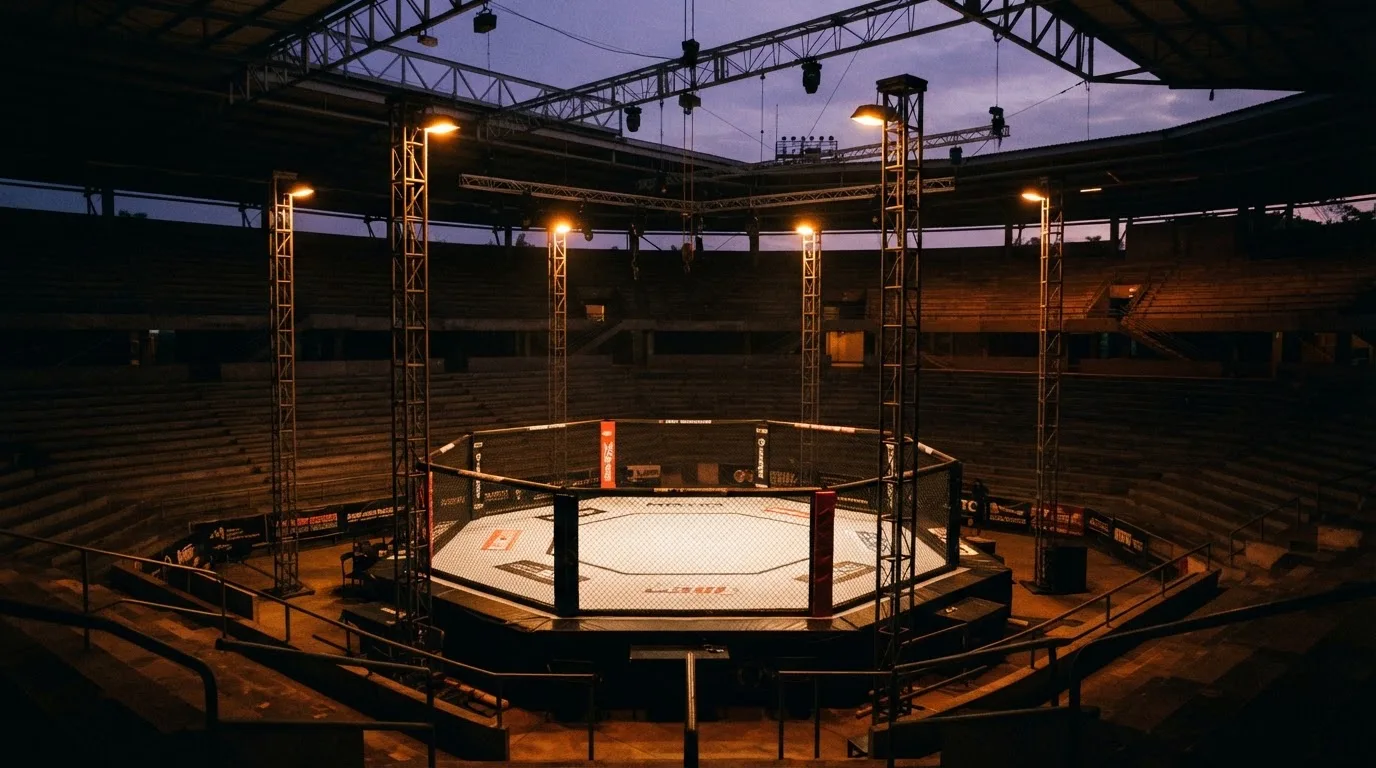
That calendar is what a British punter sees. Each bout has a head-to-head match winner; most have over/under rounds markets and a method-of-victory market; many have a “go the distance” prop and a “fight of the night” price. The number of available markets per bout varies between bookmakers — a marquee pay-per-view headline fight can carry forty or more lines at one firm and twelve at another — but the bones are the same: a moneyline, a totals line, a method line, and a small handful of round and finish props.
A bout is scheduled as three rounds or five. Championship bouts and the main event of a pay-per-view card run the full five; everything else is three. Each round runs a maximum of five minutes, with one minute’s rest between rounds. A bout can end by submission, knockout, technical knockout, judges’ decision (unanimous, majority, split or technical) or disqualification, and a referee can rule a no contest. Three judges at cageside score every round on the ten-point must system: the winner of a round gets ten, the loser nine or fewer, with 10-8 reserved for rounds that are clearly dominated. If a UFC title fight is ruled a draw, the defending champion retains the belt.
Those rules shape the markets. An over/under rounds line sits across the most likely finish range for the weight class: heavyweights end inside the distance more often than lightweights, so the totals line tends to sit lower for them. A method-of-victory market is priced against the fighters’ finishing records and the stylistic match-up. A “go the distance” price reflects the implied probability of three or five rounds being scored without a finish. None of this is exotic; it is the same building work a football trader does for a totals line.
The legal frame around an online UFC bet
UFC betting in Great Britain is not a separate licence category. The Gambling Commission issues a *remote general betting standard (real events)* licence to any operator that wants to take bets from customers in England, Scotland or Wales, and that licence covers UFC bouts alongside Premier League football, Championship horse racing, county cricket and every other real-world event. Since the Gambling (Licensing and Advertising) Act 2014, an operator needs a Commission licence wherever it is based if its remote facilities are used in Great Britain; a Curaçao, Maltese or Gibraltar licence does not give a brand access to the British market on its own.

The Commission’s public register can be searched by business name, trading name, domain or account number. Each operator reviewed on this page sits on that register. The register entry names the licence holder and lists the categories the licence covers. Several UK-facing brands share a single licence holder: Paddy Power and Betfair both run through PPB Counterparty Services Limited; Ladbrokes and Coral through their parent group. That overlap is normal and reflects how the trade has consolidated, not how many firms a customer has to choose between.
There is no statutory list of permitted bets or markets. The Commission does not approve “UFC betting” as a separate product; the operator decides which lines to offer and the LCCP (Licence Conditions and Codes of Practice) and the Remote Technical Standards cover the conduct of the betting, not the catalogue. In-play betting is offered across the licensed set and is controlled by the operator’s licence conditions and customer-protection duties. Spread betting on UFC outcomes exists through firms regulated by the Financial Conduct Authority for financial spread products and by the Commission for fixed-odds products, and the FCA-licensed spread product carries its own warning that losses can exceed the deposit.
A few rules apply to the customer. The minimum age is 18. Name, address and date of birth must be verified before the first deposit or the first bet, including with a free bet or bonus — a check that has applied since 7 May 2019. Credit cards cannot be used to fund gambling in Great Britain, including credit-card-funded payments through an e-wallet; debit cards and bank-based payments are not covered by that ban. No statutory cap on stake size was found: each operator sets its own maximum stake per selection and may restrict individual customers.
Responsible gambling tools at every licensed site
Every GB-licensed online operator takes part in GAMSTOP, the national multi-operator self-exclusion scheme. Registration is free and the exclusion can be set for six months, one year, five years, or five years with auto-renewal. After the minimum period the exclusion stays in place for a further seven years unless the customer asks GAMSTOP to remove it. GAMSTOP covers online sites and apps; betting shops run a separate self-exclusion scheme. Operators also offer their own deposit limits, timeouts, reality checks and product blocks; setting a deposit limit on registration is increasingly the default rather than the choice.
Two Commission controls shape the customer journey in 2026. A financial vulnerability check, in force since 30 August 2024 under LCCP condition 3.4.4, runs when a customer’s net deposits exceed £150 in a rolling 30 days; the threshold has applied since 28 February 2025. It is a public-record check, looking at markers such as bankruptcy or county court judgments, not an income check or a credit reference check. A second control — the financial risk assessments widely reported as “affordability checks” — was announced in a Commission article of 7 July 2026 in a staged plan with no start date, so a bettor reading the rules today is being asked for a check on net deposits over £150 and not yet asked for an affordability assessment on higher spend.
The help line is GamCare’s National Gambling Helpline. GambleAware funds treatment and education. NHS gambling clinics operate in several regions. Gamblers Anonymous runs peer-support meetings. Links to these services sit at the foot of every licensed operator’s site; the Commission does not endorse one over another.
Crypto, anonymity and unlicensed UFC sites
Search interest in UFC crypto betting has grown alongside the price of bitcoin and the marketing muscle of a small group of offshore-licensed sportsbooks. The premise is simple: a customer opens an account with an email address and a wallet, deposits a coin, and bets without a name or an address on file. The reality on a GB-licensed site is the opposite. Identity verification is a licence condition and runs before the first deposit; the source of funds for higher spend is checked under anti-money-laundering rules; no British-licensed operator runs an anonymous book.
No state list of permitted payment methods was found, and no statutory rule for or against cryptocurrency deposits at licensed operators was established. Where a brand does take crypto, it is on a separate licence in a different jurisdiction. The trade-off a British customer is weighing is straightforward: a licensed book gives identity verification, GAMSTOP coverage, the 10x bonus cap, dispute resolution through an ADR body approved by the Commission, and the legal duty to pay out winning bets; an unlicensed book gives none of those, and on a withdrawal dispute the customer has no British route to recover funds. The licensed path costs time at sign-up and a bank statement or two. The unlicensed path costs the protections a British bettor is otherwise entitled to.
Bonuses, free bets and the real cost of a UFC promo
The licensed UFC market in 2026 runs the same set of promotions as the rest of British online betting. A new-customer welcome offer — typically a free bet, sometimes a stake-back — sits at the front door. An acca insurance or a price boost sits on the slip. A “bet and get” reward appears on a numbered pay-per-view weekend. What changes between brands is the value, the wagering requirement, the minimum odds and the expiry window. The shape of the bonus cap is set by the Commission rather than the operator.
Two rules apply to every bonus advertised by a GB-licensed bookmaker. First, since 19 January 2026, wagering requirements on bonuses are capped at 10x the bonus amount (a £10 bonus at 50x would have needed £500 of bets; under the cap no more than £100). Second, mixed-product promotions — an offer that requires gambling on two or more product types such as betting, casino, bingo and lottery, for example “bet on football to get free spins” — are banned. Free bets whose only condition is to use them, with no wagering attached, sit in a grey area the Commission has not fully settled in the public rule book; whether the cap applies to them and whether there is any cap on the money value of a bonus are not established in the input.
The arithmetic of a free bet is the part the marketing copy skips. For a free bet whose stake is not paid back with a win — the standard form — the value is the free-bet amount multiplied by (odds − 1) divided by odds, then multiplied by the payout share of the market the free bet is used on. A £10 free bet at decimal odds of 4.00 (fractional 3/1) on a market with a 95% payout share is worth £10 × 3 ÷ 4 × 0.95 = £7.13 in expected terms. The same free bet on a market with a 90% payout share is worth £6.75. The headline is the same; the value moves with the margin of the market the bet is placed on.
A matched deposit carries a different kind of cost. If a £30 bonus carries a 5x wagering requirement on the bonus only, the customer has to place £150 of bets before the bonus is withdrawable, and only bets at or above the minimum price the terms name count toward the turnover. The expected cost of clearing the bonus is the turnover multiplied by the margin of the market the bonus is cleared on. On a UFC match winner priced with a 6% margin, clearing £150 costs £9 on average before the £30 bonus is banked. On a heavily juiced prop at 9% margin the same clearing costs £13.50, and the bonus is half-eaten by the margin before the customer sees a penny.
The deeper trade is that a free bet is a marketing cost the operator writes off in the hope of a long-term customer; the welcome bonus is the price the customer pays for a chance to try a new book. The 10x cap and the mixed-product ban have shifted the shape of those promos toward stake-backs and acca insurances and away from the 50x deposit match the offshore market still offers.
Mobile and app betting on UFC
The UFC fight-night calendar is built for the handset. A pay-per-view card starts at 1 a.m. UK time; a Saturday Fight Night card sits in the small hours. Customers price up a bet on the sofa in front of the broadcast, place it from the same handset, and watch the bet settle before they sleep. A bookmaker’s mobile app is the product, not a parallel channel.
The GB-licensed set breaks into three rough groups. The first is the deep app — bet365, William Hill, Betfair — where the UFC card has a dedicated page, the in-play market sits behind a single tap, the bet builder lives on the bout page, and the streaming or stats feed sits behind the bet slip. The second is the challenger app — Midnite, LiveScore Bet, BetGoodwin, DAZN Bet — where the app is younger, the design is mobile-first, and the depth of UFC markets is shallower than the established firms. The third is the spread-betting app — Spreadex, Sporting Index — where UFC lines exist alongside financial spread markets and the customer has to read the spread terms before placing.
Across the licensed set, the app store description is a poor guide to what a UFC bettor needs. The headline figure to check is the markets listed on the bout: a bout with a moneyline, an over/under rounds line, a method-of-victory market and a “go the distance” price is the floor. A bout with round groupings, fight-of-the-night and performance bonuses is a deeper book. App store ranks tell the reader nothing about that; the bout page does.
Live UFC betting and cash out
Live betting on UFC is the in-play product. The market opens with the undercard and runs through the main event; for a UK card with a midnight main event the in-play market is open from 6 p.m. through to roughly 4 a.m. The odds move round by round as the fight unfolds, with the bookmaker’s trader repricing the moneyline and the method-of-victory market on each significant exchange of strikes or takedowns.
Cash out closes the bet before the fight ends. The price the bookmaker offers is its own estimate of the present value of the bet, less a margin. On a UFC bout that price can swing dramatically: a customer who backed the favourite at 1.50 and the favourite drops the first round can see the cash-out price fall to 0.30 before recovering into the second. The price the bookmaker offers is never the true odds — it is the true odds less the bookmaker’s live-trading margin, and that margin widens the further the fight goes from the original price.
The licensed set offers cash out on UFC moneylines and on a handful of totals and method-of-victory markets. Betfair offers an in-play product with a 90 Minute Payout market on football alongside its UFC trading. The streaming coverage is uneven: most licensed apps show a live odds ticker and a markets ladder, fewer carry a live video stream of the broadcast (rights reasons), and the bettor is usually watching the broadcast on the ESPN+ app or a pay-per-view feed and trading on the betting app on a second screen.
Predictions, tips and the UFC betting market
The “UFC betting tips” market is built on an asymmetric supply of information. The bookmaker has a margin in every price; the tipster has a record that may or may not survive contact with a closed betting account; the customer has a bankroll and a clock. The architecture of the market is that the price already reflects everything the bookmaker can see, the tipster adds an opinion, and the bettor is choosing whether the tipster’s edge is real and worth paying for.
The honest framing is that a tipster can be right on a fight and the bet can still lose money. A 55% strike rate at average odds of 1.90 returns 1.045 × 0.55 = 0.575 in expected terms per unit staked — a 4.5% return before the tipster’s subscription. At 50% on the same odds the bettor is break-even at best. The maths of a tipster subscription is the maths of an investment product with an unknown track record, an unknown fee structure and a closed book on the tipster’s worst weeks.
What a UFC bettor can do without paying a tipster is more useful. A punter who follows a weight class knows which fighters finish inside the distance and which go the distance; that knowledge feeds the over/under rounds line and the “go the distance” price. A punter who watches the weigh-in and the staredown sees the physical condition; that feeds the method-of-victory market. A punter who tracks the camp news — injuries, weight cuts, late opponent changes — sees the market before it prices it. None of this is a tip; it is preparation. The bet that follows is the punter’s own.
The single rule that catches most losing UFC bettors is the parlay. An accumulator multiplies the odds of the legs into one price, but it also multiplies the margin of each leg; a four-fold at average odds of 2.00 carries roughly 8% margin per leg, and the combined payout share is around 0.92 to the power of 4, around 0.72. The acca looks bigger; it is mathematically worse. The licensed bookmakers now offer acca insurance and acca boosts precisely because the parlay is profitable for the book; that is the giveaway.
UFC odds, bet types and the margin inside every price
UFC odds are written two ways at British-licensed bookmakers. Fractional odds — 5/1, 11/4, evens — are the historical form; decimal odds — 6.00, 3.75, 2.00 — are the form the betting slip uses by default. The conversion is a/b → a ÷ b + 1, so 5/1 becomes 6.00 and 11/4 becomes 3.75. “Odds-on” describes anything shorter than evens (1/2, 4/6); “odds-against” describes anything longer (5/2, 3/1). The starting price, or SP, is the price the bookmaker settles the bet at when no fixed price was taken.
The bet types sit in a small set. The single is one bet on one selection; the return is the stake multiplied by the decimal odds, the profit is the stake multiplied by (odds − 1). A double is two selections, both must win; a treble is three; an accumulator (“acca”) is four or more. The total stake of a multiple bet is the unit stake multiplied by the number of legs; an each-way bet is two bets of equal stake so the stake doubles. A bet builder or same-game multi combines several markets from one bout into a single price; a Lucky 15 / Trixie / Yankee / Heinz / Goliath are package bets with a fixed structure, and the unit stake is multiplied by the number of bets in the package.
The margin is the part the marketing copy skips. On a two-way market with decimal odds of 1.90 on both sides, the payout share is 1 ÷ (1/1.90 + 1/1.90) = 0.95, and the margin is 1 − 0.95 = 0.05, or 5%. On a three-way UFC market — a draw is rare in MMA but a method-of-victory market can be three-way — the same calculation runs across all three prices and the margin is higher. The bookmaker’s edge compounds in an accumulator: a four-fold at 5% margin per leg carries a combined margin of roughly 1 − 0.95⁴, around 18.5%.
The illustration is worth doing in the round. An illustrative two-way UFC market at decimal odds of 1.90 / 1.90 gives a payout share of 95% and a margin of 5%; the same shape at 1.85 / 1.85 gives a payout share of around 92.5% and a margin of 7.5%. The price movement on a UFC card over the week of the fight typically runs in single-digit margin moves; the headline odds movement the news covers is the implied probability movement, not the margin movement, and the two are not the same.
UFC sports betting and the wider tournament calendar
UFC sports betting is part of a wider landscape of fight-sport betting that British-licensed bookmakers offer. The market sits across boxing, with the major promoters’ cards priced weekly; K-1 and kickboxing on a smaller roster; Bellator and PFL on a more limited schedule; and a handful of bare-knuckle and regional MMA promotions for the deeper book. The licensed UK set prices all of them; the depth varies by firm.
The UFC calendar runs to roughly forty numbered events a year and a longer tail of Fight Night and Contender Series cards. The big nights are the pay-per-views, four or five a year, and the volume is in the weekly cards. A British punter betting on a UFC event without strong opinions is best served by the deep app and the early prices; a punter with a strong opinion on a single fighter is best served by the firm offering the best price and the deepest prop markets for that bout.
A secondary market runs alongside the fights. The “fight of the night” and “performance of the night” bonuses are paid by the UFC to the fighters, not by the bookmaker; some licensed firms offer novelty markets on the bonuses and on the post-fight interview. None of this is a separate betting licence; it is all general betting standard (real events) and is offered under each operator’s house rules.
The licensed UK bookmakers that price UFC in 2026
The ranking below draws on the brands the Gambling Commission’s public register lists against a remote general betting standard (real events) licence and on the operators’ own published terms in 2026. Each entry is the same shape: a licence line, a market depth note, an offer description and a closing verdict. The order is editorial; the licence is the same for every brand listed.
LiveScore Bet
LiveScore Bet runs on a Gambling Commission remote licence under account 56859, with LiveScore Betting and Gaming (Gibraltar) Limited as licence holder. The site’s bet builder allows up to ten selections and covers match result, both teams to score, corners, total goals, player scoring and card markets — a multi-sport builder that handles a UFC method-of-victory-plus-round-grouping line without complaint. The brand is best known for its live-score app heritage, and the in-play product reflects it: a fast markets ladder with a clean cash-out button. UFC cards are priced from the moment the bout is announced, and the in-play product is one of the more responsive on a method-of-victory market. The verdict: a strong mobile-first option for those valuing in-play responsiveness over extensive pre-fight menu depth; it is less suitable if your strategy relies on finding granular prop pricing for championship bouts.
BetGoodwin
BetGoodwin runs on a Commission licence under account 2927, with Goodwin Racing Limited as licence holder. The brand is racing-first and the UFC pricing follows the racing-house style: clean, low-margin moneylines, fewer prop markets, and a smaller welcome package than the deep apps. The sports welcome is “Bet £10 & Get £15 in Free Bets”, paid out as a £5 sports bet, a £5 acca and a £5 Sub-Cover bet — a structured sign-up rather than a single free bet. The verdict: a tidy option if you prioritize simple moneylines and basic props over the marketing noise found on larger platforms; explore other books if your betting style necessitates deep round-by-round prop variety.
Bet600
Bet600 runs on a Commission licence under account 44731, with Tyche Tech Limited as licence holder. The brand’s headline product is the same Best Odds Guaranteed concession as the racing books: if the starting price is bigger than the early or show price taken on horse racing, the bet is paid at the SP. UFC cards are priced but sit second in the catalogue behind the racing offering. The sports welcome offer is light; the racing welcome is the lever. The verdict: a sensible choice for those who split their stake between the UFC card and Saturday racing to leverage the BOG concession; it remains a less compelling platform if your interest is exclusively in UFC markets.
William Hill
William Hill runs on a Commission licence under account 39225, with WHG (International) Limited as licence holder. The brand is the high-street heritage pick of the licensed set and the app is the deepest on a UFC pay-per-view: full card pricing, round groupings, method of victory, fight-of-the-night novelty, a working bet builder, in-play trading and a cash-out product. The BOG concession runs on UK and Irish horse racing from 8 a.m. on the day of the race, on singles and multiples, and excludes ante-post, tote and pari-mutuel bets. The verdict: the default licensed book for a UFC punter who wants every market and a familiar app; the price is not always the headline best, and a sharp prop bettor should still compare prices before laying the bet.
Hollywoodbets
Hollywoodbets runs on a Commission licence under account 53028, with Hollywoodbets International UK Limited as licence holder. The brand has South African roots and a UK-facing sportsbook that runs the standard menu. The sports welcome offer is a stake-back: new players who deposit £10 or more by card get their stake back as a free bet of up to £30 on a first qualifying losing accumulator (stake £10+, three or more legs, odds of 4/1 or greater, settled within seven days); one free bet per customer. UFC cards are priced to a respectable depth and the in-play product is solid. The verdict: a valuable secondary account for accessing the stake-back sign-up offer; however, the prop market is noticeably shallower here than at industry leaders, making it a weaker primary choice for dedicated UFC bettors.
Fitzdares
Fitzdares runs on a Commission licence under account 400, with Fitzdares Limited as licence holder. The brand pitches itself as a premium book and the app reflects the pitch: cash out, accumulators, Lucky 15s, specials and antepost markets on horse racing, football, tennis, rugby, cricket, golf and American football, with in-play live odds. The UFC offering is part of the wider catalogue rather than a featured sport; the app is polished and the betting slip is clean. The verdict: a credible book for a punter who bets across several sports and wants a single premium app; a wrong fit for a UFC-only punter who wants the deepest fight-card menu.
Betfair
Betfair Sportsbook runs on a Commission licence under account 39439, with PPB Counterparty Services Limited as licence holder. The brand runs a sportsbook alongside the better-known exchange; the two share a wallet. The sportsbook offers in-play betting, Bet Builder, free live streaming of events such as UK and Irish horse racing and football within the app, and a 90 Minute Payout market on football. UFC cards are priced to depth on the sportsbook and the exchange carries a separate market in the larger fights. The verdict: a strong licensed book for a punter who wants the sportsbook depth and the option to lay a bet on the exchange at the same brand; a heavier app than a mobile-first challenger and a learning curve for a first-time exchange user.
DAZN Bet
DAZN Bet runs on a Commission licence under account 48756, with DZBT Limited as licence holder. The brand ties into the DAZN sports streaming subscription and the betting product is a complement. Deposits start at £5 by debit card, Apple Pay, Paysafecard, Trustly and Skrill, and at £20 by PayPal, with no processing fees. The UFC offering is mid-depth; the brand’s edge is the streaming tie-in for a customer already paying for DAZN. The verdict: a sensible book for a DAZN subscriber who wants a single sign-on to stream and bet; a wrong shop for a UFC-only punter without a DAZN subscription, who pays for a tie-in they do not use.
NetBet
NetBet runs on a Commission licence under account 39170, with Netbet Enterprises Limited as licence holder. The brand runs Daily Boosts, Profit Boosts and free bet offers, a Bet Builder with instant dynamic odds, and sports stats for major leagues. The UFC offering is part of the wider sportsbook and the prop market is shorter than the deep apps. The verdict: a credible second book with a working bet builder and frequent boosts; a thin first book for a UFC prop bettor.
Sporting Index
Sporting Index runs on a Commission licence under account 27343, with Sporting Index Limited as licence holder. The brand lets customers switch between fixed odds and spread betting, with in-play betting, a Bet Builder for football, auto cash-out and Multi-Markets. The product is unusual on the licensed UK list: a punter who wants a fixed-odds UFC bet can have one, and a punter who wants a spread on the over/under rounds line can have that as well. The verdict: a specialist book for a punter who wants spread betting on UFC fights alongside fixed-odds lines; a wrong fit for a punter who wants only fixed-odds markets and has no appetite to learn the spread product.
The licensed UFC betting landscape at a glance
| Brand | Gambling Commission licence | What the operator’s own terms say on UFC |
|---|---|---|
| LiveScore Bet | 056859-R-332720-005 (account 56859), held by LiveScore Betting and Gaming (Gibraltar) Limited | Mobile-first app, bet builder across sports, fast in-play |
| BetGoodwin | 002927-R-327985-008 (account 2927), held by Goodwin Racing Limited | Racing-first book, structured sign-up, mid-depth UFC pricing |
| Bet600 | 044731-R-323941-016 (account 44731), held by Tyche Tech Limited | BOG on horse racing, UFC priced but secondary |
| William Hill | 039225-R-319373-015 (account 39225), held by WHG (International) Limited | Deepest UFC pay-per-view pricing, BOG on UK and Irish racing, full in-play and cash out |
| Hollywoodbets | 053028-R-330019-013 (account 53028), held by Hollywoodbets International UK Limited | Stake-back sports welcome, solid UFC coverage |
| Fitzdares | 000400-R-103839-030 (account 400), held by Fitzdares Limited | Premium app, multi-sport catalogue, UFC part of wider offering |
| Betfair | 039439-R-319330-013 (account 39439), held by PPB Counterparty Services Limited | Sportsbook plus exchange, free streaming of racing and football, 90 Minute Payout |
| DAZN Bet | 048756-R-327274-019 (account 48756), held by DZBT Limited | DAZN streaming tie-in, deposits from £5, mid-depth UFC menu |
| NetBet | 039170-R-319343-032 (account 39170), held by Netbet Enterprises Limited | Daily and Profit Boosts, bet builder with instant dynamic odds |
| Sporting Index | 027343-R-308898-011 (account 27343), held by Sporting Index Limited | Switchable fixed-odds and spread product, in-play, auto cash-out |
Every brand listed sits on the Gambling Commission’s public register and takes part in GAMSTOP. The table is a snapshot of what each operator’s own terms say on UFC; the depth of market and the welcome package vary by firm and the ranking above gives the editorial read.
Frequently asked questions about betting on UFC online in Great Britain
Where can a UFC fight be bet on in Great Britain?
Any operator that holds a Gambling Commission remote general betting standard (real events) licence can take UFC bets from customers in England, Scotland and Wales. The Commission’s public register lists the licensed operators; ten of them are reviewed above. UFC bouts are priced alongside football and horse racing on the licensed apps, and the depth of market varies by firm. A punter looking for a deep prop menu on a numbered pay-per-view is best served by the deep apps; a punter pricing the moneyline and a handful of props can use any of them.
Is it legal to bet on UFC online from the UK?
Yes, on a site licensed by the Gambling Commission. Since the Gambling (Licensing and Advertising) Act 2014, an operator whose remote facilities are used in Great Britain needs a Commission licence wherever it is based; a Curaçao, Maltese or Gibraltar licence does not give a brand access to the British market. Providing gambling facilities in Great Britain without the licence the Act requires is an offence under section 33 of the Gambling Act 2005. The offence is aimed at the operator; the customer has no statutory offence attached to betting on an unlicensed site but loses the British protections: no GAMSTOP coverage, no Commission complaints route, no ADR body for disputes, no recourse if funds are withheld.
How can it be checked that a bookmaker holds a Gambling Commission licence?
The Commission’s public register can be searched by business name, trading name, domain or account number. A search for the brand name returns the licence holder, the account number, the categories the licence covers and the operating addresses. The account number on the operator’s own terms page should match the account number on the register. The licence categories are remote general betting standard (real events), remote general betting standard (virtual events), remote general betting limited, remote pool betting and remote betting intermediary (for exchanges). UFC bouts sit under general betting standard (real events).
How is the return on a UFC bet worked out from the stake and the odds?
For a single bet, the return is the stake multiplied by the decimal odds; the net profit is the stake multiplied by (odds − 1). A £10 stake at decimal odds of 3.50 returns £35 (£25 profit); at 1.50 it returns £15 (£5 profit). For an accumulator, the odds of the legs multiply into one price, and the same formula applies to the combined price. A free bet whose stake is not paid back with a win is valued differently: the value is the free-bet amount multiplied by (odds − 1) divided by odds, then multiplied by the payout share of the market the free bet is used on.
What is the bookmaker’s margin and how can it be seen in UFC odds?
The margin is the share of every unit staked the bookmaker keeps on average across a market. On a two-way market with decimal odds of 1.90 / 1.90, the payout share is 1 ÷ (1/1.90 + 1/1.90) = 0.95, so the margin is 1 − 0.95 = 0.05 or 5%. A three-way market carries a higher margin because the implied probabilities sum above 100%. The margin on a UFC moneyline is typically 5–7% on a deep app and higher on a thin prop market; an accumulator multiplies the margin of each leg, so a four-fold at 6% per leg carries around 22% combined margin. The lower the margin on the market the punter is betting on, the fairer the price.
Combat & motorsport – Best Betting Tips
Content created by the «Best Betting Tips» team
