
Football accumulator bets: what an acca really pays, and what it really costs
 Available in US
Data current as of 27 October 2026, verified against the Gambling Commission’s public register of remote operating licences.
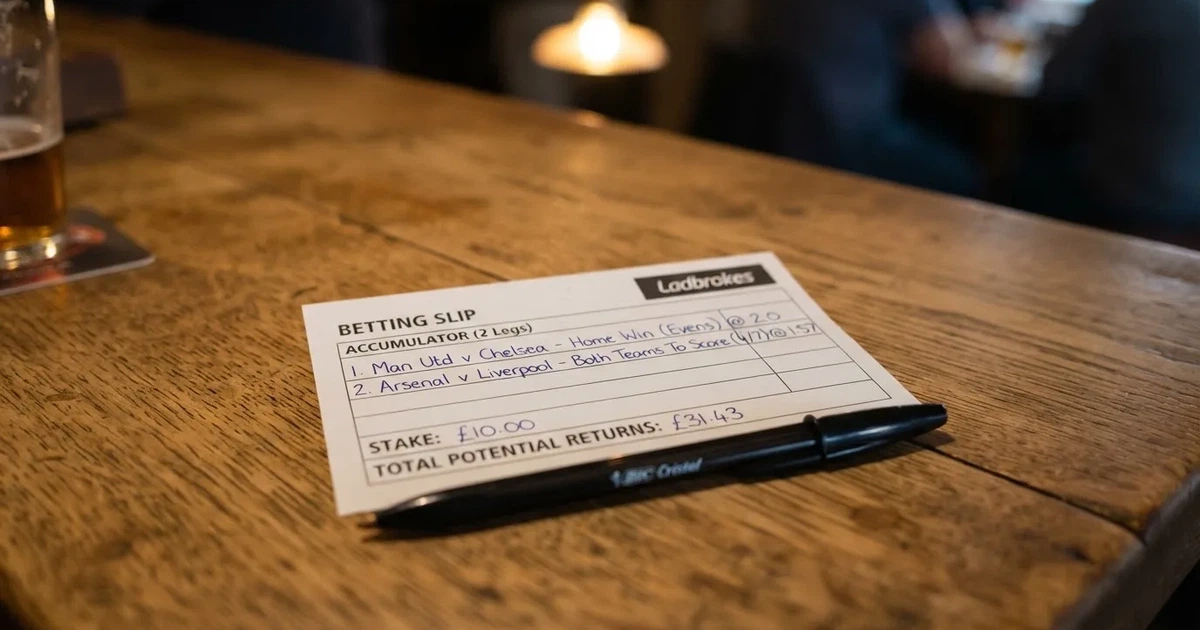
An accumulator — acca for short, also called a parlay or a multi — is one bet that links two or more selections and pays only when every leg wins. That single rule is the whole reason an acca looks generous on the betting slip and behaves like a lottery ticket in practice. A treble at 2/1, 2/1 and 2/1 returns 26/1 because the odds multiply; a fourfold at the same per-leg price returns 129/1. The bookmaker hands the punter a longer price, and in return takes a much bigger cut of every pound staked, because almost every acca loses and the few that win fund the headline payouts. The page below is about that exchange: how an acca is built, settled and paid, what the bookmaker keeps, where the regulator sits, and which licensed brands offer accumulators in Great Britain in 2026.
What an accumulator is and how the price is built
An accumulator is a single wager whose outcome depends on every leg winning at once. Each leg is a fixed-odds bet on a single event; the acca price is the product of the leg prices, and the payout is stake × that combined price, with the stake returned on top. Drop a leg and the whole bet loses; settle one leg as a dead heat or a void and that leg is taken out at odds of 1.00 and the rest carry on. Decimal odds make the multiplication obvious: a treble at 1.50, 2.00 and 2.50 carries a combined price of 7.50, so a £10 stake returns £75 if all three legs win.

The acca price is generous-looking because each leg carries the bookmaker’s own margin, and the margins stack. A market with a 5% margin on each leg does not yield an acca with a 5% margin; it yields one with a margin closer to the sum of the per-leg margins, minus the small overlap between them. A punter reading an acca price is therefore reading the book’s compounded take, not the book’s headline generosity. That compounding is also why a price-boosted leg on an acca looks dramatic: a single leg nudged from 3.00 to 4.00 lifts a fourfold from 81.00 to 108.00, and the marketing team knows the maths lands harder than the equivalent boost on a single.
How a return is calculated
For an acca with decimal odds o₁, o₂, …, oₙ, the combined price is o₁ × o₂ × … × oₙ. A winning £10 acca at that price returns £10 × (o₁ × o₂ × … × oₙ). Net profit is the return minus the stake: £10 × ((o₁ × o₂ × … × oₙ) − 1). A losing leg — including a leg that the book settles as a loser because of a Rule 4 deduction, a non-runner on an each-way leg, or a player retirement rule specific to the sport — voids the whole bet. A leg that voids for any reason is removed from the calculation with the others standing.

To put a number on it: a £10 accumulator on three illustrative prices of 1/2 (1.50), evens (2.00) and 6/4 (2.50) carries a combined price of 7.50 and returns £75 on a winning day. A £2 stake across the four bets of a Trixie on the same three selections returns £30 on a single winner, £30 on each double, and £75 on the treble; the total stake is £8 and the maximum return, on a treble-only day, is £75. Full-cover bets like the Trixie are how a punter hedges the same three picks without surrendering the treble entirely.
Full-cover bets and how they differ from a straight acca
A straight accumulator pays only on the day every leg wins. A full-cover bet spreads the same picks across a fixed set of smaller bets so that some return is paid even when not every leg wins. The trade is the stake: a Trixie on three selections is four bets, a Yankee on four is eleven, a Heinz on six is fifty-seven, a Super Heinz on seven is one hundred and twenty, and a Goliath on eight is two hundred and forty-seven. A £1 unit stake across a Goliath costs £247; across a Heinz, £57. The punter pays for the cover, and the book keeps more total margin because every one of those smaller bets carries its own take.
For three illustrative selections at 1.50, 2.00 and 2.50, a £2 per-line Trixie costs £8 total. A treble win pays £30 (£2 × 15.00); a double on the two winning legs at the bigger prices pays the combined double price times £2; the single on the one winning leg pays £3 on a 1.50 winner, £4 on a 2.00 winner, £5 on a 2.50 winner. The maximum return on a treble-only day is £30, against a maximum return of £30 on a £8 stake at the same combined price — both figures come out of the same underlying maths, but the Trixie pays something on the days the treble does not.
Each-way accumulators and horse-racing overlap
An each-way acca is two bets of equal stake on the same picks: one on the win market, one on the place market. The stake doubles, and so does the maximum payout. Place terms vary by sport and operator — horse racing place terms depend on the field size, and each book prints its own — so the place leg of an each-way football acca settles at a fraction the operator states, often a half or a quarter of the win price. A punter reading an each-way acca ticket is reading two accumulators for the price of one stake unit.
What the bookmaker keeps: margin, overround and price
Every decimal price carries the bookmaker’s margin. The margin on a three-way market such as 1X2 is the slice of every pound staked that the book keeps on average; a 5% margin means a 95% payout share, a 6% margin means 94%. On an acca, the margin is the compounded version of the same idea: per-leg margins are not added, but a wider price amplifies the book’s take in pounds. The cut-off is when a margin stops mattering because another one sits beside it — a 5% margin on a single is cheaper than a 7% margin on the same selection inside an acca, and the gap widens with every leg added.
To see the margin in a price, take a 1X2 market on a Premier League fixture priced at 2.10 / 3.40 / 3.60. The implied probabilities are 1/2.10, 1/3.40 and 1/3.60, which sum to 1.0619; the book keeps (1.0619 − 1) = 0.0619, or about 6.2% of turnover on this market. On an acca built from three such 1X2 markets at 2.10, 3.40 and 3.60, the combined price is 25.704 and the implied probability is 1/25.704 = 0.0389, or 3.89%; the margin on the acca is the residual that survives the compounding, larger than 6.2% in absolute terms because each leg carries its own slice. A punter who treats the acca price as a pure probability is overstating the chance of winning.
The honest reading of a price: a 7/2 (5.50 decimal) shot is not a “five-and-a-half times more likely than evens” shot, because the book has built a margin into both ends. The market frame here is the conventional one — bookmaker margin, punter payout share, fair odds versus posted odds — and it is what every regulated book in Great Britain is running inside, however loudly the marketing claims otherwise.
Selecting legs: where accas go wrong
An acca punter picks legs because the price looks big, and that is the wrong reason most of the time. Three considerations matter before the slip is built.
First, the leg has to have a genuine chance of winning at the price printed. A 1/3 (1.33) favourite that loses one game in twenty is not a 33% shot on the betting slip; the 33% is the implied probability after the book’s take, and the true probability is higher. The favourite loses more often than the public remembers because the favourite loses the games that matter — derbies, cup nights, end-of-season dead rubbers — and the short price on those nights is still short.
Second, the acca punter should know what the bookmaker is offering. The marketing acca sports — a price boost on a specific leg, an acca insurance that refunds the stake as a free bet when one leg loses, an enhanced-odds acca for new customers — is priced into the headline offer. A “Bet £10, get £40 in free bets” welcome package ties the £40 to a 7-day free-bet expiry and a stake-not-returned rule on each free bet; the package is worth what those free bets are worth on average, and not the £40 face value.
Third, the punter should know the bookmaker’s own book on the fixture. A Premier League book with the favourites at 1.50, 4.00 and 6.00 carries a margin inside 7%; a Championship book at 2.20, 3.20 and 3.40 carries a smaller margin but on a tighter market. The margin varies by sport, by competition, by bookmaker, and by time of week, and the punter who treats one acca price as comparable to another is comparing two different products.
What a free bet, a boost and an insurance actually cost
The marketing words for acca promotions are loaded, and the price of each one is in its small print.
A free bet is a credit the punter wagers with no cash outlay on the stake itself; the stake is not returned with a win, so a £10 free bet at 4/1 (5.00) returns £40, not £50. The average value of a free bet is the free-bet amount × (decimal odds − 1) ÷ decimal odds × the market payout share. A £10 free bet on a market with a 95% payout share at 5.00 is worth £10 × (4 ÷ 5) × 0.95 = £7.60 on average — never £40, because the stake is gone and the book’s margin takes its slice. The free bet is a marketing number; the average value is what the punter actually pockets over many such bets.
A price boost is a one-off uplift of one leg, often the favourite in a televised match. The boost looks dramatic — a 1.50 leg pushed to 2.00 — and the price on the rest of the acca is what it would have been without the boost. The boost’s value is the difference between the boosted acca price and the unboosted one, minus the marketing halo. The punter should treat a boost as a small uplift on a market the bookmaker still prices, not as a free gift.
An acca insurance refunds the stake as a free bet if exactly one leg loses. The refund has its own rules: minimum number of legs (usually four or five), minimum odds per leg (often 1/2 or evens), stake-not-returned, free-bet expiry, and a cap on the free-bet value. The insurance is a small hedge on the most common losing acca shape — one bad leg in a six-fold — and the price is the marketing halo the book attaches to a refund the punter could not have claimed without taking the offer in the first place. The honest framing: insurance pays back a fraction of one losing acca in many, on terms the book writes.
A bet builder or same-game multi is an acca on markets from one match — result, both teams to score, total goals, first goalscorer, player shots. The legs multiply as on any acca, but the book has correlated the legs and priced the correlation in. A “Liverpool to win and Mohamed Salah to score” builder at 3.50 is not the product of “Liverpool to win” at 1.80 and “Salah to score” at 2.20; the book has marked the correlation down and the price reflects the lower true chance. Same-game multis pay smaller prices than cross-fixture accas, but they settle as one ticket, which is why a punter who wants action on a single match treats them as the acca shape that fits.
How an acca is settled and what happens on the awkward days
The book settles an acca leg by leg, and the order does not change the result: a winning acca at a combined price of 25.704 pays that combined price whether the legs settle in the first minute or the ninetieth. The order matters only when the book offers a cash-out price, because the cash-out figure at minute 60 is the live mark-to-market of the still-pending legs.
On the awkward days, the rules are the same across the licensed British market. A leg voided for any reason — an abandoned match, a player retirement, a non-runner on a horse-racing leg, a match postponed by more than the operator’s threshold — is treated as a non-event with the rest of the ticket standing. A leg settled as a dead heat pays half the price. A leg that loses, for any reason, loses the whole acca.
Cash-out is the licensed British bookmaker’s offer to buy the acca back before the last leg settles. The cash-out figure is the live mark-to-market of the remaining legs, less the book’s own spread, less the cash-out fee if any. Cash-out is not guaranteed on any book, and is never a price the punter should treat as certain: a book can withdraw cash-out mid-match, settle the remaining legs at the original price if cash-out is unavailable, and the punter has no claim to a different outcome. The honest framing: cash-out is a tool for a punter who wants the bet closed, priced by the book that wrote the bet.
Which licensed bookmakers offer accumulators in Great Britain
Every online bookmaker taking bets from customers in Great Britain needs a Gambling Commission remote operating licence. The Commission’s public register is searchable by business name, trading name, domain or account number, and is the whole test of who holds one. Ten licensed brands stand out for their acca offer, and the landscape below is the spread the page walks through.
| Brand | Gambling Commission remote licence | Acca offer in the operator’s own terms |
|---|---|---|
| Betfred | Account 39544 — Petfre (Gibraltar) Limited | Bet Builder, Sub Switch, Extra Places, Acca Boosts on selected fixtures |
| Lottoland | Account 38991 — EU Lotto Limited | Sportsbook combines acca betting with lottery and scratchcard products |
| Sporting Index | Account 27343 — Sporting Index Limited | Fixed-odds acca plus spread-bets on Total Goals and Winning Favourites |
| Swifty Sports | Account 58957 — Swifty Global (UK) Ltd | Best Odds Guaranteed, daily price boosts, in-play betting, acca builder coming soon |
| BetMGM | Account 39198 — LeoVegas Gaming PLC | Bet Builder, four £10 free bets split into two football accas and two sports multiples for new UK customers |
| Fafabet | Account 57385 — Taichi Tech Limited | Best Odds Guaranteed on UK and Irish racing, acca betting with daily boosts |
| Ladbrokes | Account 54743 — LC International Limited | Acca Boosts, Best Odds Guaranteed on UK and Irish racing, in-play, odds boosts on horse and greyhounds |
| DAZN Bet | Account 48756 — DZBT Limited | Cash Out, Bet Builder, daily bet boosts, in-play; cash-out availability is not guaranteed |
| Dabble | Account 65677 — Dabble Sports UK Ltd | Bet £10, Get £10 in Free Bets on first deposit for new customers, 7-day expiry, stake not returned |
| Fitzwilliam Sports | Account 48760 — SBKI Limited | Prices track Oddschecker average price; iOS and Android apps available |
A short note on what the table is and is not. It is a licence summary: every brand sits on the Gambling Commission’s public register against an account number, a named licence holder and a remote general betting standard category that covers real-event football. It is not a ranking: a place is not a recommendation, and the acca offer column records what the operator’s own terms page states, not what every punter gets. Several of these brands sit under a single licensee — Ladbrokes runs alongside Coral under LC International, and Paddy Power alongside Betfair under Flutter — which is a feature of the GB market and not a reason to treat the brands as one. Two further brands licensed for GB-licensed spread betting carry fixed-odds accas alongside the spread book — Sporting Index is the regulated fixed-odds and spread brand named on its own register entry, and Spreadex sits under separate FCA authorisation for the spread book.
Betfred
Betfred’s app wraps Bet Builder, Sub Switch, Racing Post data, Extra Places, live casino and bingo into one wallet, and the acca offer sits across Bet Builder and the cross-fixture slips. Sub Switch lets a punter substitute a starting player on a bet-builder leg before kick-off; Extra Places extends horse-racing place terms on selected meetings; the acca shape is the standard one, with the brand’s own boosts on featured fixtures. The platform’s strength is the breadth of product, and the weakness is the same breadth on a busy Saturday: the punter has to know which market and which boost they actually want before the slip starts to fill. For a punter who wants football accas, horse-racing each-way, and bingo under one login, the brand covers all three; those looking for a pure football focus may find the rest distracting.
Lottoland
Lottoland’s GB app combines casino, lottery betting, sports betting and scratchcards under a single Commission licence, and the sportsbook is the side that takes football accas. The shape is straightforward: pre-match and in-play markets, Bet Builder on selected fixtures, and the standard acca slip. The brand sits in the comparison for the lottery product overlap: a punter who plays lottery draws on the same wallet is already on the platform, and the acca product is the natural extension. It is a convenient choice for existing users, even if the sportsbook lacks specific football-only bells and whistles.
Sporting Index
Sporting Index is the fixed-odds and spread-betting arm of its licensee, and the acca offer sits inside the fixed-odds book. The new-customer shape is a £10 fixed-odds qualifying bet at minimum odds of 1/2 unlocking three £10 fixed-odds free bets, three £5 Total Goals spread bets, three £5 Winning Favourites spread bets and a £1 Race Index spread bet; the qualifying bet cannot be placed in-play and cannot be cashed out early. The free-bet stake is not returned on a win, the free bets carry their own expiry, and the spread legs carry their own settlement. The brand’s value is the spread book for a punter who already uses Total Goals and Winning Favourites as a market; the fixed-odds acca is a smaller share of the wallet, but it is on the same licence and the same wallet.
Swifty Sports
Swifty Sports runs Best Odds Guaranteed, Cash Out on horse racing and football, daily price boosts, live streaming and in-play betting, and lists Bet Builder as coming soon. The acca shape is the standard pre-match one with the brand’s boosts on selected fixtures. The platform is a newer GB-licensed brand, and the product is the conventional full house rather than a specialist acca book; for a punter who wants the standard offer with a fresh wallet, it sits alongside the longer-established names. For a punter chasing Bet Builder on every fixture, the “coming soon” tag is the honest one and not a reason to delay the bet.
BetMGM
BetMGM’s UK sports welcome offer for new customers who deposit £10 or more and place a sports bet within seven days is four £10 free bets: two on football accumulators of four or more selections, two on sports multiples of two or more. The free bets are valid for seven days, minimum odds apply on the qualifying bet, and the stake is not returned on a free-bet win. The brand runs Bet Builder on selected football fixtures and the standard acca slip on the cross-fixture side. The shape is straightforward, and the value of the four free bets is the average free-bet value at the markets the punter actually plays, not the £40 face. For a punter who plays football accas of four-fold or larger, the offer is timed to fit; for a punter who plays singles, much of it goes unused.
Fafabet
Fafabet pays Best Odds Guaranteed on UK and Irish horse-racing win and each-way bets from 9am on race days: if the starting price is bigger than the original price, the bigger odds are paid. The acca shape is the standard pre-match and in-play one with the brand’s daily boosts, and the platform runs Bet Builder on selected football fixtures. The racing side of the book is the headline offer, and the football side is conventional. For a punter who mixes horse-racing accas and football accas under one wallet, the BOG rule pays its share; others may prefer more specialist football features.
Ladbrokes
Ladbrokes runs Acca Boosts, Best Odds Guaranteed on UK and Irish horse races, in-play betting, and odds boosts on horse and greyhounds. The acca shape is the conventional one across pre-match and in-play, and the Bet Builder is on selected fixtures. The brand sits alongside Coral under LC International Limited, and the GB-licensed product is the standard full house rather than a specialist acca book. It remains a reliable, widely recognized choice for a broad range of football punters.
DAZN Bet
DAZN Bet offers Cash Out, Bet Builder, daily bet boosts and in-play betting. Cash-out availability is not guaranteed and bets stand if it is unavailable, which the help pages state plainly. The acca shape is the standard one across pre-match and in-play, and the boost side runs on featured fixtures. The brand is a newer GB-licensed book, and the product is the conventional full house rather than a specialist acca book; it offers a solid, standard experience for those seeking a fresh wallet for their accas.
Dabble
Dabble’s welcome offer is a “Bet £10, Get £10 in Free Bets” on a first deposit for new customers, with minimum odds on the qualifying bet, a 7-day free-bet expiry and the stake not returned on a free-bet win. The brand runs the standard acca slip and a social-betting product layered on top of it — a copy-bet feed and a community angle that other books do not run. The shape is straightforward, and the value of the £10 free bet is its average free-bet value on the markets the punter plays, not the £10 face. It is a niche pick for a social-minded bettor, though less so for one chasing high-value bonuses.
Fitzwilliam Sports
Fitzwilliam Sports bases its prices on Oddschecker’s average price for each selection, and provides iOS and Android apps. The acca shape is the standard one and the headline offer is the price-tracking promise: the brand prints the Oddschecker average rather than its own line. The product is plain — pre-match and in-play markets, the conventional acca slip — and the value is the price discipline. For a punter who wants a brand whose prices track the market average, it is a deliberate choice; for a punter chasing Best Odds Guaranteed on horse racing, it does not run that product.
The cost picture: what an acca punter pays the book
A punter reading an acca ticket pays the bookmaker three things. The first is the margin on each leg, which compounds into a bigger absolute margin on the acca than on any one of the singles. The second is the marketing halo on any welcome offer, free bet, boost or insurance attached to the slip — the offer is priced in, and the punter who claims it pays for it through the smaller average value of the eventual free bet. The third is the operator’s stake cap on each leg, which limits the size of an acca the punter can build on a single match or across a busy Saturday. The three costs are the reason a £10 acca at a combined price of 25.704 is worth £240.40 in expectation only on a market without a margin, and is worth closer to £210 on a 5%-margin market.
The honest picture: an acca is the highest-cost way to bet on football, and the price is the reason the headline payouts exist. The bookmaker writes a generous-looking ticket because almost every ticket loses, and the few that win fund the marketing. A punter who bets accas for entertainment is paying for the entertainment at the compounded margin; a punter who bets accas in the hope of a life-changing payout is buying a lottery ticket with worse odds. The arithmetic is on the punter’s side only when the legs are individually good value at the price printed, and the marketing is silent on that point.
Legality and the Gambling Commission
Every online bookmaker offering football accumulators to customers in Great Britain needs a Gambling Commission remote operating licence, and the licence is the whole test of whether the brand may do so. The Commission is a non-departmental public body sponsored by the Department for Culture, Media and Sport, and it regulates under the Gambling Act 2005 (covering England, Scotland and Wales; Northern Ireland is outside the Act and runs its own older law). Since the Gambling (Licensing and Advertising) Act 2014, an operator whose remote facilities are used in Great Britain needs a Commission licence wherever it is based — a Curaçao, Maltese or Gibraltar licence is not a substitute for a GB licence.
The licence categories relevant to football accumulators are remote general betting standard (real events) for fixed-odds and spread-betting books, and remote betting intermediary for betting exchanges. A brand on the register against either category may offer accas to GB customers under the Licence Conditions and Codes of Practice; a brand not on the register may not, and providing facilities in Great Britain without the licence the Act requires is an offence under section 33 of the Gambling Act 2005. There is no statutory list of permitted bets or markets: an operator holds a category licence and offers markets under its own rules. In-play betting is permitted under the same category, subject to the operator’s licence conditions and customer-protection duties.
The Commission’s public register is searchable by business name, trading name, domain or account number. Every brand named in the comparison above sits on that register against an account number, a named licence holder and a remote general betting standard (real events) category. Spread betting on financial markets is regulated by the Financial Conduct Authority, not the Commission; a brand offering both a fixed-odds acca book and a spread book runs under two regulators.
Identity checks and the rules the punter feels first
A punter signing up with a GB-licensed book cannot deposit or gamble until name, address and date of birth are verified — the rule has been in force since 7 May 2019, and applies to free bets and bonuses as well as cash stakes. There is no anonymous play at a licensed site. A financial vulnerability check applies once deposits minus withdrawals exceed £150 in a rolling 30 days: it is a public-record check (bankruptcy or county court judgments) and is not an income check or a credit reference check. Deposit limits on the customer side are the punter’s own choice, and the operator must offer a gross deposit limit on a fixed time frame under RTS 12.
Advertising, bonuses and what the regulator caps
Advertising is not licensed by the Commission; it runs through the CAP Code (non-broadcast) and BCAP Code (broadcast), enforced by the ASA, alongside the LCCP marketing conditions. The CAP Code rule of substance for football accumulators is section 16: marketing must be socially responsible, must not be of strong appeal to under-18s, and no one who is or seems to be under 25 may feature in the advertisement.
The promotional rules that shape the acca market took effect on 19 January 2026. Wagering requirements on bonuses are capped at 10x — a £10 bonus at 50x wagering needs £500 of qualifying bets, and under the cap no bonus may carry more than £100 of qualifying-bet turnover. Mixed-product promotions (an offer that requires gambling on two or more product types such as betting, casino, bingo and lottery) are banned. The cap applies to bonuses with a wagering condition; free bets with no wagering condition are not covered, and any cap on the money value of a free bet is not established. The cap is the regulator’s main lever on the cost the punter pays in clearing bonus money, and a punter reading an offer’s small print is reading whether the wagering multiple is under the cap.
Tax: what the punter pays and what the operator pays
The punter pays no tax on betting winnings in Great Britain. General Betting Duty is the operator’s tax on gross profits, currently 15%; from 1 April 2027 a new remote betting rate of 25% applies within it, while remote bets on UK horse racing, bets on self-self-service betting terminals in licensed premises, pool betting and in-person betting stay at 15%. Whether operators pass duty on through odds is not established, and the punter should never be told that duty is charged on the player’s stake. The Commission’s statutory levy is a separate charge on operators and is not a tax.
Offshore and the loss of protection
A GB licence is compulsory at the point of consumption, and a Curaçao, Maltese or Gibraltar licence is not a substitute. A brand not on the Commission’s register may still take a bet from a GB customer; the bet is not lawful on the operator’s side under section 33 of the Act, and the punter loses the protections a GB licence carries: no GAMSTOP coverage, no Commission complaints route, no approved dispute-resolution body, no British consumer redress if funds are withheld, no 10x bonus cap, no £150 vulnerability check, no credit-card ban, no LCCP marketing rules. The honest framing: licensed means checks, limits, GAMSTOP, the bonus cap and the Commission’s enforcement — and also verification before the first bet; unlicensed means none of those protections and possible loss of funds. The regulator’s enforcement is disruption, not blocking: cease-and-desist notices, search-engine referrals, work with registrars, hosts and payment providers, and court-order DNS blocking powers the Commission has been given or is about to receive.
Responsible gambling and the help on offer
An accumulator is the bet shape that costs the most per pound staked, and the harm it can do is concentrated on the same customers the regulator is most concerned about: the ones chasing a life-changing payout, the ones adding a leg to recover a losing streak, the ones staking more than the original plan.
The tools every GB-licensed book offers
Every GB-licensed remote operator is part of GAMSTOP, the national multi-operator online self-exclusion scheme. Self-exclusion periods are six months, one year, five years, or five years with auto-renewal; after the minimum period the exclusion stays in place for a further seven years unless the customer asks GAMSTOP to remove it. GAMSTOP covers online sites and apps; betting shops use a separate offline self-exclusion scheme. A punter who self-excludes through GAMSTOP is closed out of every GB-licensed online bookmaker at once.
A GB-licensed book must offer the punter a gross deposit limit on a fixed time frame under RTS 12. The first changes applied from 31 October 2025; a second phase was postponed to 30 September 2026, and whether it is live is not established. The punter can set a deposit limit at any time and the operator must honour it. Time-out, reality checks and product blocking are also operator-side tools; a punter who wants any of them sets them in the account settings.
Where to get help
GamCare runs the National Gambling Helpline; GambleAware funds treatment and advice; the NHS runs gambling clinics across Great Britain; Gamblers Anonymous runs peer-support meetings. A punter worried about their own betting, or about someone else’s, can reach any of those organisations without giving a name. The gambling-harm conversation is not a marketing one, and the regulator’s responsible-gambling code is the floor a licensed operator operates on, not the ceiling.
The credit-card ban
Credit cards have been banned for gambling in Great Britain since 14 April 2020, and the ban covers credit-card-funded payments through an e-wallet. Debit cards and bank-based payments are not covered by the ban. The ban is the regulator’s main lever on impulse staking at the point of payment, and a punter who cannot reach for a credit card is forced onto the bank balance, which is its own brake on the size of an acca stake.
Strategy and forecasting: what an acca punter actually decides
The strategy frame for an acca punter is not “which team wins”. It is “which leg at which price carries a real edge after the book’s margin”. Three considerations sit underneath that frame, and they are the same three that separate a recreational acca from a margin-of-error one.
Edge per leg, not edge on the ticket
An acca punter who finds a 2.10 shot that should be a 2.40 true price is finding a 14% edge on that leg; the same edge inside a four-fold at 2.10 each is still a 14% edge on the leg, not on the ticket. The compounded edge on the ticket is the per-leg edge multiplied through, and the per-leg edge has to be real at the price printed. A punter reading a price boost on the favourite and calling the boosted leg a “value” pick is reading the boost, not the edge — the boost is a marketing layer and the edge is the difference between the price and the true probability.
Correlation and the same-game multi
A cross-fixture acca pays the full compounded price because the legs are independent in the bookmaker’s pricing. A same-game multi pays a smaller price because the book has priced in the correlation between legs: “team to win and star player to score” is a smaller price than the product of the two singles, and the gap is the correlation discount. A punter reading a same-game multi is reading the book’s correlation pricing, and the discount is the reason the same-game multi is a smaller price than the cross-fixture version.
Bankroll and stake sizing
An acca is one bet on N legs, and the punter’s stake should be sized to the bet, not to the ticket. A £10 acca on four legs is a £10 bet, not a £40 bet, and the variance on the acca is the variance of a longshot ticket — long quiet runs of losers punctuated by occasional big payouts. The bankroll frame for an acca punter is the same as for any other bettor: a fixed unit stake, a fixed number of bets per week, a stop-loss that halts the staking when the variance bites.
Where the data stops and the punter begins
A punter reading this page reads facts that were true on a specific date and on the specific operator’s own data: the licence number on the Commission’s register, the offer terms on the operator’s app listing, the settlement rules in the operator’s house rules. Every one of those facts ages; the licence number ages only on a Commission update, but the offer terms age every time the operator changes a promotion, and the settlement rules age every time the operator changes a market.
The honest framing: this page is a snapshot, and the snapshot is what a punter reads today. The data on the page does not predict tomorrow’s offer, tomorrow’s licence status, or tomorrow’s market margin. A punter who reads the licence number or offer terms reads the Commission’s register or the operator’s small print on the day of the bet, not the day the page was written.
Frequently asked questions
How do football accumulator bets work?
An accumulator is one bet whose outcome depends on every leg winning at once. The price is the product of the leg prices, and a winning acca returns the stake times the combined price. A losing leg voids the whole ticket; a voided leg is simply removed from the calculation. Accas are paid on fixed-odds terms under the Licence Conditions and Codes of Practice that govern every GB-licensed remote bookmaker.
Where can I place football accumulator bets?
At any GB-licensed remote bookmaker, which means a brand on the Gambling Commission’s public register against a remote general betting standard (real events) licence. A brand not on the register may not lawfully offer accas to GB customers. The page above names ten licensed brands and the licence number each one sits under.
How does an accumulator work in football betting?
The same as in any other fixed-odds sport: the punter picks legs, the book multiplies the leg prices into a combined price, and the stake is multiplied by that combined price on a winning day. Football-specific rules cover match abandonment, player retirement and Rule 4 deductions for non-runners on horse-racing legs in a mixed-sport ticket. A leg voided for any reason is removed and the rest stand.
How can it be checked that a bookmaker holds a Gambling Commission licence?
The Commission’s public register is searchable by business name, trading name, domain or account number. The page above prints each featured brand’s licence number; verify the licence by searching the register for that number, the licence holder’s name, or the brand’s domain. A brand not on the register is not licensed for GB customers, whatever the brand’s own terms say.
How is the return on a bet worked out from the stake and the odds?
For a single bet at decimal odds o, return is stake × o; net profit is stake × (o − 1). For an accumulator with legs at o₁, o₂, …, oₙ, the combined price is o₁ × o₂ × … × oₙ and a winning acca returns stake × (o₁ × o₂ × … × oₙ); net profit is stake × ((o₁ × o₂ × … × oₙ) − 1). A £10 acca at a combined price of 25.704 returns £257.04; net profit is £247.04. The same arithmetic in fractional odds runs as stake × (a/b + 1), where a/b is the fractional price.
What is the bookmaker’s margin and how can it be seen in the odds?
The margin is the slice of every pound staked that the book keeps on average across all outcomes of one market. On a three-way 1X2 market priced at 2.10 / 3.40 / 3.60, the implied probabilities (1/price) sum to 1.0619, so the margin is 0.0619 or about 6.2%. The margin is the gap between 100% and the implied-probability sum; a market with a 95% implied-probability sum carries a 5% margin. The margin compounds inside an accumulator and the deeper the wrong read of a price, the bigger the margin the punter pays.
Bet types & in-play – Best Betting Tips
Content created by the «Best Betting Tips» team
