
Where to bet on rugby union online in Great Britain
 Available in US
What an online rugby bet costs a punter is mostly a question of when it is placed, on what market, and against which bookmaker’s terms. The licensed market in Great Britain is open, mature and dense: every operator offering fixed-odds betting to customers in England, Scotland and Wales holds a Gambling Commission remote licence, and the Commission’s public register lists them all. The fixtures run almost year-round — Gallagher Premiership, the United Rugby Championship, the Top 14, Super Rugby, the Six Nations, the Rugby Championship and the looming 2027 Rugby World Cup in Australia — and the in-play product has caught up with the sport itself, so a punt on a Saturday afternoon is now decided by what happens in the next forty minutes rather than the next eight months. This page is about what that market looks like from the inside: how a price is built, what a free bet actually returns, where the rules bite, and which of the ten brands reviewed below earns its place on a serious rugby coupon.

*Current as of 27 October 2026 against the Gambling Commission’s public register.*
Live betting on rugby union: what changes once the whistle goes
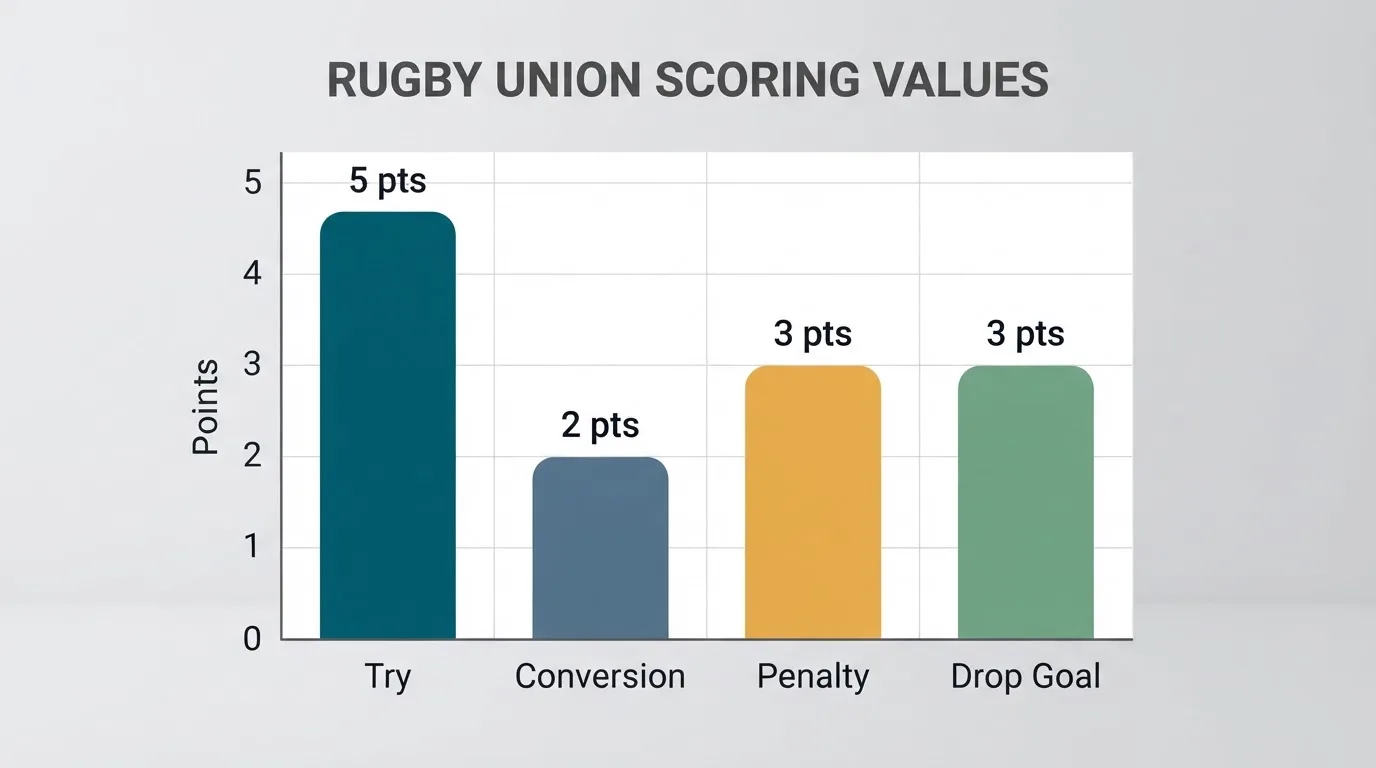
In-play is where rugby union punters live or die, and the reason is the scoreline. A try is five points and a conversion is two more; a single score can redraw the handicap in three minutes, and bookmakers re-price every market on a short delay to manage that risk. A live bet on the match winner, the handicap or the next scoring play has its odds frozen at the moment the bet is accepted; the ladder of available markets is the bookmaker’s, not yours. Two things follow.
First, the bigger the live catalogue, the more angles open during a match. bet365 lists in-play rugby markets across the major leagues on its app, alongside a Bet Builder+ product that ties pre-match and in-play selections into one bet; a price change on any leg is shown before the bet is placed. Betfair Sportsbook carries the same in-play product, with the addition of free live streaming of selected events on the exchange sibling app, and a 90 Minute Payout market on football that does not apply to rugby — worth knowing because the football product is the one the rugby UI borrows from.

Second, cash out turns those live prices into a redeemable position. The Fitzdares app lists cash out, accumulators and ante-post markets on rugby alongside horse racing and football; Midnite and NetBet similarly cite cash out on the betting slip, though only the operator’s slip tells you which markets are eligible mid-match. The mathematics of cash out is the bookmaker’s — the offer is the difference between your potential return at the current in-play price and a deduction the bookmaker does not publish — so a punter treats the button as a price, not a perk.
The consequence is direct: a serious in-play bettor needs an app that does not lag, a market depth that does not vanish on a try, and a clear rule on when the bookmaker suspends a market for re-pricing. Rugby is a low-scoring sport with long passages of play between scores, which is precisely when the suspended-market window opens and the punter is locked out.
Predictions and a strategy that survives the maths
“Tips” in rugby union tend to come from three places: form tables (which team has won its last four), injury reports (which side has its first-choice half-back pairing), and betting-market consensus (what the prices themselves say). All three can mislead. Form over a season is heavily shaped by the international window — club form in November is barely the same variable as club form in April — and injury news reaches the bookmaker’s trader before it reaches a free tipping site. The market itself is the slowest signal of the three, because money on a side moves its price but rarely moves it enough to overcome the margin.
A workable bankroll strategy depends less on which side you take and more on what size stake you take it at, and on price. Two figures from this page matter most: the bookmaker’s margin (covered in the next section), and the minimum price for a qualifying bet on any free-bet offer (covered under the welcome offers). A punter staking a fixed unit on every selection at decimal odds of 1.90 or higher, on a market with a margin near 5 per cent, sits closer to break-even than a punter staking at random.
Two specific angles suit the sport. First, totals: a tight match between two well-matched sides produces fewer scores than the same team’s average, and totals markets can drift on news a line-setter missed. Second, handicap: when a heavy favourite gives away a 12- or 14-point start, the line is half a converted try below the average winning margin, and the price often rewards the favourite at a discount to its true probability. The risk on both is that a single converted try flips the position; the work is in choosing the fixture where the market has misread the gap.
Bet types, odds and the shape of a rugby coupon
A rugby union betting slip is a quiet document. Most matches offer between fifteen and thirty markets depending on the operator: match winner (the home win, draw, away win three-way — draws are common enough in rugby to keep the market in play), handicap (often at fractions of a try to keep both sides attractive), total points, first scoring play, half-time / full-time, race to twenty points, anytime tryscorer and the larger the broadcast, the more player markets open up.
Settlement rules matter, especially on player markets. An anytime tryscorer bet pushes if the named player does not enter the field; settles as a loser if he plays and does not score; settles as a winner only on tries scored in regular time plus stoppage, not in extra time unless the market specifically says so. Draw-no-bet converts a draw to a push and refunds the stake, which costs the punter roughly five per cent of the price over a season. Each-way betting — common on outrights and ante-post markets — splits the stake into a win bet and a place bet at a stated fraction of the win odds; the stake doubles, the place terms are set by the operator and on outrights they are typically a quarter of the win odds for the first three or four places.
The price itself is the live question. Decimal odds of 1.90 mean a stake of £10 returns £19 if it wins (£9 profit, plus the £10 stake). Fractional odds of 5/1 — the British form a bookmaker will display — mean a £1 stake returns £5 profit plus the £1 stake, so the decimal form is 6.00. The conversion is straightforward: 5/1 in decimals is 5 ÷ 1 + 1 = 6.00, 11/4 is 11 ÷ 4 + 1 = 3.75, and evens (1/1) is 1 ÷ 1 + 1 = 2.00. Anything shorter than 2.00 is “odds-on” — the favourite’s price.
The margin is the figure that hides inside every price. On a two-way market priced at decimal odds of 1.90 on each outcome, the implied probabilities are 1 ÷ 1.90 = 0.5263 (≈52.63%) for each side; the two probabilities add to 1.0526, meaning the bookmaker has priced in an overround of 5.26%. A market with no margin would have the two probabilities add to exactly 1.0000; the gap is the operator’s edge on every unit staked. A wider margin (7 to 10 per cent) is typical on smaller leagues and exotic markets; a tighter margin (3 to 5 per cent) is what the headline leagues get, and even then the punter pays for it on every bet, every time. The compounding over a season is what bankroll management works against.
Rugby union tournaments the licensed bookmakers cover
The fixture list a UK punter sees depends on the operator’s trading team and the broadcast calendar. The heavy hitters sit on every licensed app: the Men’s Six Nations, the Autumn Internationals, the Rugby Championship, the British & Irish Lions tours, the Gallagher Premiership, the Top 14, the United Rugby Championship, Super Rugby Pacific, the Rugby World Cup 2027 in Australia, the World Rugby Sevens, and increasingly the women’s international and Premiership Women’s Rugby.
The international men’s cycle is the most heavily priced because it is the most heavily watched. The 2027 Rugby World Cup, hosted by Australia between 1 October and 13 November 2027, runs 24 teams in six pools of four across 52 matches, and outright markets open well in advance — ante-post markets for the tournament winner and for each side to reach the semi-finals appear twelve to eighteen months out, with prices shortening as the draw is made and squad announcements land. South Africa are the defending champions after beating New Zealand in the 2023 final; whichever bookmaker’s trader is sharpest on form in autumn 2026 will set the early line.
Club competitions have their own cadence. The Gallagher Premiership runs from late September to mid-June with a knockout stage for the top four, and the European Champions Cup and Challenge Cup run on top of it from December to late May. The Top 14 in France schedules around the Six Nations; the United Rugby Championship is a Celtic-Italian-South African league whose pool phase overlaps the Premiership. For a UK punter, that density means at least three or four televised club matches most weekends from October through May, which is what an in-play product is built for.
A note on seasons: names like “Season 2025/26” stay in digits as written. The published schedule of a rugby league or tournament is the schedule that year, never the calendar year — a fixture played in late January of the second year of the season belongs to that season, not to a hypothetical new one.
The ten reviewed bookmakers
A note before the table: every brand below is on the Gambling Commission’s public register as a remote general betting standard (real events) licensee, and every one is a GAMSTOP member. The order is the site order, not a ranking; the verdict at the end of each block is the page’s call on what each bookmaker is worth taking, and on whom it costs the most when its rules bite. Where a single licensee runs several brands (Paddy Power and Betfair under PPB Counterparty Services Limited is the relevant case here) they are written as one operator with two products, not as two independent firms.
| Brand | Gambling Commission remote licence number and licence holder | What the operator’s own terms state on the key’s subject |
|---|---|---|
| Fitzdares | 000400-R-103839-030 · Fitzdares Limited | Cash out, accumulators, Lucky 15s, ante-post and in-play markets on horse racing, football, tennis, rugby, cricket, golf and American football; premium positioning, app-led. |
| Bet Ahoy | 100094-R-341742-003 · Bet Ahoy Ltd | Welcome credit split into a £5 sports single and a £5 acca, with the usual minimum odds and seven-day expiry on the credit. |
| Betway | 039372-R-319367-029 · Betway Limited | Weekly Free Bet Club up to £10 after opt-in, earned by staking £25+ on sports. |
| Fafabet | 057385-R-333191-006 · Taichi Tech Limited | Best Odds Guaranteed on UK and Irish horse racing win and each-way bets from 9am on race days; rugby is a separate section. |
| Betfair | 039439-R-319330-013 · PPB Counterparty Services Limited | In-play betting, Bet Builder, free live streaming of UK and Irish racing and football on the app, plus the exchange sibling product. |
| NetBet | 039170-R-319343-032 · Netbet Enterprises Limited | Daily Boosts, Profit Boosts, free-bet offers, an in-slip Bet Builder with instant dynamic odds and sports stats for major leagues. |
| Kwiff | 044448-R-323408-017 · Eaton Gate Gaming Limited | Surprise-price mechanic on selected selections; the app’s main product is a randomised price boost layered on top of standard markets. |
| Star Sports | 009177-R-104555-019 · Star Racing Limited | Trader-led account opening on 08000 521 321 or by email, with telephone betting retained alongside the app and website. |
| Dabble | 065677-R-340363-005 · Dabble Sports UK Ltd | Welcome credit credited on the first qualifying deposit with a seven-day expiry and stake not returned. |
| Midnite | 101839-R-342850-001 · Midnite Limited | In-play catalogue, acca builder, popular accas and price boosts with maximum-stake limits; welcome credit followed by a seven-day window. |
Fitzdares — premium product, rugby a step behind horse racing
Fitzdares is the bookmaker that looks and feels like a private members’ club: a thin but curated market list, an app written for a small screen, a price for rugby that sits inside the same envelope as the price for racing and football. Cash out, accumulators, Lucky 15s and ante-post markets are all advertised on the app page, and live odds are quoted in-play.
The catch is depth: a punter looking for a player-tryscorer market on a United Rugby Championship fixture or a handicap line on a Top 14 mid-table match is more likely to find it on a high-volume operator than here. Fitzdares rewards a punter who treats the app as a curated shortlist rather than a supermarket, and the welcome product reflects that — there is no headline free-bet splash on the listing, only the markets and the price.
The verdict: worth the premium for a serious bettor who wants a smaller bookmaker with a British licence and clean markets, but a second account rather than a first one for the rugby-only punter.
Bet Ahoy — entry-level credit on a small bookmaker
Bet Ahoy is a newer name on the GB market, run by Bet Ahoy Ltd, and its welcome product is two free credits — £5 on a sports single and £5 on an acca — for a £10 qualifying stake. The seven-day expiry is standard, the stake on the credit is not returned, and the minimum odds rule on the qualifying bet is the kind of detail that costs the unwary punter their credit.
The product itself is modest: a sportsbook with the major leagues, a usual collection of in-play markets, no audible difference between this and the bigger names until a fixture list is checked.
The verdict: the welcome credit is small and the operating licence is current — the page judges it a holding account for the punter shopping around rather than a destination bookmaker.
Betway — the weekly free-bet club as the product
Betway’s pitch is regularity: the Free Bet Club gives up to £10 in free bets every week after opt-in, split into two £5 credits on the next payout after a £25+ spend on sports. The weekly reset is the point of the offer; a punter staking a few hundred pounds a month across leagues earns more here over a season than the headline welcome offer of a one-shot bookmaker. Free bet stakes are typically not returned with a win, and the minimum price rule is the rule that bites — a stake at fractional odds of evens (decimal 2.00) usually does not count.
Outside the weekly club, Betway is a high-volume sportsbook whose rugby coverage tracks the international calendar; the in-play product is intact.
The verdict: the strongest recurring reward scheme among the ten brands reviewed, and a sensible main account for a punter who bets weekly and tracks the minimum price rules closely.
Fafabet — best odds guaranteed, but only on racing
Fafabet pays Best Odds Guaranteed on UK and Irish horse racing win and each-way bets from 9am on race days: if the SP is bigger than the price the punter took, the bigger odds are paid. It is the headline product for a racing-led shop and the reason many GB punters keep a Fafabet account open. Rugby punters get the same app and the same sportsbook, but BOG is not a rugby term — there is no starting-price concept in a fixed-odds rugby match, and the operator’s terms reserve the guarantee for racing only.
The verdict: a sound secondary account whose value for rugby punters is its welcome offer and its rugby sportsbook, not the BOG clause that headlines the app page.
Betfair Sportsbook — the bundle that follows a big football product
Betfair Sportsbook is the fixed-odds shop; Betfair Exchange is the betting exchange — both are run under the same licensee, PPB Counterparty Services Limited, on the same GB remote licence, and share infrastructure on the app. The Sportsbook product lists in-play betting, Bet Builder, free live streaming of UK and Irish racing and football within the app, and a 90 Minute Payout market (which is a football product and does not apply to rugby). For rugby, the catalogue is conventional — match winner, handicap, totals, player markets on bigger matches — and the price is competitive on headline leagues.
The combination of Sportsbook and Exchange under one operator is the genuine differentiator. A punter who wants to back a side on the Sportsbook and lay the same side on the Exchange is the textbook use case; the rest of the audience sees a big sportsbook that borrows its UI from the football vertical.
The verdict: the right account for the punter who already understands the exchange; a strong sportsbook on its own terms.
NetBet — boosts and the in-slip bet builder
NetBet’s pitch is layered: Daily Boosts on selected matches, Profit Boosts on accumulators and singles, and free-bet offers cycling through the week; a Bet Builder with instant dynamic odds on the slip; sports stats for major leagues piped through the app. It is the conventional recipe of a 2010s-era sportsbook app, and the rugby product is conventional with it.
The free-bet value here depends on which offer is current. Profit boosts at one unit of stake usually cap at a small maximum payout, and the headline rate disguises the ceiling — a punt at 10/1 boosted from 10/1 to 20/1 returns more on paper than 5/1 boosted to 10/1, and a punter reading the small print sees which.
The verdict: a workable mid-market sportsbook whose value comes from the cycle of boosts rather than any one standout feature.
Kwiff — surprise-price mechanic is the product
Kwiff’s differentiator is simple: it surprises the punter with a randomised price boost on selected selections. The rest of the app is the conventional Bet Builder / cash out / in-play product; the surprise layer on top is what the marketing words lean on. The licence is current under Eaton Gate Gaming Limited, the app carries a 17+ age rating on the store listing, and the GB licence is the only licence a UK punter should see.
The maths of a surprise boost is a function of the boost’s size and how often it lands on a long-priced selection. A punter staking a few pounds a week sees the boost quite often; a sharp bettor staking at the limit sees it less often and the value fades.
The verdict: a second account for a punter who likes the surprise-price gimmick and accepts the lower frequency of boosts on longer selections.
Star Sports — the trader on the phone
Star Sports lets customers speak to a trader directly on 08000 521 321 to open an account, place bets or ask customer queries, with a backup email address for non-urgent queries. It is a holdover from a market in which the telephone was the betting medium, and the app carries the same product underneath — in-play markets, accumulators, a sportsbook that covers the headline leagues.
For a rugby punter, the appeal is having a named trader account at a GB-licensed bookmaker. The cost is a thinner app and a less rich in-play ladder than the high-volume competitors.
The verdict: a fit for a punter who wants a smaller British bookmaker with a real person on the end of the phone, less so for one whose bets are settled in-app at speed.
Dabble — small welcome, social-style feed
Dabble’s welcome credit — £10 in free bets for a £10 first-deposit qualifying bet — is small but typical, with a seven-day expiry and the usual rule that the stake is not returned. The app’s distinguishing feature is a chat-style social feed that surfaces picks from named tipsters; a punter using the feed treats the signal as one input among several, because the feed is curated and partly paid.
The betting product underneath is conventional and licensed under Dabble Sports UK Ltd.
The verdict: a sensible secondary account for the punter who finds the social feed useful and the welcome credit large enough to be worth claiming.
Midnite — a newer sports-and-casino app with a working welcome product
Midnite’s app listing cites Gambling Commission licence 101839, shows in-play events, an acca builder, popular accas and price boosts with maximum-stake limits, and rolls a casino tab into the same app. The welcome product for the sports side is a £25 free-bet bundle and 50 free spins on a £5+ pre-match qualifying bet at EVS (decimal 2.00) or greater, claimed within 14 days of sign-up and settled within a seven-day window on the credit. Two conditions carry weight: the minimum price rule on the qualifier (anything below evens does not count), and the seven-day expiry on the credit, which punishes a punter who leaves it in the account beyond the weekend.
The price boosts are the second product. Boosted singles have a maximum-stake limit stated in the terms, and the cap is the small print that decides whether the boost is worth chasing at all.
The verdict: a competitive mid-market newcomer whose sports welcome is the strongest figure on this page and whose price-boost caps are the rule to check before staking.
What “licensed by the Gambling Commission” actually means
The test of a GB-licensed bookmaker is the public register at the Gambling Commission’s website: a free search by business name, trading name, domain or account number returns the licence number, the categories on the licence and the licensed trading addresses. Every brand reviewed above is on that register against the account number given, and the licence category on each one is “remote general betting standard (real events)” — the right category for a sportsbook serving customers in Great Britain online. A few brands (Lottoland UK’s app, for instance) carry a lottery or casino licence under a different category; Lottoland’s GB-facing product states a Commission licence for customers in Great Britain, and the category is the one the operator holds.
A point on geography: the Gambling Act 2005 covers Great Britain, which is England, Scotland and Wales. Northern Ireland has its own older regime, and a “GB-licensed” bookmaker is licensed to take bets from customers in those three countries. The domain ending tells the reader nothing — licensed operators use .com as readily as .co.uk, and the licence number is the only test that matters.
A separate licence type, “remote betting intermediary”, governs exchanges; Betfair Exchange sits on a different licence number to Betfair Sportsbook, both held under PPB Counterparty Services Limited. The financial-spread-betting side of Spreadex is regulated by the Financial Conduct Authority on a separate framework, and the spread side warns that losses can exceed the deposit — a line that does not apply to fixed-odds betting and is not a comment on the rest of the market.
Safer gambling and the regulator’s checks
A licensed sportsbook is bound by the Commission’s Licence Conditions and Codes of Practice on social responsibility. The headline controls a punter meets are GAMSTOP (the national multi-operator online self-exclusion scheme, joined as a mandatory condition by every online operator since 31 March 2020; periods run six months, one year, five years or five years with auto-renewal), financial vulnerability checks (since 30 August 2024, a public-record check that triggers after a customer’s net deposits exceed £150 in a rolling 30 days, in force from 28 February 2025), and deposit limits on a fixed time frame (a first phase applied from 31 October 2025; a second phase was postponed to 30 September 2026 and whether it is live is not settled).
Verification is not optional. Name, address and date of birth are checked before the first deposit or bet — including a free bet — and a source-of-funds question at higher spend is normal. Credit cards have been banned for gambling in Great Britain since 14 April 2020, including credit-card-funded e-wallet payments; debit cards and bank-based payments are not affected. Help lines are GamCare, the National Gambling Helpline, GambleAware, the NHS gambling clinics and Gamblers Anonymous; the Fitzwilliam Sports site is one of several reviewed pages that link them on the homepage, which is the kind of pointer a punter can keep to hand.
The financial-risk-assessment regime the press calls “affordability checks” was announced in a Commission article of 7 July 2026 as a staged plan with no start date — so the practice on the page is “announced, staged, no start date”, not “in force”.
Welcome offers and free bets: what they actually cost
The Commission has capped wagering requirements on bonuses at 10x since 19 January 2026. A £10 bonus carries a maximum £100 wagering requirement under the cap; a 50x requirement such as some operators used to run is now off the table for licensed sportsbooks. Mixed-product promotions — an offer that requires gambling on two or more product types such as betting and casino, e.g. “bet on football to get free spins” — are banned. The cap and the cross-product ban together reset what a punter should accept in 2026.
Three concrete offers on the reviewed set illustrate the new normal. Midnite’s sports welcome: a £5+ qualifier at EVS (decimal 2.00) or greater, settled within 14 days of sign-up, returns £25 in free bets and 50 free spins valid for 7 days; the stake on the free bet is not returned. Bet Ahoy’s welcome: £10 in free bets on a £10 qualifier, split into a £5 sports single and a £5 acca. Dabble’s welcome: £10 in free bets on a £10 first-deposit qualifier, stake not returned, seven-day expiry. The arithmetic to do on each is the same: a £10 free bet at decimal odds of 3.00 on a market with a 5 per cent margin returns the stake-free £20 profit on a win; an estimated value is the free-bet amount multiplied by (odds − 1) divided by odds and by the payout share of that market — for a £10 free bet at 3.00 on a 95 per cent payout share, that is £10 × (3 − 1) ÷ 3 × 0.95 = £6.33 of expected value, before any minimum-odds rule is applied. The figure is an estimate: it averages out over many bets and promises no single winning bet.
Two points most punters miss. First, the minimum price on a qualifying bet: a fractional evens (1/1, decimal 2.00) selection is the typical floor; anything shorter, and the bet does not unlock the credit. Second, the deposit side of a welcome offer: the £10 qualifier is the stake, and the loss if the qualifier loses is the £10 — so a punter picking a long-priced qualifier (3/1, decimal 4.00) is paying more for the chance to unlock a smaller credit than a punter picking a short-priced favourite. The trade-off is structural and applies to every welcome offer on the page.
Offshore bookmakers and the cost of no licence
A bookmaker without a Gambling Commission licence is not bound by any of the controls above. The operator has no GB duty to join GAMSTOP, no obligation to apply the 10x wagering cap, no £150 financial-vulnerability check, no verification before the first deposit, no approved dispute-resolution body, and no Commission complaints route if funds are withheld. Section 33 of the Gambling Act 2005 makes providing gambling facilities in Great Britain without the licence the Act requires an offence aimed at the operator — up to 51 weeks’ imprisonment and/or a level-5 fine on summary conviction in England and Wales — and enforcement has historically taken the form of cease-and-desist notices, search-engine referrals and cooperation with payment providers; court-order DNS blocking powers have been given or are about to be given, but no blanket ISP block is in operation.
For the punter, the trade-off is straightforward: licence = checks, limits, GAMSTOP membership, a bonus cap, a complaints route and a British right of redress if anything goes wrong; no licence = none of those, plus a real risk of withdrawal friction. Neither option is “the safe choice” by default, and the page’s recommendation is a registered one — pick a brand on the public register, and check it is the brand you meant to pick (the lookalike practice in the offshore market is widespread).
Tax, payment and the small print a punter reads first
The punter in Great Britain pays no income tax on betting winnings, on a general basis; a professional gambler should ask HMRC or a tax adviser. The operator pays General Betting Duty on its gross profits, currently 15 per cent across the board, with a new remote betting rate of 25 per cent applying from 1 April 2027 — meaning remote sports betting at GB-licensed operators carries a higher duty rate from that date onward. Until 1 April 2027 the remote rate stays at 15 per cent. Spread betting (financial or otherwise) is on its own scale.
Payments in: debit cards and bank-based payments are the spine of every licensed bookmaker; credit cards are out (banned since 14 April 2020). E-wallets and bank transfer options (including Faster Payments and the Open Banking rails at some operators) are stated in each operator’s terms. Cryptocurrency is not an established payment option on GB-licensed sportsbooks — the Commission’s framework on crypto is unsettled, and a punter looking to fund an account in Bitcoin cannot rely on it.
Small print to read first on any welcome offer or boost: the minimum price on the qualifier, the expiry of the credit, the maximum stake on a boosted price, the maximum payout on a Profit Boost or acca insurance, and the markets that are excluded (typically outrights, virtuals and some player markets). A punt undone by a missing two-cent minimum odds rule is the most common cost this section describes.
How the licensed market is built: Gambling Commission, ASA and the LCCP
Three bodies sit behind every GB-licensed sportsbook. The Gambling Commission issues the licence under the Gambling Act 2005 and enforces the Licence Conditions and Codes of Practice (LCCP), including the social responsibility code. The Advertising Standards Authority enforces the CAP Code (non-broadcast) and BCAP Code (broadcast), the rules on socially responsible marketing, the ban on marketing strongly appealing to under-18s, the rule that no one who is or seems to be under 25 may be featured gambling or play a significant role, and the “whistle-to-whistle” TV ban in effect since 1 August 2019 (no betting ads on TV between five minutes before and five minutes after a live sporting event, before the 9pm watershed; horse and greyhound racing are excluded). The third body is HM Treasury’s duty side, which sets General Betting Duty.
A practical note: the Premier League’s voluntary withdrawal of gambling sponsorship from matchday shirts from the 2026/27 season onward (sleeves and hoardings remain) is a club-level decision, not a law — and the page describes it as such, because a ban is a statute and a sponsor pull-out is a contract. Promo codes are not printed anywhere on this page; the page describes offers as each operator’s terms state them, not as a route to claim them.
Working the numbers: margin, payout and a free bet in plain prose
Two worked figures cover most of what a rugby punter needs in 2026. The first is the margin of a market and how to read it. The second is a free-bet’s expected value.
A two-way market priced at decimal odds of 1.90 on each side has implied probabilities of 1 ÷ 1.90 = 52.63% per outcome. Those probabilities add to 105.26%, and the 5.0% margin — the gap above 100% in the implied probabilities — is the share of every pound staked that the bookmaker keeps on average over many bets. The wider the margin, the more it costs the punter per bet; the narrower the margin, the closer to a fair price the market gets. On a single fixture’s match-winner market the margin typically sits between 5 and 8 per cent at a GB-licensed bookmaker; on smaller leagues and exotic markets it can climb to 10 per cent or higher. The figure is an estimate based on the stated prices, not a guarantee of return on any specific bet. State it as a band — 5 to 8 per cent on headline leagues — rather than a single number, because one market is not the whole book.
The second figure is the expected value of a £10 free bet (stake not returned) on a selection priced at decimal odds of 3.00 on a market with a 95 per cent payout share. The free-bet-value formula gives £10 × (3.00 − 1) ÷ 3.00 × 0.95 = £6.33 of expected value, which is what the free bet is worth on average across many bets; it is not what any single bet wins. A punter chasing offers should run that calculation before opting in, because a “£50 free bet” at minimum odds of 4/1 (decimal 5.00) on a 90 per cent payout market is worth £10 × (5 − 1) ÷ 5 × 0.90 = £7.20 of expected value, far below the headline figure. A “£10 free bet” at minimum odds of 3/1 (decimal 4.00) on a 95 per cent payout market is worth £10 × (4 − 1) ÷ 4 × 0.95 = £7.13 — smaller headline number, similar real value.
The arithmetic also shows the cost of clearing a bonus. A £10 bonus at a 10x wagering cap demands £100 of qualifying bets, all on selections at or above the minimum price the operator sets; on a market with a 5 per cent margin, the expected loss across the £100 of turnover is £100 × 0.05 = £5 of margin, and the punter clears the £10 bonus at a net cost of about £5 of expected value before any free-bet value is added. Above the 10x cap, the offer would be off-market under the Commission’s January 2026 rule; below the cap, the trade-off is between the bonus figure and the expected cost of clearing it.
The settle: what to take from this page
A punter in 2026 should land on three habits before staking on the first rugby fixture of the weekend. First, the licence number on the public register — a free, exact check, cheaper than any other form of due diligence. Second, the minimum price on the qualifying bet and the expiry of any welcome credit, because those two numbers decide whether the headline offer is worth claiming at all. Third, the margin on the market on which the bet is placed, calculated from the prices as quoted and expressed as a band rather than a single figure, because the cost compounds over a season.
The ten brands above earn their places on a coupon for different reasons, and the verdict at the end of each block is what this page thinks each is worth. The market is open, the regulator is current, and the fixture list is unusually rich from October through May; a punter who works with the constraints above is closer to break-even than one who works against them.
Frequently asked questions
How does rugby union betting work in the UK?
A licensed bookmaker takes a fixed-odds bet on a rugby union match or outright at the price on offer, settles it according to its rules, and pays out the stake and profit on a winning selection. The sport is run by World Rugby (since 1886), with 15 players per side, 80 minutes of regulation time and scoring at 5 points for a try, 2 for a conversion, 3 for a penalty and 3 for a drop goal. In Great Britain the regulator is the Gambling Commission under the Gambling Act 2005; there is no statutory list of permitted markets, and a brand takes bets at its own discretion within its licence.
How do I place a bet on rugby union?
Open an account at a GB-licensed operator on the public register, verify your identity, deposit by debit card or bank transfer (credit cards are banned for gambling in Great Britain since 14 April 2020), browse to the rugby section, pick a market from the listed options and stake an amount within your budget. Allow a few seconds for the price to confirm in-play; pre-match, the price is fixed at the moment the bet is accepted. Settled bets pay out the stake and profit on winning selections; a non-runner or push settles under the operator’s stated rules.
How can I check that a bookmaker holds a Gambling Commission licence?
Search the Commission’s public register at its website by business name, trading name, domain or account number. The result shows the account number, the licence categories on it and the licensed trading addresses. Every GB-licensed remote sportsbook carries the account number on its own site under its licence or terms page; the table on this page carries the same numbers for the reviewed brands. A GB licence is the right test; a Curaçao, Maltese or Gibraltar licence is not a substitute at the point of consumption.
How is the return on a bet worked out from the stake and the odds?
Decimal form: return = stake × odds, net profit = stake × (odds − 1). A £10 stake at decimal odds of 3.00 returns £30 on a win (£20 profit plus the £10 stake). Fractional form (the British display): £10 at 5/1 returns £60 (£50 profit plus the £10 stake). The conversion is fractional-to-decimal as a ÷ b + 1: 5/1 → 5 ÷ 1 + 1 = 6.00, 11/4 → 11 ÷ 4 + 1 = 3.75, evens (1/1) → 1 ÷ 1 + 1 = 2.00.
What is the bookmaker’s margin and how can it be seen in the odds?
The margin is the bookmaker’s edge on a market, calculated as the overround divided by the sum of the implied probabilities. Implied probability on a decimal price is 1 ÷ odds; on a two-way market priced at 1.90 and 1.90 the implied probabilities are 52.63% each, and the sum is 105.26%, giving a margin of 5.0%. A wider margin means the bookmaker keeps more of every pound staked; a tighter margin means a fairer price. The arithmetic compounds across a season of betting, which is why it matters and why the figure is presented as a band rather than a single number for any one market.
How do fractional odds such as 5/1 convert to decimal odds such as 6.00?
The formula is decimal odds = a ÷ b + 1, where the fractional price is a/b. So 5/1 → 5 ÷ 1 + 1 = 6.00, 11/4 → 11 ÷ 4 + 1 = 3.75, evens (1/1) → 1 ÷ 1 + 1 = 2.00. A price shorter than evens (odds-on) is any decimal number below 2.00. Note that the spread-betting side of Spreadex uses points, not odds, and is not covered by this conversion.
Rugby, cricket & Gaelic – Best Betting Tips
Content created by the «Best Betting Tips» team
