
Corner Betting in the UK: Markets, Margins and the Bookmakers That Quote Them
 Available in US
Corner betting has moved from a niche prop to a fixture on the main coupon at every Premier League bookmaker, and the price a bettor sees carries the operator’s margin inside it. This page looks at what the market is, how each variant is settled, and which of ten Gambling Commission-licensed bookmakers quote it most sensibly — with the arithmetic worked so a punter knows what the price actually costs.
Data current as of 27 October 2026, verified against the Gambling Commission’s public register of operating licences and the operators’ own published terms.
How a corner bet is settled and what the price is hiding
A corner is awarded when the ball wholly crosses the goal line, having last touched a defending player, regardless of intent. That is the whole trigger: goalkeeping save that rebounds off a defender’s shin, a clearance off the back of a centre-back’s leg, a deliberate block — each produces the same corner. The kick is taken from the corner arc on the side nearest the touch where the ball exited, with the ball stationary within a one-yard arc at the corner flag. Opposing players must stay at least 9.15 metres from the ball until it is in play, and an attacker receiving the ball directly from the corner cannot be offside. Scoring directly — the Olimpico goal — was legalised by the IFAB on 14 June 1924. The corner kick itself entered the FA code in 1872 through the Sheffield Association. None of that affects the bet; it explains why corners are countable, where they happen, and why the timing lines up to the second with the live betting window.
The bookmaker’s corners market prices three things — how many, who takes them, and how the match shapes up around them. Each is settled on official competition data, supplied to the bookmaker by a feed provider, and settled on the count registered at full time, not after extra time. That last point matters: in cup ties, the corners market runs on 90 minutes plus stoppage time, and a tie that goes to extra time is settled on the regulation count. Settling at the regulation whistle is the rule across the licensed UK bookmakers; one or two price corners on the full match including extra time as a separate market, and they label it that way.
A two-way market at decimal odds 1.90 / 1.90 — typical of the over/under line a bookmaker might quote close to kick-off — gives a payout share of 1 ÷ (1 ÷ 1.90 + 1 ÷ 1.90) = 1 ÷ (0.5263 + 0.5263) = 1 ÷ 1.0526, or about 95.0%. The other 5.0% is the margin, the slice of every pound staked the bookmaker keeps across the long run. A real coupon will show the margin higher than that — 6% to 9% on Premier League corners is the band the closer-to-kick-off prices sit in, with bigger clubs or one-sided fixtures running toward the higher end because the bookmaker has sharper information on the shape of those matches. The rule of thumb a bettor can carry: at even money, anything above a 5.4% margin is where the price starts costing more than the market has to offer, and the gap from 5% to 9% is the difference between a fair line and a punishing one.
What the price is hiding is the overround — the sum of implied probabilities across all outcomes, minus 100%. On a 1.90 / 1.90 pair the overround is 105.26%, of which 5.26 points is the bookmaker’s edge. The overround widens with the number of selections: a three-way first-corner market (Home / Away / No Corner) at 3.20 / 3.40 / 2.50 carries a much larger margin because the bookmaker must price three outcomes and the imbalance between them has to be absorbed somewhere. That is why first-corner markets are notoriously tighter than totals — the bookmaker wants to be sharp on the model, and the cost of being wrong on a popular line is high.
Corner betting strategy that survives contact with the price
A strategy is not a prediction. It is a set of choices that, applied across many bets, produces a return that beats the margin. The corner market is unusual because the margin is high relative to other markets on the same fixture, and the form data is sparse: a 0-0 win with eleven corners tells the bettor something the xG model does not.

The cleanest version of the strategy is to specialise. Pick one league, learn the rhythms of how it scores corners — Premier League averages around ten per match, La Liga closer to eleven, Bundesliga closer to twelve, the Eredivisie higher still because of the pressing style. Learn how those numbers move with the state of the match: trailing teams push for late corners, sides protecting a lead concede them, the first ten minutes are sparse, the last fifteen are dense. The bettor who knows that a side trailing by one goal at 75 minutes concedes, on average, twice as many corners in the closing window as a side level, has something the price does not always reflect.
The second move is to back the number, not the team. Total corners over a line, or a banded over/under (8.5–11.5), is where the bookmaker’s price has the weakest information advantage. Team corners — home team over, away team under — is where the price has sharper inputs, because the bookmaker’s feed includes the same team-level statistics the bettor uses. Asian corners, where the quarter-line handicaps settle by half-stake refunds and full-stake wins, are a tighter version of the same idea, and the margins on Asian lines in the Premier League are noticeably thinner than on the straight over/under.
The third move is to manage the bankroll the way the market punishes. A corner bet at 1.91 carries about a 50.4% chance of winning on a market priced at the true probability. A bettor who backs it at one unit per match across 200 matches will end roughly flat — the price and the true probability are matched. To win, the bettor has to find prices the bookmaker has mispriced, and that means watching the live line as the match unfolds, where the bookmaker is slower to update on corners than it is on goals.
The strategy that fails is the chasing one — staking more after a loss to recover. Corner markets do not correlate cleanly enough for that to work, and the margin sits inside every bet, so the larger stakes after a losing run are larger stakes at the worse end of the price.
What a bettor should look for in a live corners market
The in-play corners market is where the model is sharpest and the punter’s edge, if any, is real. A bookmaker’s in-play price is updated by the same data feed that counts the corners, but there is a lag of one to two seconds during which the price reflects the last event, not the current one. A bettor who sees a corner awarded before the price updates has a window — short, but it exists — to back the over on a totals line that has not yet ticked over. The lag is widest in the first five minutes after a corner, narrows as the match settles, and reopens in the closing minutes as the bookmaker’s automated trader steps away.
The discipline is to take only the prices the bettor has already agreed are worth taking. The market punishes the punter who adjusts the threshold because the moment looks good.
How to read the betting site’s in-play corner tiles
A licensed UK bookmaker’s in-play football page lists corners as three numbers — home, away, and match total — updating every few seconds. The price sits underneath, with the over and under for the next half-corners line. The tile shows the line’s current number (4.5, 5.5, 6.5) and the two prices either side. A bettor who wants the over on the next line watches the count tick past 4 and waits for the price to widen before backing it; a bettor who wants the under waits for the count to slow and the bookmaker’s trader to push the under in. The in-play trading is a market of its own, and the rules are the same as any other: a price is only worth backing when it is better than the true probability of the outcome, and the in-play corner count is the single sharpest signal of what that probability is.
Corner markets in football and what they look like across competitions
Football is the only sport where the corner is a countable, settled event. MMA has corner rounds — the 60-second rest between rounds where a corner team works on a fighter — but MMA bookmakers do not offer a market on them in the way football bookmakers do. A “corner” in MMA betting is occasionally referenced as the rest period, but the settled outcome is the round, not the rest. The corner as a betting object is a football market, and the tournaments that matter are the ones where the corners are highest.
The Premier League averages around ten corners per match and skews high in matches with a trailing side. The Championship averages higher — closer to eleven — because of the wider gap in possession between dominant and dominated sides. The Bundesliga averages higher still, in the low twelves, because the pressing style produces more defensive interventions that deflect out for corners. The World Cup and Copa América average in the same band as the Premier League, with international corners more clustered around set pieces.
The tournament that generates the most corners per match in world football is one of the smaller European leagues — the Eredivisie and the Belgian Pro League both sit in the low teens — and the price on those leagues is correspondingly tighter, because the bookmaker has less data on them and prices conservatively. That is the opportunity the informed bettor takes: a tighter book on a higher-corners league.
The Premier League and the Champions League
The Premier League is the largest corners market in the world, by money and by fixture density, and the bookmaker’s price reflects that. The Champions League averages slightly lower than the Premier League because the group-stage mismatches are larger and the trailing side concedes more possession rather than more corners. The price on Champions League corners is, on average, a touch sharper than the Premier League — the bookmaker has sharper information on those teams and the lines move faster. The corner bettor who follows the Champions League closely will see a tighter market than the one who follows the Premier League alone.
The World Cup and the international game
The World Cup corners market is settled on the official count, and the lines are tightest at the knockout stage where the bookmaker’s model has the most information. The corners market runs on the regulation 90 minutes plus stoppage time, and extra time is a separate market if offered. International corners count is, on average, lower than the Premier League because the pressing structures are different — international sides defend in tighter blocks and concede fewer corners per shot faced — and that shows in the price.
How a corners market is built: from the bet slip to the settlement
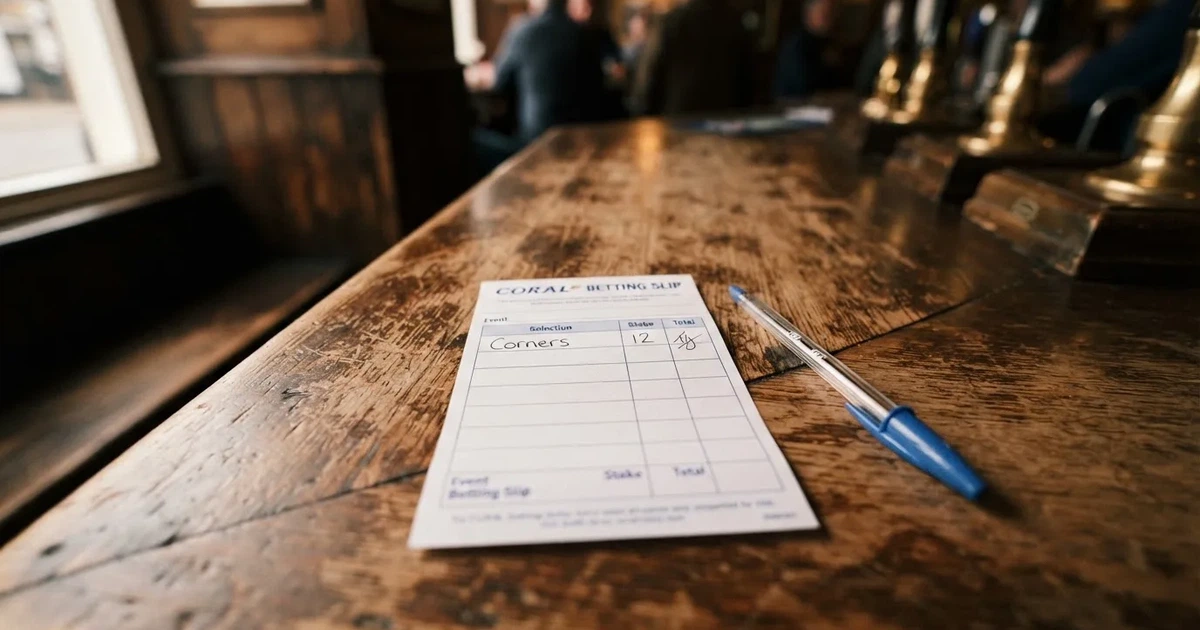
The mechanics of a corner bet are simple and the procedure is the same across every licensed UK bookmaker. The bettor opens the football coupon, selects the match, opens the corners tab, picks a market, enters a stake, and confirms. The bet is matched to the price at the moment of confirmation; a price movement between selection and confirmation is the bettor’s exposure, and the licensed bookmaker will surface a price change warning if the price has moved by more than a small threshold.
A corner bet is settled on the official count at full time, not at the final whistle. Extra time and penalty shoot-outs do not count toward the corner total. A corner awarded but not taken — for a substitution, for a dismissal, for a halt in play — counts toward the total. A corner retaken because of an infringement by the defending side counts once, not twice.
A corner match bet — the market that prices the team taking the most corners — is settled on the count at full time. A tie returns the stake; the bookmaker’s price on the draw reflects that. The home/away/draw three-way is the cleanest version of the market and the one the bookmaker prices most aggressively, because the model is sharpest there.
The Asian corner line — a quarter or half handicap on the match total — settles in two ways. A line of 10.25 corners with an OK settled at 11: the bet wins. At 10: half the stake is returned and half wins at the half-line of 10. At 9: the full stake is returned to the bettor, less the void half. The mechanics are the same as any Asian handicap, and the bettor who has traded a football handicap will find the corner Asian line familiar.
The bet builder market — same-game multi — on corners lets the bettor combine the corner count with other markets on the same match (goals, cards, player markets). The price compounds across the selections, and the bookmaker’s margin compounds with it. A two-match build on corners over 10.5 and both teams to score at 1.85 / 1.90 carries a margin noticeably higher than either market alone, and the bettor is paying for the convenience of the combination.
Top ten UK-licensed bookmakers for corner betting
The bookmakers below all hold a Gambling Commission remote licence for real-event betting, and every brand on the list is settled on the official corners count at full time. The ranking is built from three things: how thoroughly the operator covers corners markets, how sharp the price is on Premier League and Champions League corners, and how the in-play offering looks. A licence is the floor — every brand below meets it — and the comparison above it is the substance.
1. Dabble
Dabble’s sportsbook lists in-play events, a same-game acca builder, price boosts and popular accas, with maximum-stake limits disclosed on boosted prices. The welcome offer is a £10 free bet on a first deposit for new customers, with a minimum odds requirement, a seven-day expiry on the free bet, and the free-bet stake not returned with a win.
2. Coral
Coral’s sportsbook covers Premier League, Championship and European football with corners markets on totals, team totals, race to X corners, and Asian lines. The welcome offer is £40 in free bets on a £20 sports and deposit, with the free bets expiring seven days after issue, the stake not returned, and a minimum odds requirement of 2.0 (1/1). Coral’s in-play offering is dense on Premier League fixtures, and the corners pricing tracks the model closely through the match.
3. 10bet
10bet’s sportsbook covers football, tennis and horse racing, with cash out, a bet builder and live streaming on selected events. The bookmaker is licensed in Great Britain under Gambling Commission licence 43173, and the app is published by 10bet Limited. The corners pricing on Premier League and Bundesliga fixtures is in the band where the informed bettor works.
4. Geoff Banks
Geoff Banks’ app is published by GB Sports Advisors Ltd and offers live in-play prices and ante-post prices on future events, providing a distinct perspective on the market.
5. Paddy Power
Paddy Power’s app lists Bet Builder+, popular bet builders, Super Sub — a bet rolls over to the replacement if a selected player is substituted — expanded Win More markets and player and ACCA statistics. The corners offering is broad, the in-play pricing is competitive, and the bettor who wants combination markets on a single match has the tools.
6. Bet Ahoy
Bet Ahoy’s welcome offer is a £10 free bet on a £10 first sports bet, made up of a £5 sports free bet and a £5 acca free bet. The sportsbook covers Premier League and Championship corners with totals and team markets, and the in-play offering is on the main coupon.
7. LiveScore Bet
LiveScore Bet’s bet builder allows up to ten selections and covers match result, both teams to score, corners, total goals, player scoring and card markets. The corners pricing is sharp at the totals level, and the bet builder on corners is a real product rather than a checkbox.
8. BetTom
BetTom’s sports welcome offer is 50% back as a free bet of up to £50, paired with 50% back up to £50 as free slot funds for casino play. The corners market is on the main coupon, and the in-play offering covers Premier League fixtures at full depth.
9. Betfred
Betfred’s app features a bet builder, Sub Switch, Racing Post data, Extra Places, live casino and bingo. The corners offering is broad on Premier League and Championship football, and the in-play pricing on the totals line tracks the data feed closely.
10. DragonBet
DragonBet’s app features Welsh football and rugby markets, racing, American football, in-play betting and bet builder markets. The corners pricing is competitive on Premier League and the Championship, and the bookmaker’s regional focus gives it sharper pricing on Welsh football corners than the larger operators.
What a corner bet looks like across the licensed UK bookmakers
| Brand | Gambling Commission account and holder | Corner markets and terms |
|---|---|---|
| Dabble | Remote licence 065677-R-340363-005, Dabble Sports UK Ltd | In-play, acca builder, price boosts with max-stake limits; £10 free bet on first deposit for new customers |
| Coral | Remote licence 054743-R-330863-014, LC International Limited | Premier League and Championship totals, team totals, race-to-X corners, Asian lines; £40 free bets on a £20 qualifying bet, seven-day expiry |
| 10bet | Remote licence 043173-R-322899-023, Blue Star Planet Limited | Premier League and Bundesliga corners with cash out, bet builder and live streaming |
| Geoff Banks | Remote licence 054095-R-330366-010, GB Sports Advisors Limited | Live in-play prices and ante-post prices on future events |
| Paddy Power | Remote licence 039439-R-319330-013, PPB Counterparty Services Limited | Bet Builder+, Super Sub, expanded Win More markets; corners totals and team totals on Premier League |
| Bet Ahoy | Remote licence 100094-R-341742-003, Bet Ahoy Ltd | Premier League and Championship corners totals and team markets; £10 free bet on a £10 first sports bet |
| LiveScore Bet | Remote licence 056859-R-332720-005, LiveScore Betting and Gaming (Gibraltar) Limited | Bet builder up to 10 selections across corners, totals, BTTS, cards |
| BetTom | Remote licence 064959-R-339314-003, Bet Tom Limited | Premier League in-play corners with totals and team markets; 50% back as a free bet of up to £50 |
| Betfred | Remote licence 039544-R-319290-010, Petfre (Gibraltar) Limited | Bet builder, Sub Switch, Premier League and Championship corners with in-play pricing |
| DragonBet | Remote licence 064908-R-339041-003, DragonBet Ltd | Welsh football and rugby markets, Premier League and Championship corners, in-play and bet builder |
The column that matters is the third. Every brand holds a Commission licence and is settled on the official corners count; what separates them is the depth of the market, the price on the totals line, and how the in-play offering tracks the live count. A bookmaker with cash out and a bet builder on corners is a different proposition from one with totals only, even if the licence is identical.
The licensed UK corners market at a glance
Every operator above is licensed by the Gambling Commission under the Gambling Act 2005, and every GB-licensed online operator takes part in GAMSTOP. That is the floor: verification before the first deposit, source-of-funds questions at higher spend, a financial vulnerability check at £150 of net deposits over a rolling 30 days, GAMSTOP exclusion on request, and a 10x cap on bonus wagering requirements. The bookmakers above meet those rules, and the comparison between them is the substance above the licence.
A licensed UK bookmaker’s corners market sits inside a wider sportsbook that runs on the same pricing engine, and the price on a Premier League corner is set by the same team that sets the price on a Champions League total goals line. That shared pricing is why the corner market is, on average, a few percentage points sharper than the more exotic prop markets the bookmaker runs in parallel: the model has sharper inputs on the major leagues than it does on minor props, and the corner market sits close to the centre of the model’s information.
What separates the corner markets on this list
The bookmaker that prices corners tightly across Premier League, Championship, Bundesliga and the European cups gives the bettor the broadest playing field. The bookmaker that runs cash out on every corner line gives the bettor the option to trade a position before full time, which is the discipline the strategy section above is built around. The bookmaker that runs an in-play bet builder on corners — combining the corner count with the goal count, the card count, the player markets — gives the bettor a way to express a single match view across multiple markets, at a price that compounds the margins.
A bookmaker with regional focus — DragonBet on Welsh football — gives the bettor sharper pricing on a smaller market, where the larger operators are less attentive. The bettor who wants exposure to a regional corner market has a smaller field to choose from and a sharper book on the brands that lead it.
How the corner market ages over the course of a match
The first five minutes of a football match produce, on average, half a corner. The closing fifteen minutes produce, on average, three and a half. The trailing team concedes more corners in the closing window than the leading team, and a one-goal margin is the threshold where the trailing team pushes for corners rather than for goals. The bookmaker’s price moves with the count and with the state of the match, and the bettor who watches the count and the score at the same time sees both halves of the picture.
The corner market ages fastest in the first twenty minutes, when the model is sharpest on the count and the bookmaker’s price reflects it. The corner market ages slowest in the closing ten minutes, when the bookmaker’s trader has stepped away and the in-play price lags the live count. That lag is the bettor’s edge, and the bettor who watches the in-play tile sees it open and close.
The legal framework for corner betting in Great Britain
The Gambling Commission licenses the whole commercial betting market in Great Britain under the Gambling Act 2005, which covers England, Scotland and Wales. Northern Ireland sits outside the Act and has its own older law; a “GB licence” regulates Great Britain, never Northern Ireland. An operator whose remote facilities are used in Great Britain needs a Commission licence wherever it is based, after the Gambling (Licensing and Advertising) Act 2014. A Curaçao, Maltese or Gibraltar licence is not a substitute for a Commission licence.
There is no statutory list of permitted markets. An operator holds a licence for a category — remote general betting standard (real events), remote general betting standard (virtual events), remote general betting limited, remote pool betting, or remote betting intermediary for exchanges — and offers markets under its own rules and the Licence Conditions and Codes of Practice (LCCP). A corners market is offered under the same licence as any other football market, and the bookmaker’s right to suspend or void a market is governed by the operator’s own terms and the LCCP.
The Commission’s public register can be searched by business name, trading name, domain or account number, and is the whole test of whether a brand holds a licence. The ten bookmakers above are on the register, and the comparison between them is the substance above the licence. A licence is the floor; the comparison above the floor is the substance.
In-play betting is offered by GB bookmakers under the operator’s licence conditions and customer-protection duties; the controls are the operator’s, and no statutory prohibition applies. Esports are treated like any other event under the real-events licence; virtual events are a separate licence category. Bets on politics, TV shows and novelty markets are offered by GB bookmakers and no statutory prohibition was found.
Betting exchanges run under a betting intermediary licence, and rates and rules specific to exchanges are stated only from each exchange’s terms. Spread betting on a financial product is regulated by the Financial Conduct Authority; spread betting on a sporting outcome that is not a financial product is inside General Betting Duty.
Verification, identity and the first deposit
The minimum age is 18. Identity verification — name, address and date of birth — is required before a customer can deposit or gamble at a licensed UK bookmaker, including with a free bet or bonus. That rule has applied since 7 May 2019. A licensed bookmaker cannot offer anonymous play, and a bettor who wants a no-verification experience is on an unlicensed site, where the GAMSTOP exclusion, the bonus cap and the vulnerability check do not apply.
The credit-card ban for gambling in Great Britain has applied since 14 April 2020 (LCCP condition 6.1.2), including credit-card-funded payments through an e-wallet. Debit cards and bank-based payments are not covered by the ban. Cryptocurrency deposits are not established in the regulation; payments are described from each operator’s own terms.
Bonuses, wagering and the marketing rules
Promotion rules in force since 19 January 2026 cap wagering requirements on bonuses at 10x — a £10 bonus at 50x needs £500 of bets; under the cap no more than £100. Mixed-product promotions — an offer that requires gambling on two or more product types — are banned. Whether the cap applies to free bets with no wagering condition, and any cap on the money value of a bonus, are not established. The free bet has a stake that is not returned with a win, and the cap on the bonus money value is a separate question from the wagering cap.
Marketing runs through the CAP Code (non-broadcast) and BCAP Code (broadcast), enforced by the ASA, alongside the LCCP marketing conditions. The CAP Code section 16 rule on no one who is or seems to be under 25 appearing in marketing concerns who may appear in the advertisement, not who may bet.
The offshore comparison
A GB licence is compulsory at the point of consumption. Providing gambling facilities in Great Britain without the licence the Act requires is an offence under section 33 of the Gambling Act 2005 (on summary conviction up to 51 weeks’ imprisonment, a fine up to level 5, or both; six months in Scotland), aimed at the operator. No offence aimed at a customer who merely bets on an unlicensed site was found: state the loss of protection — no GAMSTOP coverage, no Commission complaints route, no approved dispute-resolution body, no British consumer redress if funds are withheld — and never “legal to use”. Enforcement is disruption, not blocking; the Commission has been given, or is about to receive, court-order DNS blocking powers, but no ISP blocking regime is in operation.
A licensed operator is checked, limited, GAMSTOP-covered and bound by the 10x bonus cap. An unlicensed operator offers none of those protections and a real risk of loss of funds. Neither is “the safe choice” by default.
Responsible gambling and the bettor’s own safeguards
GAMSTOP is the national multi-operator online self-exclusion scheme, a mandatory licence condition for online operators since 31 March 2020. Exclusion periods are six months, one year, five years, or five years with auto-renewal, and after the minimum period the exclusion stays in place for a further seven years unless the customer asks GAMSTOP to remove it. It covers online sites and apps; betting shops use a separate service.
A financial vulnerability check (LCCP condition 3.4.4, in force since 30 August 2024) applies to licensed remote betting when a customer’s deposits minus withdrawals exceed £150 in a rolling 30 days (since 28 February 2025). The check is a public-record check (for example bankruptcy or county court judgments), not an income check and not a credit reference check. Financial risk assessments — the “affordability checks” of the press — are announced in a staged plan (Commission article of 7 July 2026), with no start date. Deposit limits (RTS 12): operators must offer a gross deposit limit on a fixed time frame; the first changes have applied since 31 October 2025, a second phase was postponed to 30 September 2026, and whether it is live is not established.
The bettor who wants help has four routes. GamCare runs the National Gambling Helpline. GambleAware funds treatment and research. The NHS runs gambling clinics in several regions. Gamblers Anonymous runs peer-support meetings. The bettor who is worried about their own play should reach for one of these; the bettor who is worried about a friend should reach for the same.
The bettor’s own safeguards are sharper than the regulation requires. A fixed deposit ceiling — a maximum weekly amount the bettor will lose before stopping — is more powerful than a regulatory default. A bet log — the bettor’s own record of every bet placed and the price taken — is the only way the bettor sees the margin in their own data. A cooling-off period — twenty-four hours after a loss before staking again — is the discipline the in-play market punishes the bettor for breaking.
Live betting on corners and the role of cash out
In-play corner betting is offered by every major licensed UK bookmaker on Premier League, Championship and European football, and the price moves with the live count. The bookmaker’s trader updates the price every one to two seconds during open play, slower at set pieces and substitutions. The bettor who sees a corner awarded before the price updates has the brief window the in-play market always opens; the bettor who watches the live count rather than the price is the bettor who makes the window work.
Cash out on a corner bet is offered at a derived price — the bookmaker’s mid of the in-play market, less a fee the bookmaker charges for the privilege. The fee is the bookmaker’s margin on the cash-out price, and the bettor who reads the cash-out price against the in-play price sees the fee in the gap. A bettor who can replace a position at a better price in the open market should let the cash-out lapse and trade the position manually.
The combination of in-play corners and cash out is the cleanest expression of the live betting strategy. A bettor who has backed the over on a totals line at 1.91 with the count at 4 by the 60th minute has a position that the cash-out price quotes, and the bettor who wants to lock in the profit has the cash out button. The bettor who wants to add to the position waits for a corner, watches the lag in the price, and backs the over again. The discipline is the same as in every other market: take only the prices the bettor has already agreed are worth taking, and walk away when the price does not offer it.
What the in-play corners market looks like in practice
The licensed UK bookmaker’s in-play football page lists corners as three numbers — home, away, match total — updating every few seconds. The price sits underneath, with the over and under for the next half-corners line. The bettor who wants the over on the next line watches the count tick past the line and waits for the price to widen before backing it; the bettor who wants the under waits for the count to slow and the bookmaker’s trader to push the under in. The in-play trading is a market of its own, and the rules are the same as any other: a price is only worth backing when it is better than the true probability of the outcome, and the in-play corner count is the single sharpest signal of what that probability is.
The lag in the in-play price is the bettor’s edge, and the lag widens at three moments: the first five minutes after a corner (when the trader is updating the count and the totals line), the closing ten minutes (when the trader steps away), and after a substitution or a stoppage (when the feed is rebuilding). The bettor who recognises the moments and trades them has a real edge, and the edge closes as the bettor takes it. The rule is the same as every other market: take the price only when the price is worth it.
Corner betting, the bookmaker’s margin, and what the bettor is up against
The bookmaker’s margin on a corner market sits between 5% and 9% on the closer-to-kick-off prices at the licensed UK operators, and above that on the more exotic lines and the smaller leagues. The 5% to 9% band is the band the bettor pays to play, and the band a price sits in depends on three things: how much the bookmaker knows about the fixture (sharper for the major leagues, looser for the lower divisions), how much the bookmaker has invested in the pricing model (sharper for the operators with a serious trading desk), and how exposed the bookmaker is on the line (looser when the book is heavy on one side).
The bettor’s edge, when it exists, is in the gap between the bookmaker’s price and the bettor’s own estimate of the true probability. The bettor who watches the form data — the rate of corners per shot faced, the rate per defensive action, the rate per set piece — and produces a sharper estimate than the bookmaker’s model has the edge. The bettor who does not watch the form data is paying the bookmaker’s margin and getting nothing back.
The free-bet welcome offer at a licensed UK bookmaker is a real value, in the same way any free bet is. The bettor who takes the offer and uses the free bet on a price the bettor would have backed anyway has captured the value. The bettor who chases the offer with a stake the bettor would not otherwise have risked has paid for the offer in expectation.
The bonus cap (10x wagering) is a real ceiling on the marketing. The bettor who reads the wagering terms and stakes the bonus on prices above the minimum threshold has the cleanest path through. The bettor who looks at the offer as a path to a withdrawal will find the wagering terms a much harder read than the headline suggests.
What the bettor should hold onto
The corner market is a sharper version of the totals market, and the same discipline applies. Specialise in one league. Back the number, not the team. Trade the in-play window when it opens. Manage the bankroll at one unit per match and do not chase losses. Read the bonus terms before staking the bonus. Watch the GAMSTOP register if the bettor is tempted to exclude.
The bookmaker’s margin is inside every price. The bettor who takes only the prices the bettor would have taken without the offer has priced it correctly. The bettor who adjusts the threshold because the moment looks good has paid the margin and lost the value.
The bettor who wants to win at corner betting plays the same game the bookmaker plays: estimates true probability, finds prices that exceed it, and stakes each one to a size the bankroll can absorb. The bettor who wants to enjoy corner betting plays a different game: takes the price on the match they want to watch, and lets the rest of the coupon take care of itself.
Corner markets in the licensed UK sportsbook: a final read
The ten operators above are the licensed corner of the GB sportsbook, and the corner market is one of the markets they price. The price on a Premier League corner is set by the same team that sets the price on a Champions League total goals line, and the bettor who follows the corners model sees the same sharpness as the bettor who follows the goals model.
The book’s edge is the margin, and the margin is inside every price. The bettor’s edge, when it exists, is the gap between the book’s price and the bettor’s own estimate of the true probability. The bettor who finds that gap and trades it wins, slowly, over many bets. The bettor who does not find that gap pays the margin and loses, slowly, over many bets.
The arithmetic is the same as every other market, and the market is the same as every other market in the licensed UK sportsbook. What changes is the count, the timing, and the price.
Frequently asked questions about corner betting in the UK
How do you bet on corners?
A corner bet is settled on the official count at full time, with totals, team totals, race-to-X corners, and Asian handicaps the common markets. The bettor opens the football coupon, picks a match, opens the corners tab, picks a market, enters a stake, and confirms. The bet is matched to the price at confirmation; a price movement between selection and confirmation is the bettor’s exposure.
How does Asian corner betting work?
An Asian corner line — a quarter or half handicap on the match total — settles in two ways. A line of 10.25 with the final count at 11 wins in full. At 10: half the stake is returned and half wins at the half-line of 10. At 9: the full stake is returned, less the void half. The mechanics are the same as any Asian handicap.
What is a corners match bet?
A corners match bet prices the team taking the most corners. The market is settled on the count at full time, with the draw a third outcome in the three-way version of the market. A tie returns the stake on the two-way version.
How can a bettor check that a bookmaker holds a Gambling Commission licence?
The Commission’s public register can be searched by business name, trading name, domain or account number, and is the whole test of whether a brand holds a licence. A brand with a Commission account number listed against it holds a licence; a brand with no entry does not.
How is the return on a bet worked out from the stake and the odds?
The return on a winning bet at decimal odds is the stake multiplied by the odds; the net profit is the stake multiplied by (odds − 1). At fractional odds of 5/1, a £10 stake returns £60 (£10 stake + £50 profit). At decimal odds of 6.00, the same stake returns £60. The conversion is fractional a/b to decimal a ÷ b + 1.
Bet types & in-play – Best Betting Tips
Content created by the «Best Betting Tips» team
