
Field Hockey Betting Odds 2026: What the Price Tells You and What It Costs
 Available in US
A price on a field hockey match is not a neutral figure. It carries the bookmaker’s margin inside it, reflects how thin the in-play offering is on a Tuesday league game, and tells the bettor whether the licensed set is even competing on this sport. The pages below work through that — from how the price is built, through the live markets and the bet types that sit underneath them, to the ten Gambling Commission-licensed bookmakers the article covers and what their own terms say on the subject. The angle is consequence: every figure, rule or limitation named here is followed by what it means for the person placing the bet.

Data current as of 27 October 2026 and verified against the Gambling Commission’s public register.
In-Play Field Hockey and When Cash Out Actually Fires
Live field hockey betting is one of the smaller in-play markets a GB-licensed bookmaker offers. The sport rarely runs the volume of football or tennis, so the depth of markets per match — and the reliability of cash-out — depends on which event is on. A Pro League fixture between ranked sides pulls more lines than a lower-division friendly, and a women’s international draws different coverage to a men’s club game.

Cash out is the licensed bookmaker’s right to settle a bet before the match ends, at a price it sets. On field hockey, the price moves quickly because goals come in clusters, and a 2-1 scoreline that looked safe at the end of Q3 can collapse with one penalty corner. A cash-out button that is offered at Q3 and then disappears at Q4 has not malfunctioned — the bookmaker has pulled the price because the model can no longer quote it within its risk limits. That is the consequence: a punter who placed a bet expecting to lock in profit at the break may find no cash-out available when the score tightens.
For field hockey specifically, the in-play windows worth knowing are the breaks. Since 2017 the sport has been played in four 15-minute quarters, with a 2-minute break after the first and third and a 15-minute half-time. Those breaks are when suspension bets and next-goal markets tend to re-price, because the bookmaker has a clean reset. Pre-match bettors who treat a half-time score as a snapshot — and assume the next-goal market is honest — are reading a price that was just recalibrated with a margin baked in.
What the in-play market does and does not offer
Most licensed bookmakers covering field hockey will offer at least: 1X2 (home / draw / away, with draw often available because the sport does permit tied results under FIH rules ), next goal, total goals over/under, and a handful of handicaps. Same-game multis — bet builder products — are less common on field hockey than on football, and where they exist they often restrict the number of legs. The licensed set named in the ranking below shows the spread: some carry live in-play on the sport as a baseline, others list it only on the showpiece events.
The consequence of a thin in-play offering is straightforward. A bettor who wants to trade a position mid-match — laying off a pre-match bet when the score moves against them — needs a bookmaker that prices the market continuously, not one that suspends at the first quarter break and refuses to re-open until a goal goes in. That difference shows up only after the bet is placed.
Field Hockey Predictions and the Strategy That Survives the Margin
A field hockey betting tip is only as useful as the margin sitting on top of it. Pick any price the bookmaker offers: a tip that names the winner at 1.85 is still wrong on the maths if the bookmaker’s margin on the 1X2 market is 8% — because the bettor’s actual payout share is closer to 92%, and the value calculation has to start from there.
The strategy that survives is not a system that picks winners. It is a discipline that knows the market, knows the limits, and reads the price as a number rather than a prediction. Three points carry the weight:
- Tournament context. International field hockey follows a calendar — the FIH Pro League, Hockey World Cup qualifiers, continental championships, the Olympics. Club hockey runs by national federation. The same squad plays very differently across them, and form in the Pro League does not transfer to a continental qualifier. A tip that ignores which competition is being played is a tip stripped of its context.
- Squad rotation. International windows pull players out of club sides; club seasons stretch across the summer and into autumn. A team resting two players for an upcoming qualifier is not the team that won last week. Lines on those matches move sharply with squad news, and a bettor who acts on the team sheet an hour before pushback gets a different price to one who backed the team a week earlier.
- Match format. Since 2017 every competitive field hockey match runs 60 minutes in four quarters, but what happens after a tie depends on the competition. FIH classification matches since March 2013 go straight to a shoot-out. League matches may end in a draw. A bettor backing the draw in a league match is taking a different bet to one backing the draw in a knockout that goes to a shoot-out — because the bookmaker’s draw price reflects the probability of a tied 60 minutes, not of a winner being found.
What a tip cannot do is name who will win. A reader who follows a tip and the tip is wrong loses the stake. A reader who treats a tip as one input into a price comparison — is this 1.85 fair, given the margin? — keeps the discipline intact.
Why bankroll discipline matters more than a system
Field hockey is a sport where the public rarely has the same information as the bookmaker. Squad news breaks late, weather affects scoring rate, and the lower-division leagues are covered sparsely. A punter who reads the price as a market signal — backing when the line moves, laying when it stalls — is closer to a real strategy than one who follows a tipster’s weekly acca. The bankroll discipline that matters is staking a fixed percentage of a budget, not chasing losses on a Tuesday night because the previous match went against the bet.
Field Hockey Bet Types and How the Odds Are Built
The field hockey betting odds a bookmaker quotes are the visible half of the market. The other half is the margin — the cut the bookmaker keeps on every pound staked. Reading the odds as a number rather than a prediction is the single most important habit a field hockey bettor can build.
The core markets
For a standard field hockey match a licensed bookmaker will offer:
- 1X2. Home win, draw, away win. Field hockey permits a tied score after 60 minutes under most rules, so the draw is a real outcome and the market has three runners. The price on each of the three outcomes sums to more than 100% once converted to implied probability — the surplus is the margin.
- Over/under total goals. A line set at 2.5, 3.5 or higher depending on the match. A bookmaker quoting over 2.5 goals at 1.85 and under 2.5 at 1.95 has priced the over as more likely than the under, and the difference between the two prices is part of the margin.
- Handicap. A goal-line handicap of +1.5 or −1.5 applied to one side. Useful when the teams are uneven.
- Next goal. A market that resets after every goal. Suspended during play, re-priced at the quarter breaks.
- Correct score. Higher margin than 1X2, lower hit rate, but the prices reflect the rarity.
- Outright tournament winner. Available ahead of major events — the FIH Pro League standings, Hockey World Cup, Olympics.
The odds in the form a British bookmaker publishes are fractional: 5/1, 11/4, evens. They convert to decimal by dividing the first number by the second and adding 1, so 5/1 becomes 6.00 and 11/4 becomes 3.75. Both forms say the same thing — the decimal makes the return calculation easier, the fractional is what the betting slip uses.
The margin, shown in the price
Take a two-way market priced at 1.90 and 1.90 — a 9/10 shot on each side in fractional terms. The payout share is 1 divided by the sum of the reciprocals: 1 ÷ (1/1.90 + 1/1.90) = 1 ÷ 1.053 = 0.950. The margin is 1 minus the payout share, or roughly 5% in this example. The band is the point: a margin in the 4–6% range is typical for a balanced two-way market, anything above 8% is a high-margin market and a bettor paying it should expect less value per pound staked.
A three-way 1X2 market with the same margin band per outcome is rarer, because three prices are harder to balance than two. Most field hockey 1X2 markets sit at 7–10% margin, which is why they are less attractive than a two-way handicap.
The Sport, Its Calendar and Where the Lines Move
Field hockey as a betting product is small compared to football, horse racing or tennis, but it is not invisible. The licensed bookmakers the article covers tend to list it for the FIH Pro League, the Hockey World Cup, continental qualifiers and the Olympics, and treat lower-division club matches as a separate proposition.
The pitch is fixed: 91.4 metres long and 55 metres wide, with goals 2.14 metres high and 3.66 metres wide. Eleven players a side, ten outfield plus a goalkeeper. Match format: four quarters of 15 minutes since 2017, with a 2-minute break after Q1 and Q3 and a 15-minute half-time. The structure is consistent enough that a punter reading the team sheet knows the match length exactly.
Where the lines have volume
The competitions a GB bettor can bet on with reasonable market depth:
- FIH Pro League. The top-tier international competition, contested by both men and women, runs across the calendar. Markets open a week or more ahead of each fixture.
- Hockey World Cup and continental qualifiers. Held every four years for the World Cup; the continental qualifiers feed into the World Cup qualification pathway.
- Olympic tournament. The most-watched field hockey event of the cycle. India won all five games at the 1928 Olympic tournament without conceding a goal and went on to win men’s gold in 1932–1956, 1964 and 1980. The competitive history of the sport at the Games is long — men’s hockey at the Olympics dates to 1908, with the women’s tournament added in 1980 — but a punt pricing the modern tournament should treat that history as background, not as a form guide.
- National leagues. The English Premier League, the Dutch Hoofdklasse, the German Bundesliga, the Indian Hockey League. Volume varies by bookmaker.
Where the lines are thin
Lower-division club matches, friendly internationals, age-grade tournaments and women’s club hockey outside the top flight often appear on only a handful of bookmakers. The available markets narrow to 1X2 and match result, sometimes with total goals. Cash out and in-play are less reliably offered. A bettor who plans to play those markets needs to know which bookmaker lists them, because the comparison across the licensed set is not uniform.
Ten Licensed Bookmakers for Field Hockey in Great Britain
The ten brands below each hold a Gambling Commission remote licence and appear on the Commission’s public register. Each is described by what sets it apart in the comparison rather than a generic description. No brand is “the only” licensed one — the register lists many more — and a place in this list is not a recommendation. Where the subject of this page cuts against a brand (an in-play thin operator for live betting, a brand that doesn’t price field hockey at all), the mismatch is named.
| Brand | Gambling Commission licence and holder | What the operator’s own terms say on field hockey |
|---|---|---|
| Fitzwilliam Sports | 048760-R-335434-009 (account 48760); SBKI Limited | A Dublin bookmaker with capped membership and a “High Stakes Welcome” subject to compliance criteria; field hockey is offered under the standard real-events licence. |
| Smarkets | 039173-R-319366-011 (account 39173); Smarkets (Malta) Limited | Runs as a betting exchange, so prices are set by members; open-bank deposits are instant from £10 to £10,000 and withdrawals within 6 hours from £10 to £100,000. |
| Sporting Index | 027343-R-308898-011 (account 27343); Sporting Index Limited | Lets customers switch between fixed odds and spread betting, with in-play, auto cash-out and Multi-Markets; field hockey coverage is described as part of the standard in-play service. |
| Hollywoodbets | 053028-R-330019-013 (account 53028); Hollywoodbets International UK Limited | The new-player offer applies to a first qualifying losing accumulator with three or more legs at minimum odds of 4/1, stake returned as a free bet up to £30, settled within 7 days. |
| Betboro | 044181-R-324363-007 (account 44181); Webmedia Development N.V. | The welcome package is a matched free bet up to £25 on the first qualifying wager, requiring a debit-card deposit of at least £10 and a first bet between £5 and £25 with three or more legs at 3/5 (1.60) or higher. |
| Dabble | 065677-R-340363-005 (account 65677); Dabble Sports UK Ltd | The new-customer offer is a fixed-amount free bet on a first deposit and bet, with a 7-day free-bet expiry and the stake not returned on a winning free bet. |
| Unibet | 045322-R-324275-019 (account 45322); Platinum Gaming Limited | The welcome is a fixed free-bet bundle on a first £20 sports bet at minimum odds of 2.0, with free bets expiring within 7 days, on a debit card or instant bank transfer deposit. |
| Star Sports | 009177-R-104555-019 (account 9177); Star Racing Limited | Customers can open an account, place a bet or resolve a query by calling a trader on 08000 521 321, in addition to the standard online flow. |
| William Hill | 039225-R-319373-015 (account 39225); WHG (International) Limited | Best Odds Guaranteed applies to UK and Irish horse racing from 8 AM on race day; the BOG mechanism does not extend to field hockey. |
| Betmaster | 065699-R-339929-002 (account 65699); BM Solutions GB Ltd | Coverage centres on football, cricket, horse racing, NFL and eSports; field hockey is not part of the named core sports list. |
The licensed set, what it shares and where it splits
Every brand above is on the Gambling Commission’s register, every one takes part in GAMSTOP, and every one verifies name, address and date of birth before a customer can deposit. The field hockey offering is the variable. Sporting Index’s in-play and cash-out product is described as standard across the platform, which gives it a wider range of in-play markets on field hockey than a brand whose in-play product is built for football. Hollywoodbets, Betboro and Dabble attach the welcome offer to an accumulator with three or more legs, which shapes the kind of bet a new customer is steered towards. Smarkets, as a betting exchange, is structurally different — prices are set by members, the margin is whatever the market settles at, and the cash-out equivalent is to lay off the position on the exchange.
The mismatches are worth naming. Betmaster’s coverage centres on football, cricket, horse racing, NFL and eSports — field hockey is not in the named core list. A reader who comes to this page for live field hockey betting will find Betmaster useful only for other sports. William Hill’s Best Odds Guaranteed is for horse racing, not field hockey — the brand’s headline product does not transfer. Star Sports runs a phone-trader model that does not match the app-first experience a younger bettor might expect. A page that hides those mismatches does its reader a disservice.
What every brand above has to offer on player protection
Each of the ten brands offers deposit limits, timeouts and self-exclusion through GAMSTOP, links to GamCare, GambleAware and Gamblers Anonymous, and is bound by the Commission’s Licence Conditions and Codes of Practice. The financial vulnerability check applies when a customer’s net deposits exceed £150 in a rolling 30-day window, and the bonus wagering cap of 10x applies to any bonus the operator offers. These are the operator’s licence conditions, not the operator’s choice to opt in.
The Landscape: Field Hockey Betting in Great Britain
Field hockey is a niche product in a market dominated by football and horse racing. The bookmakers who price it do so under their remote general betting standard (real events) licence, the same category that covers every other sport — there is no separate licence for field hockey and no statutory list of permitted events. A licensed bookmaker can offer it or not, set its own lines, and choose which matches to price.
The bet payouts on field hockey follow the same logic as on any other sport. A winning bet returns the stake plus the winnings, calculated as stake × odds (decimal) or stake × (numerator/denominator + 1) (fractional). A combination bet multiplies the legs together, so a treble at 2.00, 3.00 and 4.00 is a 24.00 shot — but every leg carries its own margin, and the combined price is less generous than three separate value bets. The payout the bettor sees is what the betting slip says; the question is whether the price is fair given the margin.
The consequence of a small market is thinner liquidity, slower price movement, and fewer cash-out opportunities. A bettor who has used a betting exchange for football and moves to field hockey will see the difference: fewer counterparties, larger spreads between back and lay, and a market that can sit for minutes without a quote. That is the cost of betting on a smaller sport, and no operator feature changes it.
Crypto and field hockey
The licensed set covered in this article accepts fiat deposits — debit cards, bank transfer, e-wallets — and is bound by the same source-of-funds and identity-verification rules as every other GB-licensed operator. A separate question — whether field hockey can be bet on with cryptocurrency at an unlicensed operator — is a question about a different market, and one the article does not cover because the licensed set in Great Britain does not run crypto deposits under a GB licence. A reader who chooses an unlicensed operator trades away GAMSTOP coverage, the £150 vulnerability check, the 10x bonus cap and the Commission’s dispute route. That trade-off is named in the section on offshore operators.
Legality: What a Gambling Commission Licence Means and What It Does Not
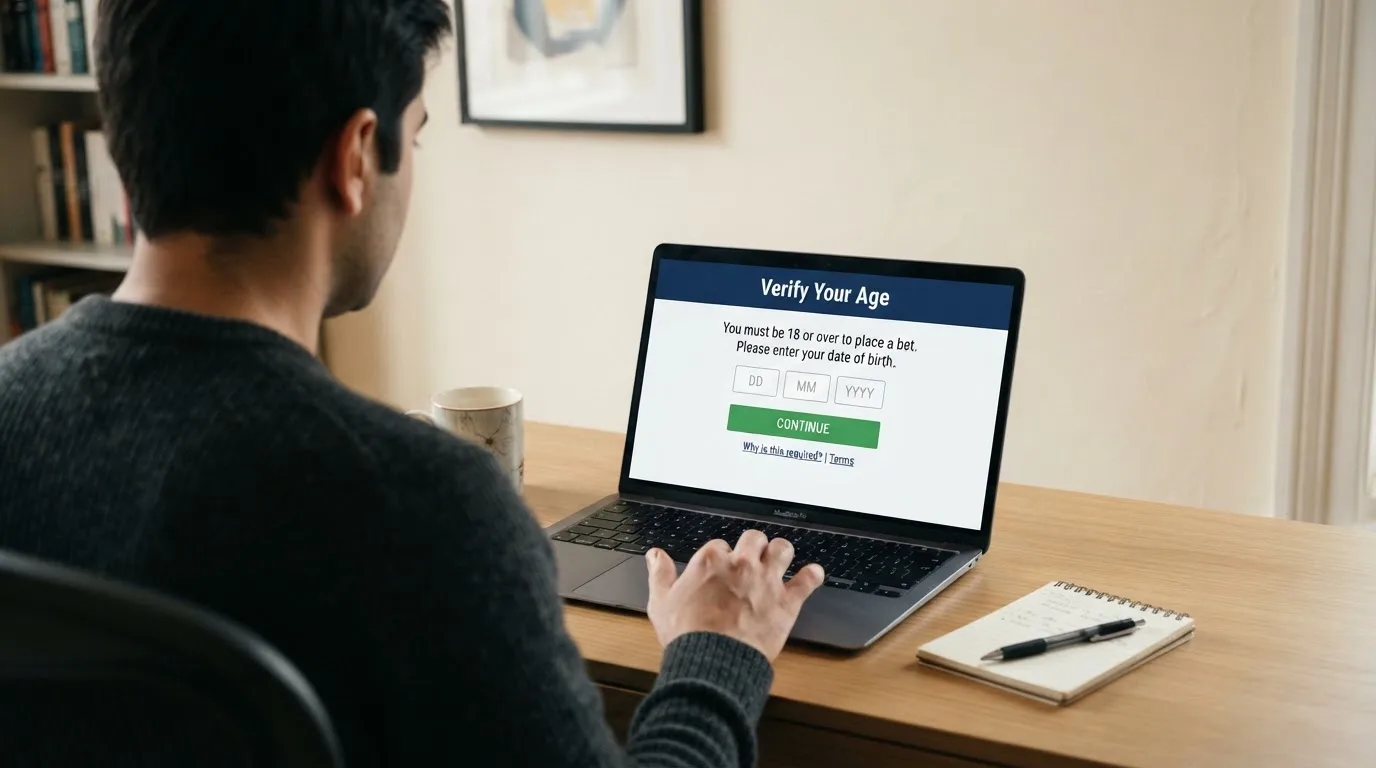
A Gambling Commission licence is the whole test of who can take bets from customers in Great Britain. Under the Gambling (Licensing and Advertising) Act 2014, an operator whose remote facilities are used in Great Britain needs a Commission licence wherever it is based — a Curaçao, Maltese or Gibraltar licence is not a substitute. Since 7 May 2019 every customer at a GB-licensed site has name, address and date of birth verified before deposit. The minimum age is 18.
The five betting licence types relevant to field hockey are remote general betting standard (real events), remote general betting standard (virtual events), remote general betting limited, remote pool betting, and remote betting intermediary — the last being the licence for betting exchanges like Smarkets. The Commission’s public register is searchable by business name, trading name, domain or account number, and is the only place to check a brand’s status. A reader who wants to confirm that a brand holds a licence searches the register, not the brand’s own website.
What the licence requires the operator to do
The Licence Conditions and Codes of Practice (LCCP) and the Remote Technical Standards (RTS) bind the operator on player protection, anti-money-laundering, marketing and game fairness. The practical consequences for the bettor:
- Identity verification before deposit. No anonymous play. The verification applies to free bets and bonuses as well as cash.
- Source-of-funds questions at higher spend. Not an income check, not a credit reference check — a check of public records (bankruptcy, county court judgments) once net deposits exceed £150 in a rolling 30 days.
- GAMSTOP coverage. A self-exclusion registration covers every GB-licensed online operator, with periods of six months, one year, five years or five years with auto-renewal.
- Bonus cap. Wagering requirements on bonuses are capped at 10x since 19 January 2026. A £10 bonus at 50x wagering is no longer permitted; under the cap the requirement cannot exceed £100 of qualifying bets.
- Mixed-product promotion ban. An offer that requires gambling on two or more product types — betting and casino, for instance — is banned.
- Credit card ban. Credit cards are not accepted for gambling in Great Britain, including credit-card-funded e-wallet deposits.
What the licence does not cover
A Gambling Commission licence does not cover financial spread betting. Spreadex, for example, is regulated by the Financial Conduct Authority for spread betting and by the Gambling Commission for fixed-odds betting. Spread betting losses can exceed deposits — that is a structural feature of the product, not a marketing claim. A reader who reads “spread betting” in the same breath as “fixed-odds betting” should know the two products are regulated differently and behave differently.
Advertising is not licensed by the Commission. It runs through the CAP Code (non-broadcast) and BCAP Code (broadcast), enforced by the ASA, alongside the Commission’s LCCP marketing conditions. CAP Code section 16 prevents marketing of strong appeal to under-18s and limits who may appear in gambling advertisements. The “whistle-to-whistle” ban on betting advertising around live sport before the 9pm watershed is an industry code, not a statute. None of that changes the licensed status of the operator — it shapes how the operator is allowed to promote the product.
Tax in Great Britain
The bettor pays no tax on betting winnings in Great Britain. General Betting Duty is the operator’s tax on gross profits, currently 15%. From 1 April 2027 a new remote betting rate of 25% applies within it, while remote bets on UK horse racing, self-service betting terminal bets, pool betting and in-person betting stay at 15%. Until that date the remote rate stays at 15%. Whether operators pass the duty on through tighter odds is not established — the margin and the duty are reported separately, and the bettor sees only the price. The Commission’s statutory levy is a separate charge, not a tax. A professional gambler should ask HMRC or an adviser; for everyone else, betting winnings are not taxed.
Responsible Gambling: What the Operator Has to Offer and What the Bettor Has to Use
A licensed bookmaker in Great Britain is required to offer a set of safer-gambling tools. The bettor’s task is to use them. The tools and the threshold that triggers them:
| Tool | What it does | When it applies |
|---|---|---|
| Deposit limit | A gross deposit cap over a fixed time frame | Required under RTS 12; phased in from 31 October 2025, with a second phase postponed to 30 September 2026 — check the operator’s site for current status |
| Timeouts | A short break from gambling, usually 24 hours to 6 weeks | Available on request at every GB-licensed operator |
| GAMSTOP self-exclusion | Exclusion from every GB-licensed online operator | Six months, one year, five years, or five years with auto-renewal; minimum six months plus a further seven years unless removed on request |
| Financial vulnerability check | A public-records check (bankruptcy, county court judgments) | When net deposits exceed £150 in a rolling 30-day window since 28 February 2025 |
| Financial risk assessment | The “affordability checks” in the press | Announced, staged, no start date — not yet in force |
The deposit limit is the most-used tool and the one the bettor sets for themselves. There is no state-set ceiling — the limit is the customer’s choice, and a bettor who sets it at £50 a week and is tempted to raise it has the operator bound to act on the request, not to push it. The financial vulnerability check is automated and runs in the background; a bettor who sees a request for documentation at higher spend is seeing the operator comply with its licence, not target the customer personally.
Help outside the operator
GamCare runs the National Gambling Helpline. GambleAware funds treatment and research. The NHS runs gambling clinics. Gamblers Anonymous runs peer-support meetings. Fitzwilliam Sports, for instance, links to all three — and that is the standard a licensed operator is expected to meet. A bettor who feels the product has stopped being entertainment has a list of services to contact, all free and confidential.
Offshore operators and the loss of protection
A brand without a Gambling Commission licence cannot be marketed to customers in Great Britain, and providing gambling facilities in Great Britain without the licence the Gambling Act requires is an offence under section 33 of the 2005 Act, aimed at the operator. The bettor on an unlicensed site is not prosecuted for betting, but loses: no GAMSTOP coverage, no Commission complaints route, no approved dispute-resolution body, no British consumer redress if funds are withheld, and not bound by the 10x bonus cap or the £150 vulnerability check. Honest framing — licensed means checks, limits, GAMSTOP and the bonus cap, but also verification before the first bet; unlicensed means none of those protections and possible loss of funds. Neither is “the safe choice” by default.
Enforcement against unlicensed operators is disruption, not blocking: cease-and-desist notices, search-engine referrals, work with registrars and payment providers, and court-order DNS blocking powers the Commission has been given or is about to receive. ISP blocking as a live measure should not be written as in operation; the current position is that the powers exist and are used selectively.
Bonuses and Free Bets on Field Hockey: What the Headline Cost Actually Is
A field hockey welcome offer or a price boost is a marketing product, and the price is the same word used for the bet it accompanies. The headline — “Get £40 in Free Bets when you bet £20”, “100% matched free bet up to £25”, “Bet £10, Get £10 in Free Bets” — names a number the operator would like the bettor to remember and a number the bettor pays in return.
What the headline does not name is the wagering requirement, the minimum odds, the expiry, the cap on free-bet winnings, and whether the stake is returned with a win. Those are the cost.
The licensed set’s offers, in their own terms
The ten brands above attach the welcome offer to different conditions. The marketing word and the underlying cost:
- Hollywoodbets — a first qualifying losing accumulator with three or more legs at minimum odds of 4/1, stake returned as a free bet up to £30, settled within 7 days. One free bet per customer. The £30 cap is the ceiling; a winning first acca returns the stake plus winnings at the offered price, a losing first acca returns the stake as a free bet, not cash. The free-bet stake is not paid back with a win — that is the standard free-bet rule.
- Betboro — a 100% matched free bet up to £25 on the first qualifying wager, requiring a debit-card deposit of at least £10 and a first bet of £5 to £25 with at least three selections each at 3/5 (1.60) or higher. The qualifier requires an acca-style bet (three or more legs), so the cost of unlocking the free bet is a bet that has to win at a price the operator has set.
- Dabble — a fixed-amount free bet on a first deposit and bet, with a 7-day free-bet expiry and the stake not returned on a winning free bet. The 7-day expiry is the cost: a free bet that is not used within the window is gone.
- Unibet — a fixed free-bet bundle on a first £20 sports bet at minimum odds of 2.0 (1/1), with free bets expiring within 7 days, on a debit card or instant bank transfer deposit. The deposit method is restricted to debit card or instant bank transfer; an e-wallet deposit may not qualify.
Other brands on the licensed set run their own welcome mechanics — Star Sports’ phone-trader model allows bespoke sign-up, Fitzwilliam Sports’ “High Stakes Welcome” runs on compliance criteria, William Hill’s headline product is Best Odds Guaranteed on horse racing rather than a sports free bet. Each of those has its own cost; what every welcome offer on the licensed set shares is the 10x wagering cap on any bonus, the 7-day expiry where applicable, and the requirement that the qualifying bet meet a minimum-odds floor.
What a free bet is worth on average
A free bet whose stake is not paid back with a win has a calculable value. Take a free bet of £10 at decimal odds of 3.00 on a market with a 5% margin (payout share 0.95). The value is £10 × (3.00 − 1) ÷ 3.00 × 0.95 = £6.33. The headline says £10; the average worth is closer to £6.33 on that market. At higher odds the value climbs — a free bet at 6.00 on a 5% margin is worth £7.92, because the operator is paying a larger multiple on a stake it does not return. The conclusion is the value, not the headline: a £10 free bet is not a £10 bonus, and the difference is the cost of the operator giving back the stake.
Why the wagering cap matters
Before 19 January 2026 a £10 bonus at 50x wagering needed £500 of qualifying bets; the cap brought that down to a maximum of £100 in qualifying bets. A field hockey bettor who would previously have been steered towards high-margin casino products to clear a 50x bonus is now steered less aggressively, because the maths no longer supports it. The cap is a ceiling on what the operator can require; it is not a floor, and most licensed welcome offers sit well below it. The bettor’s task is still to read the terms — minimum odds, qualifying markets, expiry, free-bet stake return — and to compare the headline number against the qualifying-bet cost.
Operator Reviews
The ten brands below are the licensed set the article covers. Each review closes on a verdict that names the figure or condition that changed the picture, not a generic suitability line.
Fitzwilliam Sports
Fitzwilliam Sports is a Dublin bookmaker with a capped membership and a compliance-gated welcome. The “High Stakes Welcome” is a product aimed at a bettor who places larger single bets and accepts the compliance process, not the casual punter. The site offers instant deposits, fast withdrawals, timeouts and deposit limits, and links to GambleAware, GamStop and Gamblers Anonymous — the standard safer-gambling suite. Field hockey sits under the general real-events licence and is offered as part of the standard sportsbook product.
Verdict: A bookmaker for the bettor who wants a phone-and-account relationship and accepts a compliance-gated welcome, not the bettor who wants a frictionless app signup.
Smarkets
Smarkets runs as a betting exchange under a remote betting intermediary licence, with the Commission’s account number 39173. The deposit and withdrawal terms are explicit: open bank transfer deposits are instant from £10 to £10,000, withdrawals are processed within 6 hours from £10 to £100,000, and UK debit card deposits are instant from £10 to £15,000. A betting exchange is structurally different to a traditional bookmaker — prices are set by members, the margin is whatever the market clears at, and the cash-out equivalent is to lay off the position on the exchange. The welcome offer on a betting exchange is usually a commission rebate rather than a free bet, and the value to the bettor is in the spread between back and lay.
Verdict: A bookmaker for the bettor who reads the price as a number and is comfortable setting their own odds, with a withdrawal time that is faster than most fixed-odds bookmakers.
Sporting Index
Sporting Index holds a remote general betting standard (real events) licence under Sporting Index Limited. The product lets customers switch between fixed odds and spread betting, with in-play, auto cash-out, Multi-Markets, and Bet Builder for football. The “switch between fixed odds and spread betting” feature is the distinguishing point — a bettor can run a fixed-odds position and a spread position from the same account, and the same in-play product covers both. Field hockey is offered under the standard in-play service; the depth of markets is the variable.
Verdict: A bookmaker for the bettor who uses both fixed odds and spread betting, with a platform that supports the in-play and cash-out mechanics across both.
Hollywoodbets
Hollywoodbets is a remote general betting standard (real events) licensee under Hollywoodbets International UK Limited. The new-player offer is a stake-back free bet up to £30 on a first qualifying losing accumulator, with three or more legs at minimum odds of 4/1, settled within 7 days. The qualifying bet has to be an accumulator — a single or a double does not unlock the offer. The free bet is paid back only on a losing first acca; a winning first acca returns the stake plus winnings at the offered price, with no free bet. The 4/1 minimum is the cost: the qualifying bet is at a price that is rarely value.
Verdict: A bookmaker whose welcome offer routes the new customer towards a 4/1 minimum accumulator, with a stake-back free bet as the return rather than a matched deposit bonus.
Betboro
Betboro holds a remote general betting standard (real events) licence under Webmedia Development N.V. The welcome is a 100% matched free bet up to £25 on the first qualifying wager, requiring a debit-card deposit of at least £10 and a first bet of £5 to £25 with at least three selections each at 3/5 (1.60) or higher. The structure is similar to Hollywoodbets: an acca-based qualifier, a free-bet return rather than cash, and a minimum-odds floor on each leg. The matched-free-bet wording — “up to £25” — sets the ceiling at the first bet’s stake, not a multiple of it.
Verdict: A bookmaker whose welcome offer is a matched free bet on a three-leg acca at 1.60 minimum per leg, with the matched amount capped at the qualifying bet.
Dabble
Dabble is a remote general betting standard (real events) licensee under Dabble Sports UK Ltd. The new-customer offer is a fixed-amount free bet on a first deposit and bet, with a 7-day free-bet expiry and the stake not returned on a winning free bet. The structure is simpler than Hollywoodbets or Betboro: a single bet, a fixed free bet, no acca requirement. The 7-day expiry is the constraint; a bettor who does not place the qualifying bet within the window forfeits the offer.
Verdict: A bookmaker with a single-bet welcome and a fixed free bet, where the 7-day expiry is the only timing constraint on the offer.
Unibet
Unibet is a long-established operator — the site states it has run since 1999 — and its UK site is operated by Platinum Gaming Limited, Gibraltar, under account 45322. The sports welcome is a fixed free-bet bundle on a first £20 sports bet at minimum odds of 2.0 (1/1), with free bets expiring within 7 days, on a debit card or instant bank transfer deposit. The deposit-method restriction matters: an e-wallet deposit may not qualify. Unibet is also one of the operators running Bet Builder products on football and in-play across the platform.
Verdict: An established operator with a fixed free-bet welcome at 1/1 minimum, where the deposit-method restriction (debit card or instant bank transfer) is the qualifier that catches out e-wallet depositors.
Star Sports
Star Sports is a remote general betting standard (real events) licensee under Star Racing Limited. The defining feature is the phone-trader model: customers can open an account, place a bet or resolve a query by calling a trader on 08000 521 321, alongside the standard online and email support at [email protected]. The product is aimed at a bettor who wants a person on the other end of the line — a feature that has largely disappeared from the app-first bookmakers. Field hockey is offered under the standard sportsbook.
Verdict: A bookmaker for the bettor who wants to talk to a trader, with a phone-first service that is the opposite of the app-first experience.
William Hill
William Hill holds a remote general betting standard (real events) licence under WHG (International) Limited. The headline product is Best Odds Guaranteed on UK and Irish horse racing from 8 AM on the day of the race, on both single and multiple bets. BOG does not apply to field hockey, to ante-post, to tote or to pari-mutuel bets. The brand’s strength is the racing product; the field hockey product is a standard sportsbook offering. The licensed status, the GAMSTOP coverage and the licence conditions are the same as every other GB-licensed operator.
Verdict: A bookmaker whose headline product is Best Odds Guaranteed on horse racing, where field hockey is a standard sportsbook offering rather than a featured market.
Betmaster
Betmaster is published by Bm Solutions Gb Limited under account 65699. The app coverage centres on football, cricket, horse racing, NFL and eSports — League of Legends and Dota 2 are the named eSports. Field hockey is not in the named core sports list. A bettor who comes to Betmaster for live field hockey betting will find the sport listed as part of the wider sportsbook, but not as a featured market. The bet builder and in-play products on the platform are built around football and the named eSports.
Verdict: A bookmaker for football, cricket, horse racing, NFL and eSports bettors, with field hockey as a wider-sportsbook market rather than a featured line.
Frequently asked questions
How can a bookmaker’s Gambling Commission licence be checked?
The Gambling Commission’s public register can be searched by business name, trading name, domain or account number. Every licensed remote operator appears against an account number and a licence category, with the licence holder named. The register is the only place to confirm a brand’s licensed status, and the test is the presence of the brand and the licence category on the register, not the brand’s own website. Licensed operators use both .com and .co.uk domains, so the domain does not prove a licence.
How is the return on a bet worked out from the stake and the odds?
For decimal odds, the return is stake × odds, and the net profit is stake × (odds − 1). For fractional odds, the return is stake × (numerator/denominator + 1). A £10 bet at decimal odds 3.00 returns £30, of which £20 is profit. For an accumulator, the odds of the legs multiply into one combined price, and the return is stake × the combined odds. The calculation assumes the bet wins; a losing bet returns zero.
What is the bookmaker’s margin and how does it show in the odds?
The margin is the cut the bookmaker keeps on every pound staked. For a two-way market priced at 1.90 and 1.90, the payout share is 1 ÷ (1/1.90 + 1/1.90), or roughly 0.95, and the margin is 1 minus the payout share, around 5%. The margin shows in the gap between the prices and a fair book — a market where every outcome is priced at “true” odds would sum to 100% in implied probability, and the surplus over 100% is the margin. A higher margin means a worse price for the bettor.
How do fractional odds like 5/1 convert to decimal odds like 6.00?
Fractional odds a/b convert to decimal by dividing a by b and adding 1. 5/1 becomes 5 ÷ 1 + 1 = 6.00. 11/4 becomes 11 ÷ 4 + 1 = 3.75. Evens (1/1) becomes 2.00. The conversion works both ways: a decimal price minus 1, expressed as a fraction, is the fractional form. British bookmakers publish fractional odds on the betting slip; the decimal form is what the return calculation uses.
Which tools for controlling play does a licensed bookmaker have to offer?
A licensed bookmaker has to offer deposit limits, timeouts and self-exclusion through GAMSTOP, and must run a financial vulnerability check on customers whose net deposits exceed £150 in a rolling 30 days. Timeouts are short breaks, usually 24 hours to 6 weeks. GAMSTOP self-exclusion is six months, one year, five years, or five years with auto-renewal. The financial vulnerability check is a public-records check, not an income check. The tools are the operator’s licence condition, not the operator’s choice to opt in.
Are betting winnings taxed in Great Britain, and who pays General Betting Duty?
Betting winnings are not taxed in Great Britain. General Betting Duty is the operator’s tax, currently 15% on gross profits, with a new remote betting rate of 25% applying from 1 April 2027. The duty is the operator’s liability, and the bettor sees only the price the operator publishes. A professional gambler should ask HMRC or an adviser. The Commission’s statutory levy is a separate charge, not a tax on the bettor.
US & other team sports – Best Betting Tips
Content created by the «Best Betting Tips» team
