
Betting on snooker online in Great Britain
 Available in US
Data current as of 27 October 2026, checked against the Gambling Commission’s public register and each operator’s own published terms.
Snooker sits oddly in a betting guide. It is a quiet sport between rounds, then a sprint of long pots and safety exchanges that can swing a frame in two visits. A bet placed on the outright winner at the Crucible in April settles weeks later; a bet placed on the next frame settles inside twenty minutes. That range — from season-long outrights to the next colour — is what makes snooker worth a closer look. A punter who treats it like a football coupon leaves money on the table; a punter who treats it like a chess clock leaves the match early.
This page walks through what betting on snooker actually involves in Great Britain in 2026: how a bet on a frame, a match or a tournament pays back, how the bookmaker’s margin sits inside the odds, which markets the licensed shops carry, and what the regulator’s safer-gambling framework means for the person placing the bets. It also runs through ten licensed brands side by side, on a fixed set of comparison columns, so a reader can see what each one does and where each one falls short.
Why snooker punts the way it does
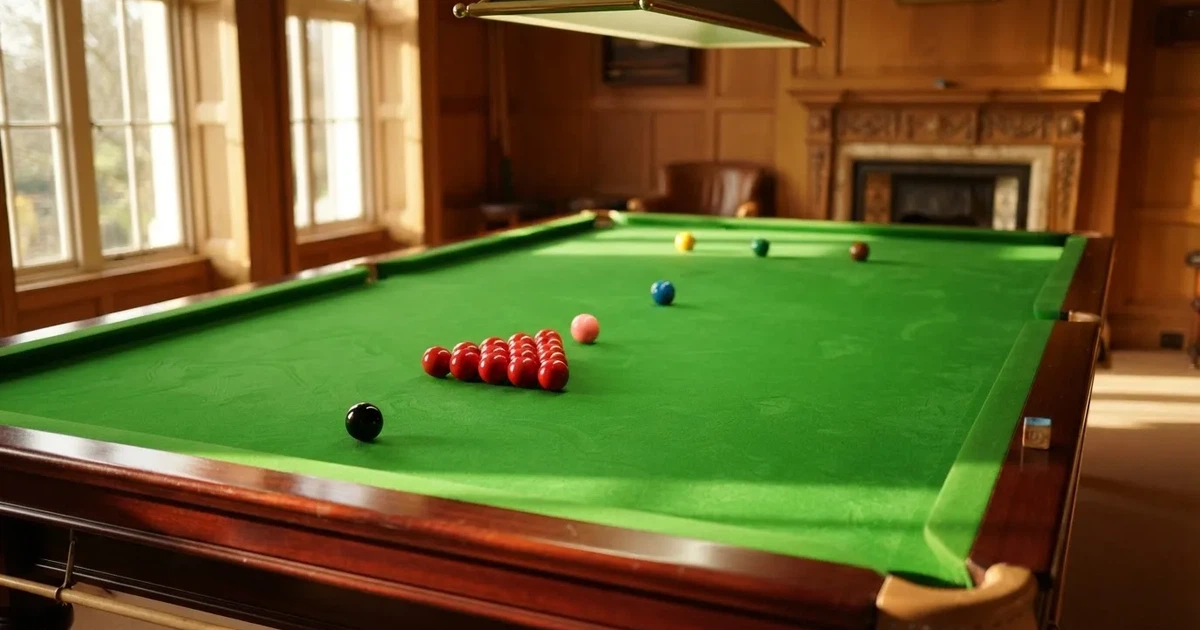
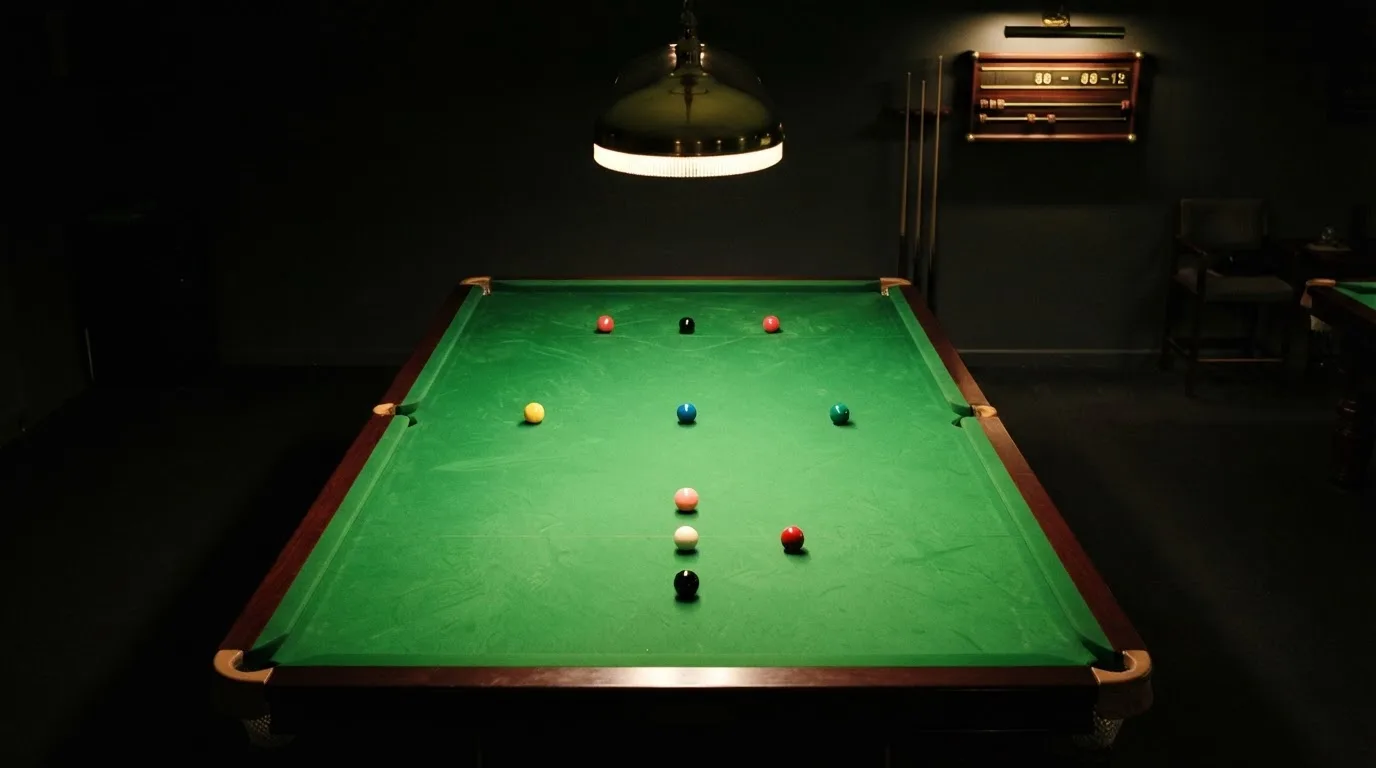
Snooker is played with 22 balls: a white cue ball, 15 reds worth one point each, and six colours worth yellow 2, green 3, brown 4, blue 5, pink 6 and black 7. The maximum break is 147, made by potting all 15 reds with blacks and then clearing the six colours in order. A full-size table measures 12 ft by 6 ft with six pockets. Most professional matches are short — best of 7, 9 or 11 frames — which is why in-play markets sit so naturally on the sport. A single visit to the table can run two or three minutes; a safety exchange, longer. The frame settles quickly enough that a price taken at 30-0 means something quite different from a price taken at 60-50.
The World Snooker Championship has been held at the Crucible Theatre in Sheffield since 1977. The first round is best of 19 frames; the final is best of 35. The 2026 World Snooker Championship ran from 18 April to 4 May at the Crucible, with Wu Yize beating Shaun Murphy 18-17 in the final; the winner’s share was £500,000 from a £2,395,000 prize fund. Stephen Hendry and Ronnie O’Sullivan share the modern record of seven world titles each; Joe Davis won 15 in a row between 1927 and 1946. The professional game is governed by the WPBSA, which owns the official rules; amateur snooker sits under the IBSF.
Those numbers matter for betting because they shape the markets a bookmaker is willing to write. A best-of-7 match offers fewer in-play angles than a best-of-19 Crucible first round; a 147 on the table, with the balls sitting right, is the kind of moment that moves a specials price harder than almost anything else in the sport.
Responsible gambling: the framework the licence comes with
A Gambling Commission licence for Great Britain is not just a permission slip. It bundles a set of player-protection requirements into the conditions a brand has to meet to keep the licence. Anyone betting on snooker online in Great Britain in 2026 is interacting with them whether they realise it or not, and the safer-gambling pages are worth opening before the first deposit.
Identity is checked before the first deposit. Name, address and date of birth are verified before a customer can deposit or gamble at a licensed operator — that has been the rule since 7 May 2019 and applies even when a free bet or bonus is being claimed. There is no anonymous play at a GB-licensed site, because there is no GB-licensed site that does not verify. A reader who wants to bet without showing ID is, by definition, looking at the offshore section of this market.
GAMSTOP is the national multi-operator self-exclusion scheme and has been a mandatory licence condition for online operators since 31 March 2020. A customer registers once with GAMSTOP and is excluded from every licensed online operator for the period chosen: six months, one year, five years, or five years with auto-renewal. After the minimum period the exclusion remains in force for a further seven years unless the customer asks GAMSTOP to remove it. GAMSTOP covers online sites and apps; the high-street betting shops run a separate self-exclusion service.
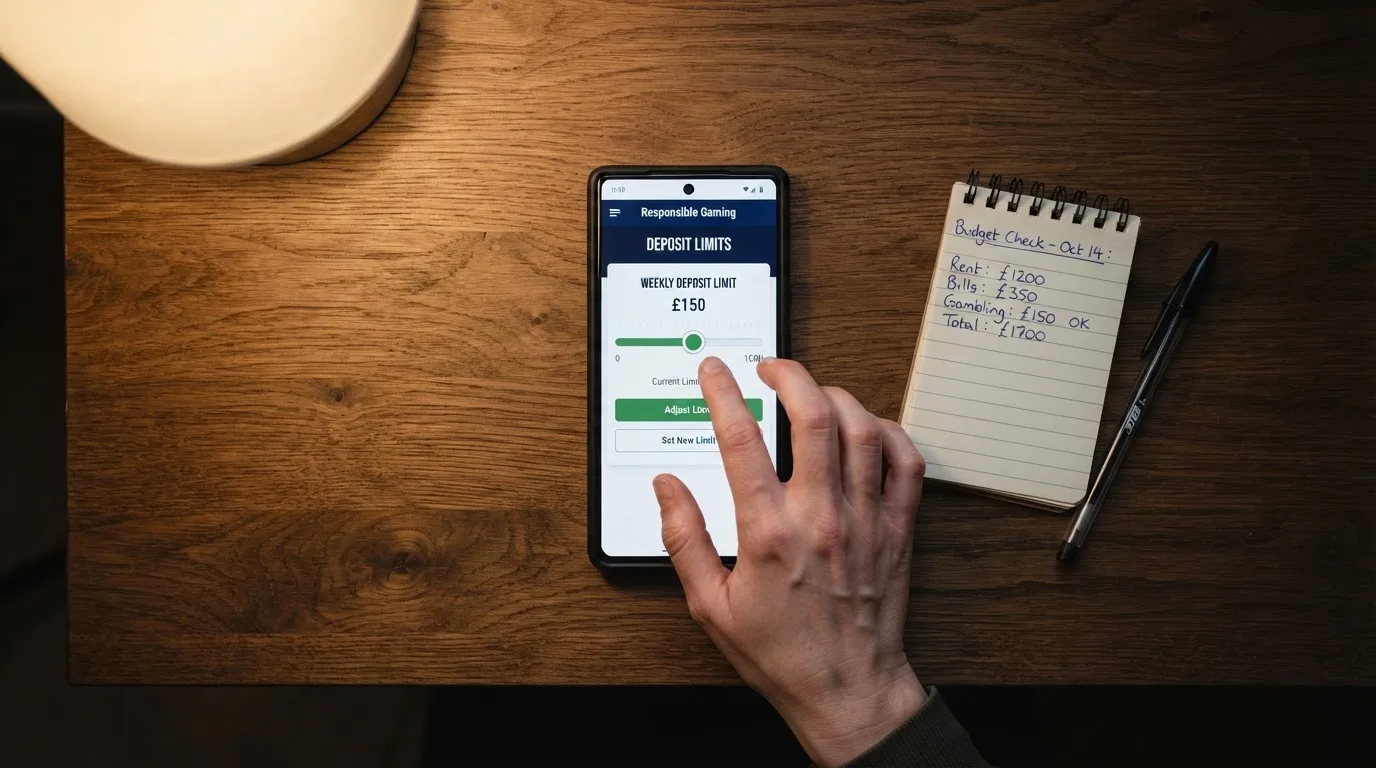
The financial vulnerability check has applied to licensed remote betting since 30 August 2024 under LCCP condition 3.4.4 and went live operationally on 28 February 2025. It triggers once a customer’s deposits minus withdrawals exceed £150 in a rolling 30-day window. A bank operator is then expected to run a public-record check — bankruptcy registers, county court judgments — to look for signs of financial difficulty. It is not an income check and not a credit reference check; it is a softer step than the financial risk assessments the Commission announced on 7 July 2026 in a staged plan with no start date. Where those land is not established; what is in force today is the vulnerability check at the £150 threshold.
Deposit limits sit under Remote Technical Standard 12. Operators must offer a gross deposit limit on a fixed time frame. The first changes have applied since 31 October 2025; a second phase was postponed to 30 September 2026. Whether that second phase is live is not established from the public record, so the honest framing is that a limit can be set by the customer, the operator must offer one, and what the default is depends on the operator.
Credit cards are banned for gambling in Great Britain since 14 April 2020 under LCCP condition 6.1.2, including credit-card-funded payments through an e-wallet. Debit cards and bank-based payments are not covered. Cryptocurrency deposits at licensed operators are not addressed in the public framework one way or the other; the practical answer is that licensed brands settle in pounds and euros, not coins.
Help exists outside the operators. GamCare runs the National Gambling Helpline; GambleAware funds treatment and research; the NHS runs gambling clinics across Great Britain; Gamblers Anonymous runs support groups. Most licensed operator sites link out to all four. The link is worth clicking.
Crypto and anonymity: what an offshore route actually costs
The crypto question lands differently in snooker than it does in a casino guide, because the licensed British market does not take coins. A reader who wants to bet on snooker with bitcoin, ethereum or any other cryptocurrency is, by definition, looking at sites licensed outside Great Britain. That is not a moral judgement. It is a structural one: the regulated market runs in pounds and a bank check, and the crypto market runs somewhere else.
What the licence gets the punter is concrete. GAMSTOP coverage, the £150 vulnerability check, the bonus cap described below, an approved dispute-resolution route through the Commission, and access to British consumer redress if a licensed operator withholds funds. None of those protections travel with a bettor a VPN customer who lands on an offshore site. What an offshore route costs is not the crypto fee or the network delay. It is the loss of every safeguard above, plus the loss of any practical way to chase a complaint if the operator decides not to pay.
Enforcement against unlicensed operators is real but it is not blocking. The Commission can issue cease-and-desist notices, refer sites to search engines, work with domain registrars, hosting providers and payment companies, and now has, or is about to receive, court-order DNS blocking powers. None of that is a single customer pressing a button and seeing a site disappear. The honest framing is that licensed play means checks, limits, GAMSTOP and the bonus cap, but also a credit check, an ID check and a source-of-funds conversation at higher spend; unlicensed play means none of those checks and none of those protections. Neither is the safe choice by default; both have a price.
Bonuses and free bets: what the offer is actually worth
The marketing words a snooker punter meets in 2026 are familiar: free bet, enhanced odds, acca insurance, price boost, best odds guaranteed. Each of them carries a small print, and the small print is where the offer stops being what its headline said.
The headline rule is the wagering cap. Wagering requirements on bonuses are capped at 10x under the bonus promotion rules in force since 19 January 2026. A £10 bonus with a 50x wagering requirement would have demanded £500 of qualifying bets; under the cap, the same £10 bonus can demand no more than £100 of qualifying bets. Mixed-product promotions are banned — an offer that requires gambling on two or more product types (betting plus casino, betting plus bingo, betting plus lottery) is not a permitted promotion. The 10x cap applies to bonuses with a wagering condition. Whether it applies to free bets whose stake is not returned as bonus money, and any cap on the headline money value of a bonus, are not established in the public record.
A free bet is a credit the operator places in an account. The stake is usually not paid back with a winning free bet: a £10 free bet at decimal odds of 3.00 returns £20, not £30, because the £10 stake was the operator’s money. A free bet at minimum qualifying odds of 1.50 (3/2) that wins returns the winnings at the odds minus the stake that was never there; the value to the punter is the winnings, not the headline amount. The expected value of a free bet on a market the bookmaker has margined at 5% works out as the free-bet amount multiplied by (odds − 1) divided by the odds, then by the 95% payout share. A £10 free bet at 3.00 against a 95% market returns about £6.33 on average; against a 90% market, about £6.00. The headline number is not the number.
A price boost is a one-off enhancement to a price the bookmaker has already written. The boost is real money in the winnings, not bonus money, and is usually settled like any other winning bet. An accumulator insurance refunds a stake (often as a free bet, not as cash) if one leg of a multi lets the punter down. A cashback returns a slice of net losses over a window, usually as a free bet rather than as cash. Each one is what its terms call it; nothing is more.
Best odds guaranteed, or BOG, is a horse-racing convention that has bled into greyhound racing. The bookmaker promises that if the starting price is bigger than the price the punter took, the bet is paid at the bigger price. Several of the operators on this page extend it to specific markets. The maximum benefit is often capped: QuinnBet caps the BOG benefit at £150 per customer per race on UK and Irish horse racing from 10:00am daily; Copybet runs it all day, every day, on UK and Irish racing, and pays first past the post even when the winner is later disqualified; William Hill runs BOG from 8 AM on UK and Irish racing on singles and multiples, with ante-post, tote and pari-mutuel bets excluded.
The arithmetic of a bonus takes the bonus base, multiplied by the wagering factor, divided by the stake per bet, to give the number of qualifying bets. A £100 bonus with a 10x wagering requirement, played at £10 a bet, demands 100 qualifying bets at minimum odds. Each bet carries the bookmaker’s margin on the market being played. The expected cost of clearing the bonus on a market margined at 5% works out at roughly £50 over those 100 bets — the turnover, multiplied by the margin. A punter who plays a higher-margin market (a novelty market at 8% or 10%) clears more expensively; a punter who plays a low-margin market (a major outright at 3%) clears cheaper. The offer’s cost is the market it is played on, not the headline.
Live betting and cash out on snooker
Snooker is built for in-play. Frames settle in twenty to forty minutes; a single break can change the shape of a frame and the price of the match. A bookmaker that covers snooker properly updates frame winner, next colour, total points in the frame and the match outright several times a visit.
The legal frame for in-play is the operator’s licence conditions and its customer-protection duties under the LCCP. There is no statutory prohibition on in-play snooker betting in Great Britain. The market margins are wider than the pre-match market on the same match, because the bookmaker is writing prices faster than the model can update them; that gap closes as the frame settles. A punter who reads in-play well does so on the gap, not on the price.
Cash out is the operator’s offer to settle a bet before the event has finished, at a price the operator sets. The price is built the same way every other price is built, and the operator’s margin is in it. Auto cash out closes a position at a chosen price without the punter pressing the button; the price the operator offers at the trigger is the price the punter gets. Sporting Index’s app lists auto cash-out alongside its Multi-Markets feature and Bet Builder for football. The price is the price; the feature is whether the punter has to be at the screen to claim it.
Live streaming of snooker events is offered by several operators on this page; the rule is that streaming is conditional on the customer having a funded account or a bet on the event, and the picture quality varies by operator. The picture is a convenience, not a price edge.
Predictions and strategy: what a tip actually buys
Search results for snooker betting tips and snooker betting predictions are full of paid picks for the proper play. The honest framing is that nobody can know who will pot the pink in frame 19, and a reader who pays for a tip is buying the tipster’s confidence, not a result. A prediction is a forecast, not a payout.
What a punter can do is build a process. Track which bookmaker’s outright market has the longest price on a player the punter thinks is undervalued; track which frame markets the bookmaker covers and which ones it leaves to the exchanges; track the minimum qualifying odds on a free bet, the wagering requirement on a bonus and the deadline before each expires. The arithmetic above — the margin, the bonus turnover, the free-bet value — is the work. The pick is the surface.
Bankroll management is the boring half of the work. A punter who stakes 2% of a bank on a single match and lets a free ride settle as a transaction rather than a tipping point is the punter who is still betting in three months. A punter who stakes 20% on a single frame winner because the price looked generous is the punter who is not. The number is not the pick; the stake size relative to the bank is the strategy.
Forecast work has its limits. A price on Ronnie O’Sullivan to win the World Championship at the Crucible reflects the market’s view of his first-round draw, his recent form and his longest fatigue against a qualifier who has nothing to lose. The price is what it is; the punter’s edge is knowing something the market has not priced in, and the edge is small. The shape of the snooker season — short tournaments, long breaks, a Crucible that dominates the calendar — means outright markets are open for weeks, and the price moves on results.
Bet types and odds: how the snooker market is priced
A snooker punter meets several market shapes, each built the same way: the bookmaker sets a price on every outcome, the prices carry a margin, the punter pays the margin inside the spread.
A match outright is the simplest. Two players, two outcomes (or three if a draw is offered on a format that allows one), prices set on each. A frame market is shorter: a price on who wins the next frame, on whether the frame goes to a deciding colour, on the total points in the frame. A handicap frame market gives one player a frames head-start; an over/under points market splits the total. A 147 market is a specials bet on whether the maximum break is compiled in a given match or tournament. Each market carries its own margin.
Decimal odds are the convention in Great Britain and Ireland. A £10 stake at decimal odds of 3.00 returns £30 (£10 stake plus £20 profit); at odds of 1.50 it returns £15 (£10 stake plus £5 profit). Fractional odds of 5/1 mean £5 profit per £1 staked; converting to decimal divides the numerator by the denominator and adds 1, so 5/1 becomes 6.00. Odds-on prices are shorter than evens: 1/2 in fractional terms is 1.50 in decimal; 4/6 is 1.67. A punter who reads the fractional board at a betting shop converts by dividing the first number by the second and adding one.
The margin is the slice of every pound staked the bookmaker keeps. It is the one number that matters most in a price, because it is the number the bookmaker controls. The arithmetic runs as follows: take every outcome of a market, invert its decimal odds (so 1.50 becomes 0.667 and 3.00 becomes 0.333), add the inverted odds together and divide 1 by the sum to get the payout share. The margin is 1 minus the payout share. A two-way market priced at 1.90 and 1.90 inverts to 0.526 and 0.526, which sums to 1.053; the payout share is 1 ÷ 1.053 = 94.96%, and the margin is about 5.04%. A bookmaker writing the same two-way market at 1.85 and 1.85 keeps a margin of roughly 8.1%; at 1.95 and 1.95 the margin shrinks to roughly 2.6%. The market the punter sees as “tight” is the market with the lowest margin; the bookmaker’s profit per pound staked is highest on the market with the highest margin.
A combination bet multiplies the odds of the legs into one price. Two legs at 2.00 and 3.00 combine to 6.00; three legs at 1.50, 2.50 and 3.00 combine to 11.25. The margin compounds with each leg, which is why a four-fold accumulator is rarely as generous as it looks: the bookmaker’s margin on each leg sits inside the combined price.
A free bet settles differently from a cash stake. A £10 free bet at 3.00 returns £20 (the £20 winnings, not the £30 a cash stake would return), because the £10 stake was the operator’s money. The free-bet value on a market with a 95% payout share at odds of 3.00 is roughly £10 × (3.00 − 1) ÷ 3.00 × 0.95 = £6.33. The punter should treat the headline as £6.33, not as £10, when working out whether the offer is worth taking.
A best-odds-guaranteed concession pays the larger of the price taken and the starting price. The benefit is the difference between the two prices, multiplied by the stake. The cap on the benefit is the cap on the offer: QuinnBet’s £150-per-customer-per-race cap is the ceiling on how much a single customer gains from BOG on a single race.
Sports and tournaments: the snooker calendar
The professional snooker calendar runs almost year-round. The major ranking events are the World Championship at the Crucible (April–May), the UK Championship in York (November–December), the Masters at Alexandra Palace (January), the Champion of Champions, the Shanghai Masters, the China Open, the Welsh Open and the Players Championship. Each event sits on the bookmaker’s outright market for weeks before its tournament runs open.
The Crucible dominates the betting calendar. A best-of-35 final moves through four sessions over two days; a best-of-19 first round settles inside a day. Outright markets open months ahead, frame markets open hours ahead, in-play markets open frame by frame. The Crucible is also the tournament where the 147 market is most actively written, because the table is known and the conditions are stable.
The UK Championship in York is the second leg of snooker’s Triple Crown, alongside the Masters and the World Championship. The Masters at Alexandra Palace is invitational, with the top 16 in the world; the field is fixed, the format is short, and outright markets are tight. Smaller ranking events carry thinner markets; the bookmaker may offer match outright and a handful of frame markets, but the specials and 147 markets dry up.
Amateur and women’s snooker is covered by some bookmakers. The format is shorter, the field is wider, and the outright market is often priced by the bookmaker’s own model rather than by an active exchange. The WPBSA governs the professional game and the IBSF governs amateur competition; both feed into the bookmaker’s fixture list.
The season shapes the punter’s plan. Outright bets placed in November on the World Championship settle in May; free bets with a seven-day expiry are best placed on a frame market during a live event; bonus wagering is best cleared on a low-margin outright market rather than a high-margin specials market. The calendar is the punter’s timing.
The ten licensed operators: a comparison
The ten brands below all hold a Gambling Commission remote licence for general betting on real events. Each is verified against the Commission’s public register. The set is not a ranking: the licence is the licence, and what differentiates the brands is the markets they cover, the features they ship and the small print attached to each. Several brands can sit under one licensee; each brand is treated as the operator its own terms describe.
| Brand | Gambling Commission account | Licence holder | What the operator’s terms state |
|---|---|---|---|
| DAZN Bet | 48756 | DZBT Limited | Debit card, Apple Pay, Paysafecard, Trustly and Skrill deposits from £5; PayPal from £20; no processing fees |
| Swifty Sports | 58957 | Swifty Global (UK) Ltd | Best Odds Guaranteed, Cash Out on horse racing and football, daily price boosts, live streaming, in-play; Bet Builder listed as coming soon |
| Ladbrokes | 54743 | LC International Limited | Sports betting app rated 4.66 from 101,255 ratings; published by Entain Operations Limited |
| QuinnBet | 61011 | QuinnBet (Gibraltar) Limited | Best Odds Guaranteed on UK and Irish racing from 10:00am; £150 maximum benefit per customer per race; singles, multiples and system bets |
| DragonBet | 64908 | DragonBet Ltd | Welsh football and rugby markets, racing, American football, in-play, Bet Builder |
| Copybet | 53774 | Copybet UK Limited | Best Odds Guaranteed all day, every day on UK and Irish racing; pays first past the post when the winner is later disqualified |
| Bet600 | 44731 | Tyche Tech Limited | Best Odds Guaranteed on horse racing: bet paid at SP if the starting price is larger than the early or show price taken |
| Sporting Index | 27343 | Sporting Index Limited | Switch between fixed odds and spread betting; in-play, Bet Builder for football, auto cash-out, Multi-Markets |
| William Hill | 39225 | WHG (International) Limited | Best Odds Guaranteed on UK and Irish racing from 8 AM on the day; singles and multiples; ante-post, tote and pari-mutuel bets excluded |
| LiveScore Bet | 56859 | LiveScore Betting and Gaming (Gibraltar) Limited | Bet Builder up to 10 selections; match result, both teams to score, corners, total goals, player scoring and card markets |
DAZN Bet
DAZN Bet is the newest of the ten brands on this page and is run by DZBT Limited under Gambling Commission account 48756. The deposit floor is unusually low: £5 by debit card, Apple Pay, Paysafecard, Trustly or Skrill, and £20 by PayPal, with no processing fees on any of them. For a punter with a small bank who wants to keep the first deposit small, that floor matters; for a punter placing £100 at a time, it is invisible. The site’s snooker outright market is built around the major ranking events; in-play markets open on the bigger tournaments. The brand is best understood as a low-friction entry point: low deposits, the standard safer-gambling tools, a snooker market that covers what a punter actually needs. The wagering cap at 10x applies to any bonus the punter claims.
Swifty Sports
Swifty Sports is run by Swifty Global (UK) Ltd under Gambling Commission account 58957. The brand’s pitch is the live feature list — Best Odds Guaranteed, Cash Out on horse racing and football, daily price boosts, live streaming and in-play — with a Bet Builder feature listed as coming soon. A punter who wants the live picture and the live cash-out on a snooker frame has both; a punter who wants a Bet Builder for snooker has to wait, and the gap matters. The site carries the major ranking events outright and frame markets on the live tournaments. A snooker punter who values the live feature bundle over the outright depth is well served here.
Ladbrokes
Ladbrokes is run by LC International Limited under Gambling Commission account 54743, and its app is published by Entain Operations Limited, rated 4.66 from 101,255 ratings. Ladbrokes and Coral both sit under LC International, which is worth knowing for the reader who has already opened one: the safer-gambling settings and the GAMSTOP exclusion travel across both. The snooker coverage is broad: outrights on the major ranking events, frame markets on the live tournaments, specials on 147s and century breaks. The cash-out feature and the live picture are standard. A punder who wants the broadest snooker outright market and the deepest specials book is well served here.
QuinnBet
QuinnBet is run by QuinnBet (Gibraltar) Limited under Gambling Commission account 61011. The brand’s best-known concession is Best Odds Guaranteed on UK and Irish horse racing from 10:00am daily on singles, multiples and system bets, capped at £150 per customer per race. The cap matters more than the headline: a punter staking £1,000 on a 20/1 winner at SP gains £5,000 from BOG; a punter staking £100 on the same race gains £500, capped at £150. The snooker market is thinner than Ladbrokes or William Hill, but the bonus terms and the safer-gambling tools are standard. A horse-racing punter with a snooker side interest is well served here; a snooker-first punter has more snooker on bigger rivals.
DragonBet
DragonBet is run by DragonBet Ltd under Gambling Commission account 64908. The brand’s pitch is Welsh sport: Welsh football and rugby markets are the headline, with racing, American football, in-play and Bet Builder on the side. Snooker is covered on the bigger tournaments; frame markets exist on the live events, but the outright depth is thinner than the mainstream brands. A Welsh sport punter who wants snooker on the same site has both; a snooker-first punter has more on the bigger brands. The safer-gambling tools and the licence are the same as every other brand on this page.
Copybet
Copybet is run by Copybet UK Limited under Gambling Commission account 53774. The brand’s pitch is Best Odds Guaranteed all day, every day on UK and Irish racing, with first-past-the-post payouts even when the winner is later disqualified. For a horse-racing punter that is a useful concession; for a snooker punter the relevant market is the snooker outright and frame coverage, which sits in the middle of the pack. The Bet Builder feature and the in-play picture are standard. A punter who splits their betting between racing and snooker is well served here.
Bet600
Bet600 is run by Tyche Tech Limited under Gambling Commission account 44731. The brand’s pitch is Best Odds Guaranteed on horse racing: a bet is paid at the SP if the SP is bigger than the early or show price taken. The mechanic is the same BOG concession the bigger brands run; the brand is smaller, the snooker market is thinner than the mainstream rivals, and the safer-gambling tools are standard. A punter looking for a smaller-brand experience with the standard licence protections is well served here.
Sporting Index
Sporting Index is run by Sporting Index Limited under Gambling Commission account 27343. The brand’s pitch is the spread-betting hybrid: customers can switch between fixed odds and spread betting on the same login. Spread betting on financial markets is regulated by the FCA, and losses can exceed deposits on a spread bet; fixed-odds betting on snooker sits under the Gambling Commission licence. The site lists in-play betting, Bet Builder for football, auto cash-out and Multi-Markets. A punter who wants spread betting on a non-sporting event and fixed-odds snooker on the same site is well served here; a punter who wants only fixed-odds snooker has more on a fixed-odds-only brand.
William Hill
William Hill is run by WHG (International) Limited under Gambling Commission account 39225. The brand’s BOG concession runs from 8 AM on the day of the race on UK and Irish horse racing, on singles and multiples, with ante-post, tote and pari-mutuel bets excluded. The snooker outright and frame coverage is broad: the major ranking events are priced weeks ahead, the live events carry frame markets, and the specials book on 147s and century breaks is deep. The cash-out feature and the live picture are standard. A punter who wants a deep snooker market on a mainstream brand is well served here.
LiveScore Bet
LiveScore Bet is run by LiveScore Betting and Gaming (Gibraltar) Limited under Gambling Commission account 56859. The brand’s pitch is the Bet Builder: up to 10 selections covering match result, both teams to score, corners, total goals, player scoring and card markets. The Bet Builder is built for football, where the 10-leg limit gives the punter room to build a same-game multi; snooker markets are covered on the bigger tournaments. A punter who wants Bet Builder for football and snooker outright coverage on the same site is well served here; a snooker-first punter has more outright depth on the bigger brands.
Overview: what the snooker punter is actually buying
Betting on snooker online in Great Britain in 2026 is a punt on a market, in a frame, on a margin the bookmaker has already set. The licence gets the punter the safer-gambling framework; the market gets the punter the prices. The two are not the same thing.
The bookmaker’s margin on a snooker market sits inside every price the punter sees. On a two-way frame market priced at 1.90 and 1.90, the bookmaker keeps about 5% of every pound staked. On the same market priced at 1.85 and 1.85, the bookmaker keeps about 8%. The punter’s edge, if there is one, is in finding the market with the lowest margin and the market where the punter’s information beats the bookmaker’s. The arithmetic is mechanical; the edge is not.
The safer-gambling framework is the part the licence buys. Identity checks before the first deposit, GAMSTOP coverage across every licensed site, the £150 vulnerability check after a rolling 30 days of net deposits, the 10x wagering cap on bonuses, the ban on mixed-product promotions, the ban on credit cards, the dispute-resolution route through the Commission. None of those are negotiable and none of them are available at an unlicensed site.
A punter who bets on snooker once a season on the World Championship outright has different needs from a punter who bets on snooker every week on the frame market. The brand matters less than the match between the punter’s habit and the brand’s coverage. A punter who wants the deepest outright market has Ladbrokes or William Hill; a punter who wants the lowest deposit floor has DAZN Bet; a punter who wants spread betting on a non-sporting event and fixed-odds snooker on the same site has Sporting Index; a punter who wants the deepest horse-racing concessions alongside snooker has QuinnBet, Copybet, Bet600 or William Hill.
The page above closes the comparison on what each brand does and what each brand’s terms state. The judgement is the punter’s, on the brand that fits the punter’s habit.
Legality and regulation: what the licence actually means
A bookmaker serving customers in Great Britain needs a Gambling Commission licence wherever it is based, under sections 33 and 36 of the Gambling Act 2005 as amended by the Gambling (Licensing and Advertising) Act 2014. The Commission’s public register is the whole test of who holds one; it can be searched by business name, trading name, domain or account number. A brand that does not appear on the register is not licensed to take a bet from a customer in Great Britain.
The register lists several licence categories. The relevant one for snooker betting is remote general betting standard (real events), which is the category every operator on this page holds. Remote betting intermediary is the licence for betting exchanges; pool betting is its own category; financial spread betting is regulated by the FCA. The brands on this page sit under remote general betting standard (real events) and, in Ladbrokes’ case, also under remote betting intermediary.
There is no statutory list of permitted bets or markets in Great Britain. An operator holds a licence for a category and offers markets under its own rules and the LCCP. In-play snooker betting is offered by GB bookmakers and the controls are the licence conditions and customer-protection duties; the legal conclusion is not that in-play is unrestricted but that it is permitted under the licence conditions the operator has signed up to. Esports sit like any other event under the same licence; virtual events are a separate licence category. Politics, TV shows and novelty markets are offered by GB bookmakers; no statutory prohibition was found.
The player pays no tax on betting winnings in Great Britain. General Betting Duty is the operator’s tax on gross profits, currently 15% on most bets; from 1 April 2027 a new remote betting rate of 25% applies within General Betting Duty, while remote bets on UK horse racing, self-service betting terminal bets, pool betting and in-person betting stay at 15%. Until 1 April 2027 the remote rate stays at 15%; whether operators pass duty through odds is not established. Spread betting carries its own rates of 3% on financial spread bets and 10% on other spread bets.
Minimum age is 18. The advertising rules run through the ASA, the BCAP Code (broadcast) and the CAP Code (non-broadcast), with section 16 setting the social-responsibility standards. The whistle-to-whistle ban is an industry code, not a statute: since 1 August 2019 betting advertisements have not been shown on TV from five minutes before a live sporting event to five minutes after it, before the 9pm watershed, with horse and greyhound racing excluded.
Providing gambling facilities in Great Britain without the licence the Act requires is an offence under section 33 of the Gambling Act 2005, on summary conviction up to 51 weeks’ imprisonment, a fine up to level 5, or both; six months in Scotland. The offence is aimed at the operator, not the customer. No offence aimed at a customer who merely bets on an unlicensed site was found in the public record.
The honest framing is the one the regulator itself uses. Licensed = checks, limits, GAMSTOP, the bonus cap, the dispute-resolution route, but also verification before the first deposit and source-of-funds questions at higher spend. Unlicensed = none of those protections, possible loss of funds if the operator decides not to pay, no Commission complaints route, no approved dispute-resolution body. Neither is the safe choice by default. The punter chooses with eyes open.
Frequently asked questions
How does a bet on snooker work?
A bet on snooker is a stake on the outcome of a market: a match outright, a frame winner, the next colour, total points in a frame, a 147 in a match or tournament, or a handicap frames market. The stake is the amount risked; the odds are the price offered by the bookmaker; the return on a win is the stake multiplied by the decimal odds, with the profit being the return minus the stake. A free bet settles differently: the stake is not returned with the win.
Is snooker available to bet on in Great Britain?
Snooker is available to bet on at every operator licensed by the Gambling Commission for general betting on real events. There is no statutory list of permitted sports in Great Britain; the bookmaker decides which markets to offer under its licence conditions. A punter who wants to bet on snooker at a licensed brand picks a market, places a stake and settles the bet at the price the bookmaker has written.
How is a bookmaker’s Gambling Commission licence checked?
The Commission’s public register is searchable by business name, trading name, domain or account number. Every operator detail on this page has been checked against the register. The licence is the whole test: a brand that does not appear on the register is not licensed to take a bet from a customer in Great Britain, and the punter loses every protection the licence bundles in. The register is the only place the licence is verified.
How is the return on a bet worked out from the stake and the odds?
In decimal odds, the return on a winning bet is the stake multiplied by the odds; the profit is the return minus the stake. A £10 stake at 3.00 returns £30, of which £20 is profit. In fractional odds, the first number is the profit per unit stake and the second number is the unit stake; 5/1 means £5 profit per £1 staked, returning a £26 stake at £5 stake. A combination bet multiplies the odds of the legs into one price.
What is the bookmaker’s margin and how does it sit inside the odds?
The margin is the slice of every pound staked the bookmaker keeps. To work it out, take every outcome of a market, invert its decimal odds (1.90 inverts to 0.526), add the inverted odds together and divide 1 by the sum to get the payout share. The margin is 1 minus the payout share. A two-way market at 1.90 and 1.90 sums the inverted odds to 1.053, giving a payout share of about 94.96% and a margin of about 5.04%. The market with the lowest margin is the tightest market the bookmaker is offering.
How do fractional odds convert to decimal odds?
Divide the numerator by the denominator and add 1. Fractional odds of 5/1 become 6.00 in decimal; 11/4 becomes 3.75; evens (1/1) becomes 2.00; 4/6 (an odds-on price) becomes 1.67. The conversion is mechanical and works in either direction; a punter who reads the fractional board at a betting shop converts by dividing the first number by the second and adding one.
Tennis, darts & cue sports – Best Betting Tips
Content created by the «Best Betting Tips» team
