
Badminton betting odds 2026: where the price comes from, what it hides
 Available in US
A bookmaker’s quote on a badminton match is two things at once. The headline number tells a bettor what a stake returns on a win. The same number, read against its opposite, tells the bettor how much of every pound wagered on that market the bookmaker expects to keep. The second reading is harder to spot and matters more, because it is what shapes every price on the page and never goes away.
Current as of 27 October 2026, verified against the Gambling Commission’s public register of remote betting licence holders.

Badminton sits in an odd corner of the British betting market. It is not a Premier League sport with hundreds of pre-match markets two weeks out, and the in-play offering on a Tuesday afternoon BWF Tour event can run to a handful of selections on the match winner. That thinness makes the margin more visible: a two-way match winner at 1.90/1.90 is the same shape as a coin toss with a 5% take, and that 5% is paid by whichever side loses the bet.
Current as of 16 October 2026, verified against the Gambling Commission’s public register of remote betting licence holders.
Live badminton betting and cash out in practice
A rally-point game to 21 can swing on three points. Momentum turns on a net cord, a service fault at 20–20, a player calling for a new shuttle at 13–9 down. That is the structural reason in-play badminton exists as a market at all — the score moves faster than almost any other racquet sport, and a price that looks dead at 11–8 can be alive at 14–12 within a game.

In-play badminton is offered by most of the brands reviewed here, including bet365, Midnite, London Bet and Ladbrokes, but the depth varies sharply. bet365 carries live streaming of selected events alongside its in-play console, with Match Live and Bet Track surfaces for following bets already on the book; Midnite’s site lists in-play events as a navigation surface, acca builder and price boosts attached to selected live selections. At smaller operators the in-play badminton tab on a Tuesday afternoon may list two matches and the winner market only. A bettor who wants to back a third game handicap or the next-set leader mid-rally needs to check whether the operator even offers that market pre-match first; live badminton rarely grows a richer menu than its pre-match one.
Cash out is the second mechanism live betting carries. It lets a bettor settle a bet before the match is over, at a price the bookmaker recalculates from the current state of play. Two consequences follow. First, the price the bookmaker offers on a cash out is its own price, not the back-and-lay price available on an exchange — it is usually worse, because the bookmaker is buying the position back from the customer at a margin. Second, the offer can be suspended at any moment: if the score is 20–19 in the third game, the cash-out button tends to disappear, because the next point settles the match and the bookmaker will not price it. A punter who plans to cash out plans around suspensions they cannot predict.
The practical order for someone using live badminton markets looks like this. Place the bet pre-match or at the start of a game, when the menu is widest and the price is fresh. Watch the scoreboard rather than the odds ticker, because the price moves with the score and the score is the leading indicator. Decide the cash-out point before the match, not during it — the moment a player is 16–14 up in the third is too late to think about it.
Predictions, tips and the limits of a forecast
Search traffic for “badminton betting tips today” is steady year-round. The BWF Tour runs almost continuously, and the calendar gives a tipster something to write about most weeks. The honest answer to what a tip actually buys a bettor is short.
A badminton match is a duel between two players whose relative form is captured by head-to-head records, recent tournament results and the BWF world ranking. None of that is hidden — the BWF publishes results and rankings on its own site, and the better-ranked player wins most matches at every level of the tour. A tip that names the higher-ranked player is not insight; it is the ranking. A tip that names the lower-ranked player needs to explain why, in numbers a reader can check. Most published tips do neither: they name a player, quote a price, and stop.
The arithmetic behind a tip is the same arithmetic behind every other bet. A price of 1.80 on the favourite means the bookmaker’s implied probability is 55.6%. If the bettor believes the favourite’s true probability is 60%, the bet has a positive expected value; if the bettor believes it is 52%, the price is a loss dressed as a near-miss. The reader of a tip never sees the second calculation. The tip names the bet, not the edge.
Strategy in badminton betting tends to be strategy in betting in general, applied to a small market. Bankroll management — staking a fixed percentage of a fund on each selection — works in badminton because the markets are thin and the temptation to chase a loss with a bigger stake is real. Specialisation — watching one circuit, knowing which player lifts on home soil, knowing who is playing through an injury — also works, because the public price often lags the form book on a smaller event. What does not work is any system that promises a positive return, because the margin inside every price is set by the bookmaker and the bookmaker does not give that margin back.
Stats software for badminton is thinner than for football or horse racing. The BWF publishes match statistics on its tournament pages, and a few independent trackers log rally length and shot type, but there is no equivalent of a horse-racing database a bettor can subscribe to. The bettor who wants an edge earns it by watching the matches, not by buying a feed.
The bet types bookmakers take on badminton and how each is priced
The standard menu at a GB-licensed bookmaker for a BWF Tour singles match is narrower than football but wider than snooker. The match winner market — sometimes called “moneyline” in international coverage, simply “winner” in British terms — is the spine of the offering. From there, bookmakers branch into game handicap (a line of ±1.5 games, since a match is best of three), total games (over/under 2.5), set winner within a game, and on bigger tournaments the outright tournament winner and each-way places.
Match winner pricing is the cleanest case. For a match between player A and player B, the bookmaker publishes price A and price B, and the two prices together imply a payout share and a margin. A favourite at 1.40 and an outsider at 3.00 implies 71.4% plus 33.3% = 104.7%, meaning the bookmaker’s overround is 4.7% and the margin is 4.5%. A two-way match at 1.90 and 1.90 implies 52.6% plus 52.6% = 105.3%, an overround of 5.3% and a margin of 5.0%. The math is the same on every market; only the number of outcomes changes.
Game handicap and total games work the same way, with three outcomes and three prices. A line of ±1.5 games with prices 1.85, 1.85, 1.85 on the three outcomes gives a margin around 8.1%. Outright tournament pricing is the hardest market for a bettor to read, because the field can run to 32 or 64 entries and the bookmaker does not publish every price; the overround is harder to compute, and the early prices on long-odds players are often thin enough to push the margin higher.
Accumulator betting on badminton builds in a way football accumulators do not. A four-fold acca on four match winners multiplies the four decimal odds into one price; at four favourites each priced around 1.40, the combined odds are around 3.84, and the probability of all four winning is 36.5% — close to the combined probability but never equal, because the bookmaker has added a margin into each leg. A bettor who builds an acca is compounding the bookmaker’s edge four times. That is what an accumulator is for the house: a product where the bettor’s excitement about a big price is paid for with a margin that grows with every leg.
Working out the margin on a single market
Take a two-way match at 1.90 and 1.90 — a perfectly priced coin toss with a 5.3% margin built in. The payout share — the proportion of every pound wagered the bookmaker returns to bettors on average — is 1 divided by the sum of the reciprocals of the two prices: 1 ÷ (1/1.90 + 1/1.90) = 1 ÷ 1.053 = 0.949. The margin is 1 minus the payout share, or 5.3%. Read as a band, expect the margin on a typical badminton match winner to sit between 5% and 8%, and a margin above 10% on any badminton market is a sign the price is thin or the field is unbalanced.
The conclusion here is narrow on purpose: the margin is what the bookmaker keeps of every unit bet on the market, and a bettor cannot see it without doing the arithmetic the bookmaker has already done for itself. The price the bettor sees is the price minus the margin; the price the bettor would have seen on a fair market is the same number with the margin stripped out.
Tournaments, fixtures and what the calendar actually delivers
The badminton calendar runs through almost every week of the year. The BWF World Tour, the BWF International Challenge and Series events, the continental championships and the Super Series-style finals give a GB bettor something to bet on roughly 40 weeks a year, with breaks around the Olympic cycle. The headline events a British punter is most likely to see on a bookmaker’s outright market are the All England Open, the BWF World Championships, the Thomas Cup and Uber Cup team events, the Sudirman Cup mixed team event, and at four-year intervals the Olympic badminton tournament.
The All England Open dates to 1900 and is the oldest of the major badminton tournaments; the BWF World Championships began in 1977 and have run since. The Thomas Cup (men’s team) and Uber Cup (women’s team) have run on a two-year cycle for decades, with the Sudirman Cup (mixed team) joining in 1989. Badminton has been on the Olympic programme since 1992, with mixed doubles added in 1996. Five disciplines make up the sport at the elite level: men’s singles, women’s singles, men’s doubles, women’s doubles and mixed doubles.
Tournament structure affects what gets priced. A team event like the Thomas Cup offers ties of multiple matches across the five disciplines, and a bookmaker’s offering can include the tie winner plus the individual rubbers. An individual tournament offers match winner and tournament winner, with each-way places available at the bigger operators on the outright. The bettor who wants outright places needs an each-way fraction — a quarter or a third of the odds on the place — and that varies by operator and by field size.
Fixtures drive what is offered in the short term. A GB operator’s badminton page on a Wednesday in March and a Wednesday in June looks different: the March week is likely to carry a European event and the All England; the June week is more likely to carry an Indonesian or Malaysian Tour stop with a different time zone and a thinner British bookmaker coverage. The bettor who follows the tour has an information edge at the smaller events, because the bookmaker’s pricing model is trained on the headline events and tends to be slower on the rest.
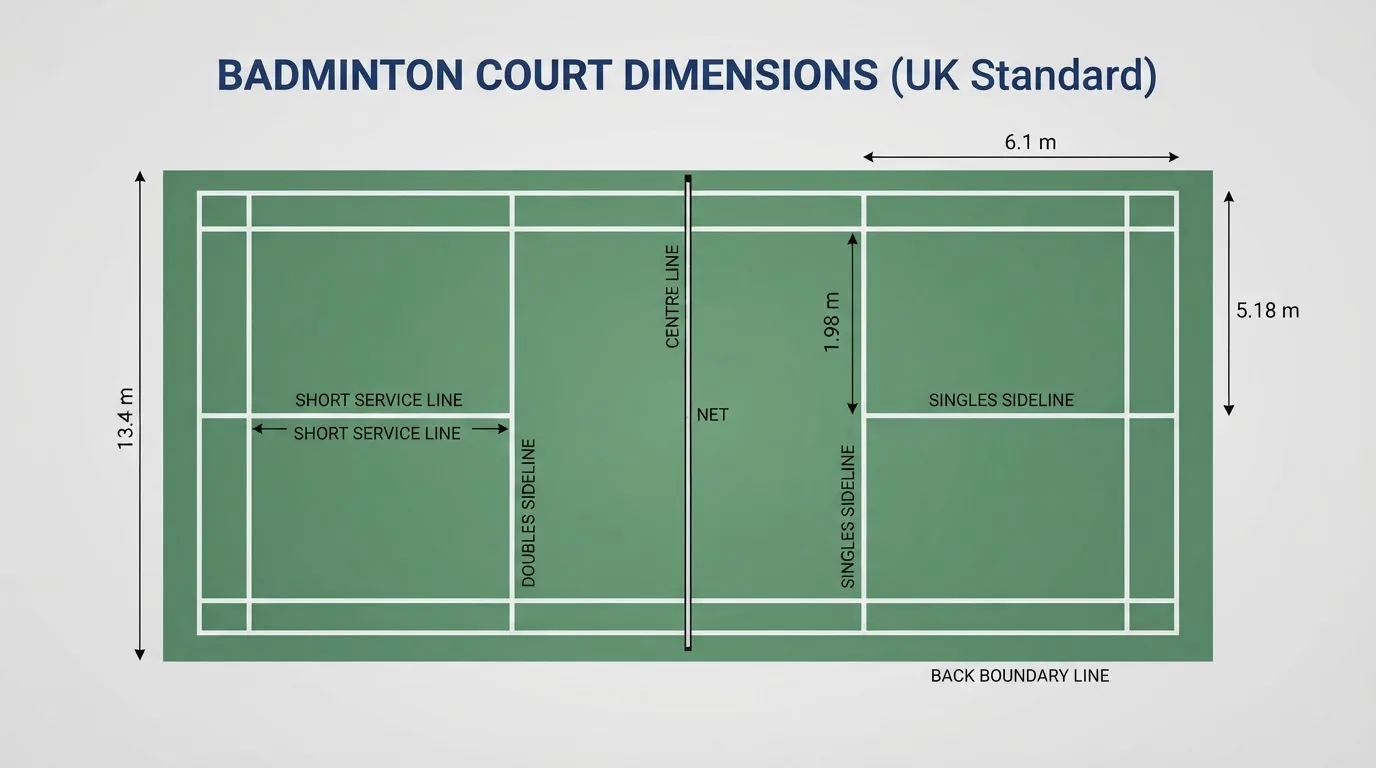
A court is 13.4 metres long, 6.1 metres wide for doubles and 5.18 metres wide for singles; the net is 1.55 metres high at the edges and 1.524 metres at the centre. The geometry of the court is part of why game handicap lines on badminton are sharp: a one-game lead in a best-of-three match is the most meaningful handicap a bookmaker can offer, and ±1.5 games is the standard line. Each game is played to 21 with rally point scoring; at 20–20 play continues until one side leads by two, and at 29–29 the next point wins.
The ten reviewed bookmakers, side by side
The comparison below covers the ten operators reviewed on this page: each holds a remote operating licence from the Gambling Commission for customers in Great Britain. The licence number is the entry on the Commission’s public register and the licence holder is the company named against it; several brands run under one licensee, but each brand here is presented as its own trading name. The fourth column carries what each operator’s own terms state on the relevant subject, since the legal terms are the only authoritative source for the fine print on any offer.
| Brand | Licence number | Licence holder | What the operator’s own terms state |
|---|---|---|---|
| Ladbrokes | 054743-R-330863-014 | LC International Limited | Sports betting app rated 4.66 from 101,255 GB App Store ratings |
| Bet Ahoy | 100094-R-341742-003 | Bet Ahoy Ltd | Welcome offer of a £5 sports bet and a £5 acca on a £10 qualifying bet |
| Fitzwilliam Sports | 048760-R-335434-009 | SBKI Limited | Dublin bookmaker with capped membership and a High Stakes Welcome subject to compliance criteria |
| London Bet | 066162-R-340278-004 | Thistle Bet Limited | Sports betting (football, tennis, horse racing, greyhounds, darts, golf, cricket, NFL, NBA, MLB, snooker) alongside Pragmatic Play casino slots and live in-play |
| Unibet | 045322-R-324275-019 | Platinum Gaming Limited | Operating since 1999; sports welcome of £40 in free bets on a £20 qualifying bet at minimum odds 2.0, expiring within 7 days |
| Smarkets | 039173-R-319366-011 | Smarkets (Malta) Limited | Open bank transfer deposits instant from £10 to £10,000; withdrawals processed within 6 hours up to £100,000 |
| Fafabet | 057385-R-333191-006 | Taichi Tech Limited | Best Odds Guaranteed on UK and Irish horse racing win and each-way bets from 9am on race days |
| bet365 | 055148-R-331498-002 | Hillside (UK Sports) ENC | Official global betting partner of the UEFA Champions League; Bet Builder+, Super Boosts, Winnings Boosts and daily Bet Boosts |
| Hollywoodbets | 053028-R-330019-013 | Hollywoodbets International UK Limited | Stake returned as a free bet up to £30 on a first qualifying losing accumulator (3+ legs, odds 4/1 or greater, settled within 7 days) |
| Kalooki Sportsbook | 057730-R-333396-005 | Kalooki Sportsbook Limited | GAMSTOP member; company number 12938274 |
The spread across this list is wider than the rows make obvious. Smarkets is a betting exchange licensed as a remote betting intermediary, which is a different category from the rest; its customers back and lay against each other, and the platform takes a commission on net winnings rather than a margin on each price. Fitzwilliam Sports is the smallest by membership and the only one that gates sign-ups behind compliance criteria, which makes it a different proposition from the rest of the list. Kalooki Sportsbook, Bet Ahoy and London Bet are smaller brands whose badminton offering tends to track the headline events only. Ladbrokes, bet365 and Unibet are the largest by customer base and the most likely to carry outright places, in-play markets and a fuller tournament winner list on a BWF Tour event.
How a betting market in badminton is actually built
A British punter looking at the BWF Tour and a British bookmaker’s offering is looking at a thin slice of a thin market. Badminton does not have the volume of football or horse racing, and a bookmaker’s pricing team covers it less aggressively than the headline sports. Two consequences follow for anyone who plans to bet on it.
The first is that the margin tends to sit higher than on Premier League football or major horse racing. A 5% margin on a badminton match winner is a competitive price; a 7% or 8% margin on the same event is what most GB operators run in practice, and on outright markets or smaller events the margin can climb above that. The punter pays this in expected return: a 7% margin on a market means the bookmaker keeps 7p of every £1 wagered on average, and the punter’s expected loss per bet is 7p per £1.
The second is that prices on less-followed events move slower than they do on the headline sports. A bookmaker’s odds compilers are not watching the BWF International Series with the same attention they give the Premier League, and the early prices on a match between two lower-ranked players can carry a stale ranking from days ago. The bettor who knows the form has a window between the publication of the price and the bookmaker’s next refresh, and that window is where the edge lives.
The deeper consequence is that badminton rewards specialisation. A punter who follows the tour, knows the players and watches the matches is in a different position from a punter who checks the page on the morning of a final. The information is public, but it is not always priced in. The same is true of any sport, but on badminton the gap between the price and the form is wider.
What the bookmaker’s margin looks like in a working number
Take a market priced at 1.90 against 1.90 — the kind of price a GB bookmaker might offer on a match with no obvious favourite. The implied probability of either outcome, ignoring margin, is 50% each. With margin, the implied probabilities sum to more than 100% and the excess is the overround. At 1.90 against 1.90 the overround is 5.3%, which means the bookmaker expects to keep 5.3p of every £1 wagered on the market and to pay out 94.7p.
In a band, expect the margin on a standard badminton match winner at a GB-licensed operator to sit between 5% and 8% on a headline event, between 7% and 10% on a smaller event, and above 10% on outright markets where the field is large and prices are thin. A margin above 10% on a two-way match is the signal to look at a different bookmaker, because the same selection is usually priced elsewhere with a tighter spread.
The cost of the margin is the cost of every bet. A punter placing ten £10 singles on badminton match winners at an average margin of 7% expects to lose £7 of stake over those ten bets on average — paid for with the pleasure of the bet, the chance of a winning streak, and whatever the margin happens to be on the day.
Legality, the licence and what the Gambling Commission actually checks
Every operator reviewed on this page is on the Gambling Commission’s public register as the holder of a remote operating licence for Great Britain. The register is the whole test of who holds a licence, and the Commission’s regulatory role under the Gambling Act 2005 is the framework every reviewed brand runs within.
A remote operating licence is required wherever an operator is based if its remote gambling facilities are used in Great Britain. Since the Gambling (Licensing and Advertising) Act 2014, an operator based in Malta, Gibraltar, the Isle of Man or anywhere else cannot serve GB customers without a Commission licence. The licence categories on the register include remote general betting standard (real events), remote general betting standard (virtual events), remote general betting limited, remote pool betting and remote betting intermediary. A betting exchange like Smarkets is licensed as a remote betting intermediary; the rest of the reviewed list carries remote general betting standard (real events).
The Commission’s enforcement is targeted at operators, not customers. Providing gambling facilities in Great Britain without the licence the Act requires is an offence under section 33 of the Gambling Act 2005; no offence aimed at a customer who bets with an unlicensed site has been identified. The practical consequence for a customer is the loss of consumer protections: no GAMSTOP coverage, no Commission complaints route, no approved dispute-resolution body, and no British redress if funds are withheld. A GB-licensed bookmaker, by contrast, must run financial vulnerability checks, must offer GAMSTOP self-exclusion, must verify identity before the first deposit and must cap bonus wagering at 10x under the promotion rules in force since 19 January 2026.
Identity verification before a first deposit has been the rule since 7 May 2019. A customer cannot place a bet, claim a free bet or use a bonus without the operator having verified name, address and date of birth. Credit cards have been banned for gambling in Great Britain since 14 April 2020, including credit-card-funded payments through an e-wallet. The minimum age is 18.
Tax falls on the operator, not the customer. General Betting Duty is 15% on the operator’s gross profits from general betting; from 1 April 2027 a new remote betting rate of 25% applies within it, while remote bets on UK horse racing, self-service betting terminal bets, pool betting and in-person betting stay at 15%. A customer in Great Britain pays no tax on betting winnings, with the caveat that a professional gambler should ask HMRC or an adviser; this is general information rather than tax advice.
The single most useful thing a bettor can do before placing a first bet with a brand is search the Commission’s public register for the brand’s trading name, the licence holder’s company name, the account number or the domain. The licence number alone, quoted in this page for each reviewed operator, is enough to open the right entry. The register also shows the licence categories the operator is permitted to operate under, which is the only place to confirm that a brand licensed for casino is or is not also licensed for sports betting.
Responsible gambling and the controls a licensed bookmaker must offer
The protection layer at a GB-licensed bookmaker is the same across the ten brands reviewed here, because most of it is set by the Commission’s LCCP and the rest by the platform’s own safer-gambling code. Five of them are worth knowing by name.
GAMSTOP is the national multi-operator online self-exclusion scheme, mandatory for online operators since 31 March 2020. A customer registers once with GAMSTOP and is excluded from every GB-licensed online operator for a chosen period of six months, one year, five years, or five years with auto-renewal. After the minimum period the exclusion stays in place for a further seven years unless the customer asks GAMSTOP to remove it. GAMSTOP covers online sites and apps only; betting shops run a separate self-exclusion scheme.
Deposit limits are the customer’s lever on their own spend. Operators must run a gross deposit limit on a fixed time frame; the first changes under RTS 12 applied from 31 October 2025 and a second phase was postponed to 30 September 2026, and whether it is live is not established. There is no state-set deposit or loss ceiling for betting, and the limits a customer sets are the customer’s choice.
Financial vulnerability checks are a public-record check applied to licensed remote betting when a customer’s deposits minus withdrawals exceed £150 in a rolling 30 days, in force since 28 February 2025. The check looks for bankruptcy or county court judgments, not income. A financial risk assessment, the broader affordability check the press has discussed, was announced on a staged plan with no start date as of the Commission’s article of that date.
Reality checks, time-outs and product restrictions sit alongside the mandatory protections. A time-out is a short break — 24 hours, a week, a month — during which the customer cannot deposit or bet. Reality checks are pop-ups during play that show the customer how long they have been on the site and what they have won or lost. Fitzwilliam Sports, one of the reviewed operators, publishes on its homepage that it offers instant deposits, fast withdrawals, timeouts, deposit limits and links to GambleAware, GamStop and Gamblers Anonymous.
The help lines are not operated by the bookmakers. GamCare runs the National Gambling Helpline; GambleAware funds treatment and research; the NHS runs regional gambling clinics; Gamblers Anonymous runs peer-support meetings. The bettor who feels their gambling is drifting out of control should reach for one of these before another deposit.
Bonuses, free bets and what the headline price actually costs
The welcome offers on this page are described only from each operator’s own terms. None of the figures on this page is a working code or a live offer; the details of any offer the operator is running today should be checked against the operator’s own promotions page before any commitment is made.
Unibet’s sports welcome offer is a £40 free-bet package on a £20 qualifying sports bet at minimum odds of 2.0, with the free bets expiring within 7 days of issue, for new GB customers funding the deposit with a debit card or instant bank transfer. Bet Ahoy’s welcome is a £5 sports bet and a £5 acca on a £10 qualifying bet. Hollywoodbets’ welcome returns the stake as a free bet up to £30 on the first qualifying losing accumulator, with a £10 minimum stake, three or more legs, odds of 4/1 or greater, settled within 7 days, one free bet per customer.
The shape of an offer tells the receiver more than the headline number. A free bet whose stake is not returned with a win is the standard shape at GB-licensed operators; the value of a £10 free bet at odds of 3.00, where the stake is forfeit, is £10 × (3.00 − 1) ÷ 3.00 = £6.67 in expected return, not £20. That gap between the headline price and the expected value is the free-bet tax. A “risk-free” bet refunded as a free bet after a loss is the same shape in reverse: the customer does not get the stake back, they get a free bet whose expected value is below the original stake.
Promotion rules in force since 19 January 2026 cap wagering requirements on bonuses at 10x, meaning a £10 bonus requires £100 of qualifying bets before the bonus is withdrawable. Mixed-product promotions — an offer that requires gambling on two or more product types — are banned under the same rules. Whether the 10x cap applies to free bets with no wagering condition is not established.
The practical order for a punter looking at a welcome offer is this. Read the qualifying bet — minimum stake, minimum odds, qualifying markets, qualifying payment method. Read the free bet — expiry, minimum odds for use, market restrictions, whether the stake is returned. Read the withdrawal rules — what is withdrawable and when. The margin on the qualifying market is the cost the punter pays to unlock the free bet, and the free bet’s expected value is the return; the gap is the offer.
A worked view of two readers’ bookmakers
Two of the ten are worth setting beside each other because they sit at opposite ends of the spectrum the page has been describing. Smarkets is a betting exchange; Ladbrokes is a traditional high-street bookmaker. The two products look similar on the surface — both offer badminton match winner, both offer in-play, both hold a GB remote licence — but the pricing underneath is built differently.
Smarkets is licensed as a remote betting intermediary; the platform matches back-and-lay bets between customers and charges a commission on net winnings rather than building a margin into each price. The headline price a customer sees is closer to the true probability than the equivalent price at a traditional bookmaker, and the difference is the commission. UK bank transfer deposits at Smarkets are instant from £10 to £10,000 and withdrawals are processed within 6 hours up to £100,000, which is the fastest payout ceiling in the reviewed set.
Ladbrokes runs as a traditional bookmaker. The price includes a margin on each market, and the customer pays for the marketing, the app and the brand recognition through that margin. Ladbrokes’ GB App Store rating is 4.66 from 101,255 ratings, which is the largest review base in the reviewed set. The cost is the margin; the gain is the product surface — bet365-style bet builders, acca insurance, Super Boosts — that a smaller operator cannot afford to build.
For a punter placing a £10 single on a badminton match winner at decimal odds of 2.00, the expected return is £20 if the bet wins (stake £10 plus profit £10) and zero if it loses. The expected value depends on the bettor’s view of the true probability of the selection, which is independent of the bookmaker’s margin. A punter who believes the true probability is 55% and the bookmaker’s price implies 50% has a bet with a positive expected value; a punter who believes the true probability is 50% has a bet with a negative expected value equal to the bookmaker’s margin.
Frequently asked questions on badminton betting odds
How does a bettor place a bet on badminton?
A bettor registers with a GB-licensed bookmaker, completes the identity verification that the operator runs before a first deposit, funds the account by debit card or instant bank transfer (credit cards are banned for gambling in Great Britain), and selects a badminton match from the operator’s sportsbook. The minimum age is 18.
How can a bettor confirm that a bookmaker holds a Gambling Commission licence?
The Commission’s public register can be searched by business name, trading name, domain or account number. The licence number on this page for each reviewed operator opens the right entry, which also shows the licence categories the operator is permitted to operate under.
How is the return on a bet worked out from the stake and the odds?
For decimal odds, return = stake × odds. For decimal odds of 2.00 on a £10 stake, the return is £20, made up of the £10 stake plus £10 profit. For a combination bet the odds of the legs multiply into one price.
What is the bookmaker’s margin and how does it show in the odds?
The margin is the proportion of every unit wagered on a market the bookmaker expects to keep. It shows as the gap between the implied probabilities of the outcomes and 100%. A two-way match at 1.90 and 1.90 implies 52.6% on each side, summing to 105.3%, and the excess of 5.3% is the margin.
How do fractional odds like 5/1 convert to decimal odds like 6.00?
The conversion is a/b → a ÷ b + 1. For 5/1, 5 ÷ 1 + 1 = 6.00. For 11/4, 11 ÷ 4 + 1 = 3.75. British bookmakers publish odds in fractional form by convention; decimal odds are the working figure for the arithmetic above.
Tennis, darts & cue sports – Best Betting Tips
Content created by the «Best Betting Tips» team
