
Reading American football odds: markets, margin and what every price is hiding
 Available in US
The scoreboard reads 24-17, the spread on the screen sits at -3.5 and the price next to it is 1.91. None of those numbers is the headline. The headline is the third digit the screen does not show you: the slice of every pound staked that stays with the bookmaker whatever the result. That slice is the margin, and it is built into every American football price a UK-licensed bookmaker posts, from the first pre-season match-up to the Super Bowl market that closes the season. The article below is about what an American football price contains, what it costs, which markets the licensed UK bookmakers offer, and where the offer’s fine print changes the picture. Every figure, date and licence cited comes from the operators’ own terms or from the Gambling Commission’s public register, current as of 27 October 2026 and checked against that register.

Where the season sits and what the game is built from
The fixtures that run a year of NFL football
The NFL runs 32 franchises split between two conferences, the AFC and the NFC, each carrying 16 teams. Every team plays 17 games across an 18-week regular season, and 14 sides — seven from each conference — reach the single-elimination playoffs. The season is the unit. Asking “what NFL games are on this weekend” is asking where in that 18 weeks a reader sits. The postseason runs through January, the conference championships settle the Super Bowl match-up in early February, and the Super Bowl itself is the cap on the calendar.
The most recent Super Bowl, Super Bowl LX, was played on 8 February 2026 at Levi’s Stadium in Santa Clara, California, with the Seattle Seahawks beating the New England Patriots 29-13 and Kenneth Walker III taking the MVP award. The next edition, Super Bowl LXI, is the marker on the calendar that every futures book turns toward from the moment the previous one ends, and from late spring onward the bookmakers begin pricing division winners, conference champions and outright winner markets for it. UK bookmakers carry all of it: pre-season exhibition games, the regular-season 17-week schedule, the playoffs, the Pro Bowl and the Super Bowl, plus a packed calendar of college football through the autumn and the early bowls in late December and January.
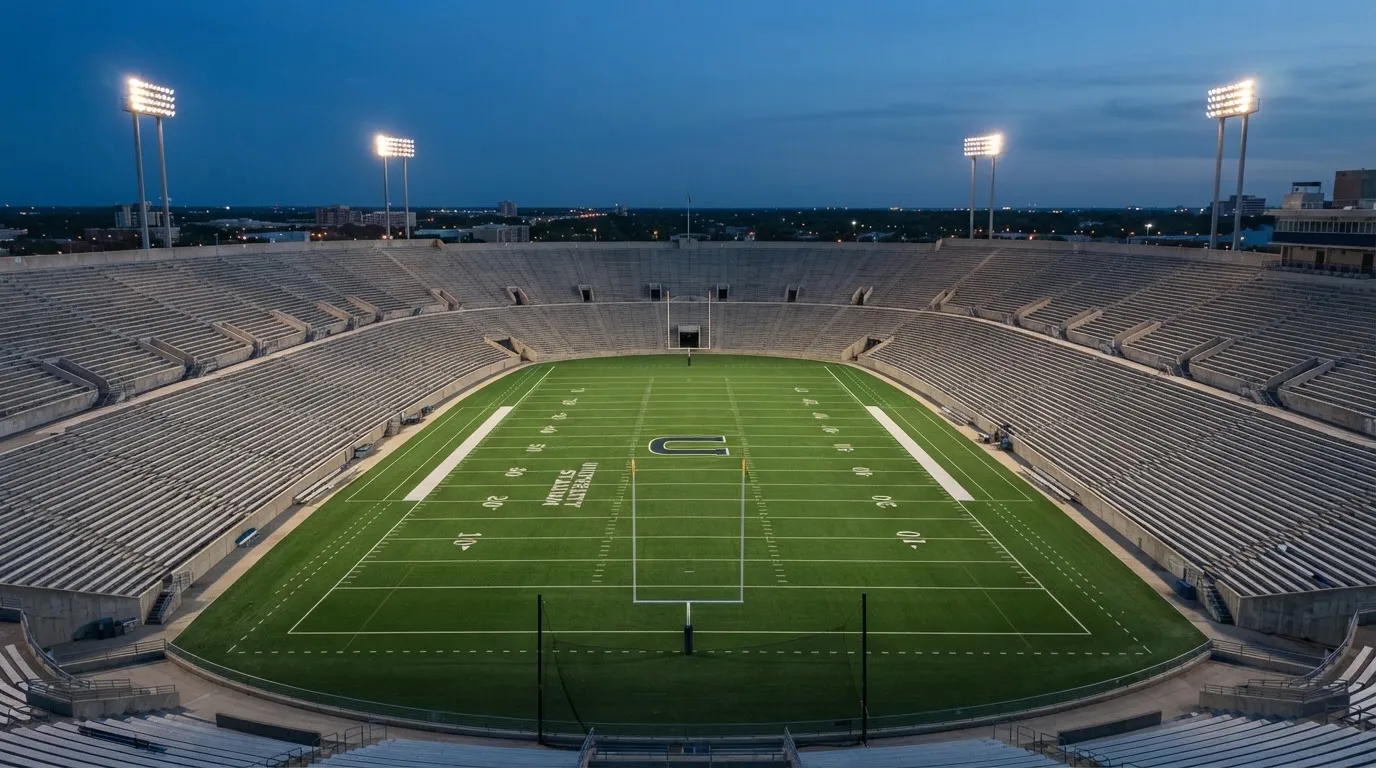
The college game is its own ecosystem. The College Football Playoff (CFP) replaced the Bowl Championship Series in the 2014 season, and the expanded 12-team format that began with the 2024-25 season is now the settled shape of the postseason, with the four-team field of the earlier era a thing of the past. The regular season runs from late August through early December, conference championship games settle the 12 CFP places, and the four first-round games are played in mid-December on campus sites. The two semi-finals rotate through the major bowls — the Rose, Sugar, Cotton, Orange, Fiesta, Peach and Fiesta again in the rotation — and the national championship game has been booked into neutral-site stadiums each January. UK punters who follow the college game bet it the same way they bet the NFL: spreads, totals, moneylines, futures, and player props on the quarterbacks who carry the bigger programmes.
The Canadian Football League (CFL) is the third professional league that UK books carry at full depth. It runs a longer field, 110 yards, with 12 players a side and a 20-second play clock that produces noticeably higher scores than the NFL. The Grey Cup, the CFL’s championship, takes place in late November. Bookmakers handle CFL markets under the same rules as NFL markets, with one wrinkle worth noting: CFL overtime rules produce ties in the regular season, so a moneyline bet on a regular-season CFL game can settle as a push if neither side scores in overtime. That is one of the few places where a tie is a real outcome in North American gridiron, and the terms page of the bookmaker states whether the line accepts that as a winning selection or refunds the stake.
The points on the board and what they cost on the betting slip
American football is played with 11 players a side on the field, and a regulation game is 60 minutes long, broken into four 15-minute quarters. The two-minute warning at the end of each half is a clock stoppage that has no rule book analogue in rugby or association football, and it sits behind the structure of in-play markets the same way stoppage time sits behind the in-play markets of association football: a window where scoring is disproportionately likely, and where the price moves to reflect that. Knowing the two-minute warning is half of knowing why an in-play price snaps when it does.

The points that go on the board, and the price the betting slip attaches to them, run in a small fixed set: a touchdown is six points, the extra-point kick that follows is one, the two-point conversion the offence can run or pass for instead is two, a field goal is three, and a safety — the rare play where the defence tackles an opponent in its own end zone — is two points awarded to the defence. A scoring summary is therefore an arithmetic exercise: a 24-17 final is two touchdowns plus a field goal and an extra point for the home side, and three field goals plus a late safety for the away side, or some other combination that adds to the same total. Bookmakers price the totals market on that arithmetic, and punters who read a scoreboard with this in mind read a totals market with the same clarity.
That structure has a side effect. Because scoring comes in chunks of 2, 3, 6, 7 and 8, the most common total lines sit on whole numbers, and a line of 47.5 produces far more pushes — bets made void on the exact number — than a line of 46.5 would on a sport that scores more freely. UK bookmakers handle that with half-point increments in the spread and totals markets, so the line on the screen ends in .5 and the tie is structurally absent; the settlement page on the operator’s site states whether half-point increments are used across all American football markets or only some. Where the line is on a whole number, the operator’s terms state whether the bet settles as a push on the exact number or is paid on the side that the event itself reached: the standard answer in UK rules is push, with a selection on the tie offered when the market allows it.
The licence frame and the line between legal and illegal
What a Gambling Commission licence does and does not cover
Every UK-licensed bookmaker that takes a bet online from a customer in Great Britain holds an operating licence from the Gambling Commission, the non-departmental public body sponsored by the Department for Culture, Media and Sport that regulates commercial gambling in Great Britain under the Gambling Act 2005. Since the Gambling (Licensing and Advertising) Act 2014, an operator needs a Commission licence wherever it is based if its remote facilities are used by customers in Great Britain. A Curaçao, Maltese or Gibraltar licence is not a substitute for serving customers in Great Britain, and the absence of a Commission entry on the public register is the only test that matters.
The Commission issues a small set of remote licence types, and they are not interchangeable. A remote general betting standard (real events) licence covers the markets most readers think of first: pre-match and in-play sports, including American football. A separate remote general betting standard (virtual events) licence covers computer-simulated events that use an RNG. Remote pool betting covers pool products, including off-course horse racing pools. Remote betting intermediary is the licence for betting exchanges, where customers back and lay against each other rather than against the bookmaker. Several brands can run under one licensee, and where that is the case on the public register — Paddy Power and Betfair under PPB Counterparty Services Limited, for example — the register’s account number is the only point of truth and the two brands are not two independent operators. The Commission’s public register, searchable by business name, trading name, account number or domain, is the place to verify a licence, and the access date of any check belongs in the reader’s notes because the register is a live document and entries can change.
A bookmaker holding a financial spread betting licence is regulated by the Financial Conduct Authority, not the Commission, and a brand may hold a Commission licence for fixed-odds betting and a separate FCA authorisation for financial spread betting. Spread betting losses can exceed the deposit on the financial side, and that is a different order of risk from a fixed-odds bet where the loss is capped at the stake. UK readers who see spread bets on American football at a firm that also runs a fixed-odds sportsbook are looking at two different regulatory regimes on the same screen.
Identity, age and the deposit limit before the first bet
Minimum age for any gambling product with a Commission licence is 18, and verification of name, address and date of birth has to happen before a customer can deposit or gamble, including with a free bet or a bonus. The verification rule took effect across remote operators in May 2019 and is the reason anonymous play at a licensed site is structurally impossible: the deposit button is gated by an identity check that holds for the life of the account, and a free-bet offer does not unlock the slip without the same check. Source-of-funds questions at higher spending levels are a normal part of the money-laundering regime and are not discretionary; the operator is bound to ask.
The Commission has rolled out a layer of financial protections on top of that identity frame. A financial vulnerability check applies to licensed remote betting when a customer’s deposits minus withdrawals exceed £150 in a rolling 30 days; it is a public-record check rather than an income check, and a credit-reference check is something different and is not what the vulnerability check is. A financial risk assessment — the affordability check that has been in the press — is a separate step that the Commission has announced in a staged plan, with no start date yet. Deposit limits on a fixed time frame have applied to remote operators since 31 October 2025, with a second phase that has been postponed to 30 September 2026; readers should expect to see a gross deposit limit on the account dashboard and should know that limits are a customer choice as well as an operator duty, and a self-imposed monthly ceiling is the cleanest way to keep a bankroll honest. None of this is a state-set ceiling on stakes or losses; operators set their own maximum stakes and may restrict individual customers, and the absence of a state ceiling is the rule, not the gap.
What an unlicensed book costs the bettor
There is no British offence for a customer who bets on an unlicensed site, and writing that an offshore book is “illegal to use” is wrong. What is lost by going to an unlicensed brand is the protection the Commission frame gives: no GAMSTOP coverage (the self-exclusion scheme that GB-licensed online operators belong to as a condition of their licence), no complaints route to the Commission, no approved dispute-resolution service, no British consumer redress if funds are withheld, and the 10x cap on bonus wagering and the £150 financial vulnerability check do not apply. Credit cards are banned for gambling at GB-licensed operators, including credit-card-funded payments through an e-wallet, and that ban does not extend to an offshore brand. The Commission’s enforcement tools are cease-and-desist notices, search-engine referrals, work with payment providers and court-order DNS blocking powers that have been granted or are about to be granted, and the practical picture is that an unlicensed brand is harder to reach for a British customer than it was a few years ago, not that it is impossible to reach. The framing that holds is the protective one: licensed equals checks, limits, GAMSTOP and the bonus cap; unlicensed equals none of that and possible loss of funds.
Where the price comes from: markets, margin and how the bookmaker earns
The two-way line and what the margin hides in it
A two-way market is the simplest construction a bookmaker runs. Two selections, two prices, the stake sits on one side, the price on the other side is what the stake pays if that side wins. The NFL moneyline on a Super Bowl favourite is the cleanest example: New England to win at 1.55, Seattle to win at 2.55, one stake, one price, no complications. The complication is what the pair of prices leaves on the table.
Take an illustrative pair: New England at 1.90, Seattle at 1.90 (9/10 in fractional form, just below even money in American terms). The implied probability of each side, read off the price, is 1 ÷ 1.90 = 0.5263, or 52.63%. Add the two implied probabilities and the sum is 1.0526, or 105.26%. The real probability, since the game only has two outcomes, is 100%. The 5.26% gap between the two is the bookmaker’s margin — the share of every pound staked that the bookmaker keeps on average, whatever the result. Stated the other way, the payout share of the market is 1 ÷ 1.0526 = 95.0% of every pound staked, so the bookmaker keeps 5.0% and returns 95.0% across a long run of bets at these prices. The number on the screen is the price; the number behind it is the margin, and every market a bookmaker posts carries a margin, with American football typically a touch higher than soccer or tennis and noticeably lower than basketball or baseball, where the number of outcomes and the vig on each is structurally larger.
The calculation generalises to any market. A three-way market — home, draw, away on a soccer match — has three prices whose implied probabilities add to more than 100%, with the gap being the margin on that market. A spread market is a two-way market with a handicap applied, and the margin is the gap on the pair of prices after the handicap is set. A totals market — over/under a line — is the same structure on the two sides of the total. The principle holds everywhere: the implied probabilities of the selections add to a number above 100%, and the gap is the slice the bookmaker keeps.
That margin is the single most important number a reader of odds can hold in mind. A bookmaker quoting 1.90 / 1.90 on a two-way market is keeping 5% of stakes on average; a bookmaker quoting 1.85 / 1.95 is keeping roughly 5.4%; a bookmaker quoting 1.80 / 2.00 is keeping roughly 5.6%. The bookmaker posting 1.91 / 1.91 has shaved the margin closer to the 4.7% mark and is, on that market, a sharper book than the one posting 1.85 / 1.95. The choice between the two over a long run is a difference in expected return, and at scale the difference is the difference between losing slowly and losing quickly. The price is the front of the bookmaker’s offer; the margin is the back, and a reader who looks only at the front is reading half a sentence.
Margin on the American football markets that UK bookmakers price
The price the screen shows varies by market, and the reason is that bookmakers set the margin to the market’s structural characteristics. A two-way NFL moneyline on a single game typically carries a margin in the 4.5% to 5.5% range at UK-licensed books, with the strongest prices (lowest margin) on the most heavily bet match-ups — primetime Thursday Night Football, Sunday Night Football, the playoffs and the Super Bowl. Spread markets tend to carry a similar margin to the moneyline on the same game, with the spread priced to attract roughly balanced action on each side. Totals markets — over/under on a line — carry a slightly higher margin than moneylines at most UK books, often in the 5% to 6% range, because the public bets totals heavily on a few round numbers and the bookmaker widens the margin to compensate. Player prop markets — passing yards, rushing yards, anytime touchdown scorer — carry a wider margin still, often 6% to 8%, because the markets are more specialised and the bookmaker’s modelling edge is larger. Futures markets — Super Bowl outright, conference champion, division winner, season win totals — carry the widest margins of the standard menu, often 8% to 12% on the outright, because the book holds the position for months and prices in a vig that compensates for the long exposure. A reader who only bets the moneyline and totals on a single game is paying a margin in the 4.5% to 6% range; a reader who builds accumulators across several games is paying a margin on every leg and the accumulator’s total margin is the sum of the legs, with the variance compounding the same way.
How a winning price pays back
The arithmetic of a winning bet is the second thing the screen does not show. A stake of £10 at decimal odds of 2.50 returns £25 — that is the stake plus the winnings — and the winnings alone are £15. The general form: return = stake × odds, and net profit = stake × (odds − 1). At fractional odds of 5/2, the decimal form is 3.50, the return on a £10 stake is £35, and the profit is £25. At American odds of -150 (the standard favourite notation), the decimal form is 1.67, the return on a £10 stake is £16.67, and the profit is £6.67. UK bookmakers display prices in fractional form by default and in decimal form on request, and a £/1 fractional price is a 2.00 decimal price, also called “evens” because a winning £1 stake returns £2 — the stake plus £1 profit.
A combination bet — an accumulator, a Yankee, a Lucky 15, a Heinz, a Goliath — multiplies the odds of the legs into a single price. A four-fold accumulator with legs at 1.80, 2.10, 1.95 and 1.70 has a combined price of 1.80 × 2.10 × 1.95 × 1.70 = 12.52, so a £10 stake returns £125.20 if all four legs win, with profit of £115.20. The catch is that every leg carries its own margin, and the accumulator’s total margin is the combined vig of the four legs, which is wider than the margin of any single leg. An accumulator is the most expensive way to bet, on a margin basis, that the UK market offers, and a reader who treats accumulators as a long-term investment is paying a premium for the privilege.
What an offer is worth and what it costs to clear
The shape of the welcome offers on NFL betting
The welcome offers on the licensed UK bookmakers that carry American football at full depth come in a small set of shapes, and the shape determines what the offer is worth. The £40-in-free-bets-for-a-£20-qualifying-bet form — Unibet’s headline — is the standard: deposit and bet £20 at minimum odds of 2.0 (1/1), receive £40 in free bets, with the free bets expiring within 7 days. The stake is not returned on a free-bet win, so a winning £10 free bet at odds of 3.00 returns £30 — £20 of profit and the £10 stake kept by the bookmaker. The free bet is, in effect, a discount on the stake the customer would have placed with their own money, and the value of that discount is the free bet amount times the odds minus 1, divided by the odds, multiplied by the payout share of the market the free bet is placed on. On a market with a 95% payout share, a £10 free bet at odds of 3.00 is worth £10 × (3.00 − 1) ÷ 3.00 × 0.95 = £6.33 on average across the long run, with the variance on any single bet being whatever the bet actually wins.
The 50%-back-as-a-free-bet form — BetTom’s headline — is a different shape: a 50% return as a free bet up to £50 on the sports side, matched by a 50% return as free slot funds up to £50 on the casino side. The sports free bet is the same instrument as Unibet’s: stake not returned on a win, expiry on the free-bet credit. The casino free slot funds are a different product, settled under the casino licence and the casino wagering requirements, and the two sides of the package are settled independently. A reader who takes the BetTom offer is taking both halves and clearing them on their respective terms; the value of the package is the sum of the two sides, with the casino side requiring its own play-through.
The £10-free-bet-if-the-first-bet-loses form — Vbet’s headline — is a refund as a free bet, and it is the most misread shape in the welcome market. A losing first bet of £10 or more on a verified account returns a £10 free bet; the free bet is paid only on a loss, and the free bet is paid in the same instrument that the welcome that follows uses. The value to the bettor is the protection against a single losing first bet, not a free ride. The free bet, once issued, follows the same rules as any other free bet: stake not returned on a win, expiry on a fixed clock, and the market the free bet is placed on is the customer’s choice within the bookmaker’s allowed markets.
The Betfair Sportsbook welcome sits in a different shape again: a free bet on the first settled bet, with the offer’s size and conditions stated on the Betfair sports betting page. Betfair is a betting exchange that also runs a fixed-odds sportsbook, and the two products have separate terms; the welcome on the sportsbook is the offer the customer claims, and the exchange’s commission structure is a separate question settled under the betting intermediary licence.
The 90-Minute-Payout market on Betfair Sportsbook is a feature, not a welcome offer, and it is the kind of feature that says more about the bookmaker’s market design than its welcome. The market refunds the stake on a football match that ends 0-0 at the 90-minute mark, and the rules on which leagues the payout applies to are stated on the Betfair site. The point of mentioning it here is that a “refund” market is a different shape from a free-bet welcome: the refund is on a specific result, not on a customer’s first bet, and the market’s terms state the scope.
What the wagering requirement really costs
A wagering requirement is the play-through a bonus or free bet has to be cleared at before any winnings become withdrawable. The Commission’s promotion rules in force since 19 January 2026 cap wagering requirements on bonuses at 10x: a £10 bonus at 50x needed £500 of qualifying bets before the cap; under the cap, no more than £100 of qualifying bets is needed. The cap applies to bonuses, and whether it applies to free bets with no wagering condition is not settled. What the cap does not change is the cost of the play-through itself.
The cost of clearing a bonus is the turnover required, multiplied by the margin of the market the bonus is being cleared on. A £10 bonus with a 5x wagering requirement, cleared entirely on a market with a 5% margin, costs the bettor £50 of turnover × 0.05 margin = £2.50 on average across the long run. A £10 bonus with a 10x wagering requirement, cleared on a market with a 6% margin, costs £100 × 0.06 = £6.00. The bonus’s headline value is the bonus amount; the bonus’s real cost is the expected loss on the wagering, and the difference between the two is the bonus’s value to the bettor. A reader who clears a 10x bonus on a 5% margin market at the minimum stake is paying 50% of the bonus in expected loss and keeping the other 50% as actual value, on average; a reader who clears it on a 7% margin market at a higher stake is paying 70% and keeping 30%. The marketing language treats the bonus as a gift; the arithmetic treats it as a discount with conditions, and the size of the discount is what the margin of the clearing market leaves.
A mixed-product promotion — an offer that requires gambling on two or more product types, such as “bet on football to get free spins” — is banned under the same set of promotion rules. The ban closes the route by which a sports welcome would have carried a casino play-through attached, and the two products are settled on their own terms.
Cash Out, Bet Builder and the in-play edge
Cash Out is the bookmaker’s offer to settle a bet before the event finishes, at a price the book sets in real time. The price on the Cash Out button is the bookmaker’s mid-market quote, with a margin built in, and a bettor who takes the Cash Out is taking a position on a price the bookmaker has set, not on the true probability of the outcome. The bettor’s expected value of taking the Cash Out is the price minus the bookmaker’s mid-market price, and on a market with a 5% margin the Cash Out price is roughly 2.5% below the true mid, so the bettor is paying about half the original market’s margin to exit early. A Cash Out at a price of 1.50 on a bet originally placed at 1.91 is a fair Cash Out at a 5% margin, in that the price is below the original but above the bet’s true value at the moment of Cash Out. The book’s own help page on Cash Out states which markets are eligible and how the price is calculated, and a reader who uses Cash Out regularly is paying a steady premium for the convenience.
Bet Builder is a same-game multi — a combination bet whose legs are all from the same event, typically a single NFL game. The book prices each leg and multiplies the legs into a single price, with the same compounding of margin that an accumulator carries. A Bet Builder on an NFL game with four legs at 1.70, 1.80, 1.90 and 2.00 carries a combined price of 1.70 × 1.80 × 1.90 × 2.00 = 11.63, and the margin on the combined bet is the combined vig of the four legs. bet365’s Bet Builder+ takes the same construction and adds the option to combine markets from one event into a single bet, available both pre-match and in-play. Unibet’s acca builder, Midnite’s acca builder and the bet builder features on the rest of the licensed set follow the same shape. The structure of the offer is the same on every site; the prices are different, and the price difference is the read.
Best Odds Guaranteed and the small print on horse racing
Best Odds Guaranteed (BOG) is a horse-racing concession that has migrated into the wider sportsbook conversation. The bookmaker guarantees that if the starting price (SP) on a UK or Irish horse race is bigger than the price the bettor took when they placed the bet, the bettor is paid at the bigger price. Fafabet’s terms state that the BOG applies from 9am on the day of the race, on UK and Irish horse racing win and each-way bets; William Hill’s terms state that the BOG applies from 8am on the day of the race, on both single and multiple bets, and that it does not apply to ante-post, tote or pari-mutuel bets. The two bookmakers pay the bigger price on the same race, the BOG clock is the difference, and the ante-post exclusion is a feature of the concession on every site that runs it.
BOG does not apply to American football. The markets that carry a BOG concession are the UK and Irish horse racing markets, with the operator’s terms defining the cutoff time and the bet types covered. A reader who sees a BOG advertised on a sportsbook home page is seeing a horse-racing concession, not a football concession, and a markets page that lists American football alongside horse racing is showing two products with two different sets of terms.
Responsible gambling and where the help sits
The frame a licensed operator is bound to
GAMSTOP is the national multi-operator online self-exclusion scheme, and a GB-licensed online operator is bound to take part in it as a condition of its licence. A customer who signs up to GAMSTOP excludes themselves from every GB-licensed online operator for a chosen period — six months, one year, five years, or five years with auto-renewal. After the minimum period, the exclusion stays in place for a further seven years unless the customer asks GAMSTOP to remove it. The scheme covers online sites and apps; betting shops use a separate service. GAMSTOP is the single most effective self-exclusion tool a British customer has, because it covers every licensed bookmaker at once, and the licensed bookmakers in this ranking all participate.
The deposit-limit regime on a fixed time frame, with the first phase applying since 31 October 2025 and a second phase postponed to 30 September 2026, is the operator-side counterpart to GAMSTOP. A customer can set their own gross deposit limit on a daily, weekly or monthly basis, and the operator is bound to honour the limit without exception. A self-imposed limit is the cleanest way to keep a bankroll honest, because it sits in the account’s own controls and the operator cannot override it.
The financial vulnerability check, in force since 28 February 2025, applies when a customer’s deposits minus withdrawals exceed £150 in a rolling 30 days. It is a public-record check — bankruptcy registers, county court judgments — not an income check and not a credit-reference check. The check exists because the Commission wants operators to know when a customer’s financial position has visibly deteriorated, and the trigger is set low so that operators catch the early signs. A reader who crosses the £150 threshold on a single account should expect a public-record check on the next deposit; the check is a one-off at the threshold and a continuing one if the public record changes. A financial risk assessment — the “affordability check” that has been in the press — is a separate step that the Commission has announced in a staged plan, with no start date yet.
The help lines a reader can call
GamCare runs the National Gambling Helpline, and the line is open 24 hours a day. The number is on GamCare’s own site, and the service is free and confidential. GambleAware funds treatment and education across Great Britain and is the Commission’s preferred partner on the public-health side. The NHS runs gambling clinics in several regions, with self-referral open to anyone who is concerned about their own gambling or someone else’s. Gamblers Anonymous runs local meetings across the country and an online presence, with the twelve-step model that the organisation has run since the 1950s. A licensed UK bookmaker’s safer-gambling page links to all of these services, and Fitzwilliam’s site is the kind of example that links the four together: GamCare, GambleAware, GamStop and Gamblers Anonymous, with the safer-gambling tools — instant deposits, fast withdrawals, timeouts and deposit limits — listed on the same page.
A bookmaker restricting a customer’s account is not a punishment; it is a licence condition. The LCCP requires operators to interact with customers in a way that minimises harm, and a customer whose deposit pattern has triggered the financial vulnerability check or whose betting pattern has triggered the operator’s own markers of harm should expect the operator to limit stakes, exclude from markets, or close the account. A reader who is at the stage of needing that intervention should reach GamCare first; the bookmaker’s restrictions are a backstop, not a treatment.
How in-play changes the picture on an NFL game
The structure of an in-play market
In-play markets are settled during the event, with the bookmaker updating prices in real time as the game state changes. A moneyline on the NFL that opens at 1.91 / 1.91 in the pre-match market will move sharply on a first-quarter touchdown, on a turnover, on a long drive that approaches the red zone, and on the two-minute warning at the end of each half. The bookmaker’s in-play engine prices each state as a fresh market, and the margin on the in-play market is typically a touch wider than the margin on the pre-match market, in the 5.5% to 6.5% range at most UK books, with the wider margin compensating the bookmaker for the cost of running the in-play model in real time.
In-play markets are offered by every GB-licensed bookmaker at scale, and the markets run from the basic — moneyline, spread, total — to the specialised — next drive result, next scoring play, current quarter total. Bet Builder products on the licensed set extend into in-play, with bet365’s Bet Builder+ the most fully featured: markets from one event can be combined into a single bet, available both pre-match and in-play, and the price updates with the in-play state. A reader who wants to bet the next score of an NFL game rather than the final result is looking at an in-play market, and the in-play product is the place to look.
The bookmaker’s in-play product is gated by a suspension: when a market is suspended, no new bets are taken, and the suspension covers the period when the next play is about to happen. The standard suspension window on an NFL game is from a few seconds before the snap to a few seconds after the play is settled, with the in-play engine resuming the market once the new state is in. A bettor who tries to place a bet during a suspension is held in the queue and either matched at the next available price or rejected if the queue clears without a match. The suspension is part of the in-play product, and a reader who does not understand the suspension does not understand the product.
Live streaming and the bet-tracking layer
Live streaming of NFL games is offered by several of the licensed UK bookmakers, with the broadcast subject to the rights that the operator has paid for. bet365’s app offers live streaming of events worldwide, alongside its in-play product, and a customer with a funded account or a settled bet in the previous 24 hours can typically watch the live feed. Betfair Sportsbook offers free live streaming of events including UK and Irish horse racing and football within the app, and the same pattern — funded account or settled bet — gates the feed. Live streaming is a value-add on top of the in-play product, and the quality of the feed is part of the in-play experience on the licensed set.
The bet-tracking layer is a separate feature. bet365’s Bet Track, Match Live and Live Golf Tracker follow bets in play with a graphical layer that shows the position of the ball, the state of the match and the live odds on the in-play markets. The tracking layer is a presentation feature, not a betting product, and a reader who uses the tracker is using the same in-play markets the bookmaker offers to every other customer, with the addition of a visual frame.
Reading an offer without the marketing language getting in the way
What a “free bet” really is
A “free bet” is a credit the bookmaker issues to a customer’s account, usable on a market of the customer’s choice within the operator’s terms. The stake is not returned on a winning free bet, so a £10 free bet at odds of 2.50 returns £25 on a win — £15 of profit and the £10 stake kept by the bookmaker. The credit has an expiry clock, typically seven days from issue, and the credit is forfeit if the clock runs out without a settled bet. The marketing language treats the free bet as a gift; the arithmetic treats it as a discount on the stake the customer would have placed with their own money, and the value of the discount is the free bet amount times the odds minus 1, divided by the odds, multiplied by the payout share of the market the free bet is placed on. A £10 free bet on a market with a 95% payout share is worth £6.33 at odds of 3.00, on average across the long run; the same free bet on a market with a 92% payout share is worth £6.13. The headline is the same; the value is not.
A refund offer, in marketing terms, is a chance to get the first stake back as a free bet if that bet loses. The offer protects the first stake, but it is not a guarantee of profit. The free bet, once issued, is subject to the same terms as any other free bet: the stake is not returned on a win, and it must be used within the expiry time. The label is a marketing hook, not a promise that no money can be lost.
A “boosted odds” offer, in the marketing language, is a price on a market the bookmaker has inflated above the market’s true price. A boosted odds of 10.0 on a horse that should be 5.0 is offering the customer twice the true price, and the value of the boost is the difference between the boosted price and the true price, multiplied by the probability of the outcome. Boosted odds are a real offer of value, on the legs where the bookmaker has overpriced the market; the bookmaker is the judge of which legs to boost, and the customer’s job is to read the price against the market.
An “accumulator insurance” offer refunds the stake as a free bet if one leg of a multi-leg accumulator loses, with the other legs required to win. The insurance is on a one-leg loss, not on a multi-leg loss, and the stake returned is the stake on the leg that lost, not the full stake on the accumulator. The insurance is a discount on the variance of an accumulator, and the value of the insurance is the probability of a one-leg loss times the value of the free bet. A four-fold accumulator with all legs at 1.80 has roughly a 30% chance of losing one leg and a 70% chance of either winning all four or losing more than one; the insurance covers the first scenario and the customer is paying the bookmaker’s margin on the rest.
A “100% bonus” is a deposit match, with the bonus amount capped at the deposit and the bonus subject to a wagering requirement. A £50 deposit matched at 100% produces a £50 bonus, with a wagering requirement of 5x or 10x on the bonus amount, and the play-through has to happen on markets the bookmaker allows at minimum stakes the bookmaker sets. The 10x cap on wagering requirements, in force since 19 January 2026, limits the play-through to £500 on a £50 bonus. The bonus is a discount on the first deposit, and the value of the discount is the bonus amount minus the expected cost of the play-through.
What the time limits really cost
The expiry clock on a free bet or bonus is the second cost that the marketing language does not surface. A free bet that expires in seven days is a discount the customer has seven days to use, and a customer who places no qualifying bet in that window loses the discount entirely. A bonus with a 30-day play-through window is a play-through the customer has 30 days to complete, and a customer who falls short forfeits the bonus and any winnings that have not been withdrawn. The clock is part of the offer, and a customer who reads the offer without reading the clock is reading the headline and missing the deadline.
The minimum odds on a qualifying bet are the third cost. A welcome offer that requires a £20 bet at minimum odds of 2.0 (1/1) is asking the customer to take a real price on a real market before the free bet is issued, and a customer who backs a heavy favourite at 1.10 to clear the minimum bet is paying the bookmaker’s margin on a market where the probability of winning is high but the value of the bet is small. The qualifying bet is the price of admission to the free bet, and the value of the free bet is reduced by the cost of the qualifying bet. A reader who has a strong opinion on a market at 2.0 or above is well placed to take the welcome; a reader who has to manufacture a qualifying bet on a market they have no view on is paying the qualifying bet’s margin for a free bet whose value is already marked down.
The ten licensed bookmakers, and where each one fits
Star Sports
Star Sports is a racing-focused bookmaker with a UK Gambling Commission remote licence (Commission account 9177) held by Star Racing Limited. The firm’s distinguishing feature is the trader desk: customers can speak to a trader directly on the phone to place bets or ask queries. For an American football bettor, the trader desk is a different service from the standard app-first model, suiting a customer who prefers to discuss a price rather than tap a button. The American football offering sits alongside the racing focus, with markets covering the standard UK set. For a customer who values human service, Star Sports is the standout choice on the licensed list.
Bar One Racing (BAR 1 Betting)
Bar One Racing operates under Commission account 56516, held by Bar-One Racing Limited, as an Irish independent bookmaker with shops across Ireland. The brand’s roots are in Irish racing, and its UK remote licence extends the offering to British customers. For an American football bettor, BAR 1 Betting sits in the racing-first cluster of the licensed set, and the American football markets are a smaller part of the menu than at the multi-sport books. A customer who follows Irish racing and wants a single account for both racing and the NFL finds BAR 1 Betting an efficient choice; those primarily interested in the NFL may find the multi-sport books deeper.
Fafabet
Fafabet holds a UK Gambling Commission remote licence under Commission account 57385, held by Taichi Tech Limited, covering remote general betting standard (real events). The brand’s distinguishing feature is Best Odds Guaranteed on UK and Irish horse racing, applied from 9am on race days to win and each-way bets, with the bigger of the original price and the starting price paid out on a win. The concession is a horse-racing product, not a football product, and the American football markets sit alongside. Fafabet is a multi-sport operator with a strong racing concession; the racing offer is a clear reason for a racing-focused customer to hold an account here.
BetTom
BetTom is licensed by the UK Gambling Commission (account 64959) via Bet Tom Limited. The brand’s welcome offer is 50% back as a free bet (up to £50) matched by 50% back as free slot funds (up to £50), settled independently. For an American football bettor, the sports portion is the relevant side, providing standard UK market depth. A customer seeking a smaller welcome with casino play-through will find BetTom a match; those wanting a larger sports-only bonus may prefer alternatives.
Fitzwilliam Sports
Fitzwilliam Sports describes itself as a Dublin bookmaker with capped membership, and the welcome is a “High Stakes Welcome” subject to compliance criteria. The UK Gambling Commission remote licence is under Commission account 48760, held by SBKI Limited, covering remote general betting standard (real events). The capped-membership structure is the brand’s distinguishing feature: a Fitzwilliam account is not open to every applicant, and the welcome is gated by the same compliance criteria that govern the rest of the customer journey. The firm’s site links to the safer-gambling services — GamCare, GambleAware, GamStop and Gamblers Anonymous — and lists the standard account tools (instant deposits, fast withdrawals, timeouts and deposit limits) on the safer-gambling page. Fitzwilliam Sports is a bookmaker for the customer who has been approved and wants a high-stakes welcome; the capped membership means it is a selective venue, not an open-access mass-market site.
Betfair Sportsbook
Betfair Sportsbook holds a UK Gambling Commission remote licence under Commission account 39439, held by PPB Counterparty Services Limited, covering remote general betting standard (real events). The Sportsbook is the fixed-odds product that sits alongside the Betfair Exchange, the betting exchange that runs under a separate betting intermediary licence. The Sportsbook’s distinguishing features in this comparison are the in-play product, the Bet Builder, the free live streaming of UK and Irish horse racing and football within the app, and the 90 Minute Payout market on selected football leagues. The 90 Minute Payout refunds the stake on a football match that ends 0-0 at the 90-minute mark, and the leagues the payout applies to are stated on the Betfair site. The Sportsbook is a multi-sport product with a deep in-play offering, and the exchange sits alongside for customers who want to lay bets as well as back them, providing a complete set of tools for a strategic approach.
Unibet
Unibet is licensed by the UK Gambling Commission (account 45322) via Platinum Gaming Limited, Gibraltar. The welcome offer provides £40 in free bets when wagering £20, with a 7-day expiry. The acca builder is the in-house Bet Builder, and American football markets run at full UK depth. For an American football bettor, Unibet offers a substantial welcome package, with the seven-day free bet expiry being the primary deadline to manage. The headline offer is large, and the qualifying terms are standard.
Swifty Sports
Swifty Sports is licensed by the UK Gambling Commission (account 58957) via Swifty Global (UK) Ltd. The brand offers Best Odds Guaranteed on racing, Cash Out on racing/football, daily price boosts, live streaming, and in-play betting, with a Bet Builder coming soon. For an American football bettor, Swifty Sports competes on the multi-sport product but lacks the active Bet Builder currently found elsewhere. Those needing a Bet Builder today may look elsewhere, while others can assess the platform as it evolves.
bet365
bet365 is licensed by the UK Gambling Commission (account 55148) via Hillside (UK Sports) ENC. It is the official global betting partner of the UEFA Champions League, and the app is widely popular in the UK. The American football product is deep, featuring Bet Builder+, in-play betting, live streaming, and a tracking layer (Bet Track, Match Live). For an American football bettor, bet365 provides the deepest product, the most in-play markets, and the most robust streaming coverage available. Price and product depth make it a primary benchmark.
VBet
VBet is licensed by the UK Gambling Commission (account 44662) via SCGO Limited. The welcome offer is a £10 free bet if a new, verified customer’s first bet of £10 or more loses. The American football offering meets standard UK depth. For an American football bettor, VBet serves as a competitor with a modest welcome offer, where the refund-on-loss mechanism provides protection rather than a guaranteed return.
The licence table
| Brand | Gambling Commission remote licence | What the operator’s own terms state |
|---|---|---|
| Star Sports | Commission account 9177, held by Star Racing Limited | Trader desk on 08000 521 321 and [email protected] for account opening, bet placement and customer queries. |
| Bar One Racing | Commission account 56516, held by Bar-One Racing Limited | Rebranded to BAR 1 Betting; Irish independent with shops across Ireland and racing sponsorships at Dundalk, Fairyhouse, Navan, The Curragh, Curraheen Park and Cork. |
| Fafabet | Commission account 57385, held by Taichi Tech Limited | Best Odds Guaranteed on UK and Irish horse racing win and each-way bets from 9am on race days, paying the bigger of the original price and the starting price. |
| BetTom | Commission account 64959, held by Bet Tom Limited | Sports welcome: 50% back as a free bet up to £50, matched by 50% back as free slot funds up to £50 for the casino, with full terms applying to each side. |
| Fitzwilliam Sports | Commission account 48760, held by SBKI Limited | Dublin bookmaker with capped membership; welcome is a “High Stakes Welcome” subject to compliance criteria. |
| Betfair Sportsbook | Commission account 39439, held by PPB Counterparty Services Limited | In-play betting, Bet Builder, free live streaming of UK and Irish horse racing and football in the app, and a 90 Minute Payout market. |
| Unibet | Commission account 45322, held by Platinum Gaming Limited, Gibraltar | Sports welcome: £40 in free bets on a £20 qualifying bet at minimum odds of 2.0 (1/1), free bets expiring within 7 days, for new GB customers using a debit card or instant bank transfer. |
| Swifty Sports | Commission account 58957, held by Swifty Global (UK) Ltd | Best Odds Guaranteed, Cash Out on horse racing and football, daily price boosts, live streaming, in-play betting; Bet Builder listed as coming soon. |
| bet365 | Commission account 55148, held by Hillside (UK Sports) ENC | Bet Builder+ combining one event’s markets into a single bet (pre-match and in-play), Super Boosts, Winnings Boosts on Bet Builders and selected singles, daily Bet Boosts, in-play betting and live streaming of events worldwide. |
| VBet | Commission account 44662, held by SCGO Limited | Sports welcome: £10 free bet if a new, verified customer stakes £10 or more on a first-ever bet that loses. |
How a reader can check a licence in two minutes
The Commission’s public register is at the Gambling Commission’s own site, and a search by business name, trading name, account number or domain returns the licence entry, the categories the licence covers, the licence holder’s name and the operating address. The two-minute check is: find the firm’s name on the operator’s site, search the register for the same name, confirm the licence status is “Licensed”, confirm the categories include remote general betting standard (real events), and note the access date. The access date matters because the register is a live document and entries can change. Where a brand and its licensee are different — Unibet and Platinum Gaming Limited, for example, or Betfair and PPB Counterparty Services Limited — the search should be on the licensee rather than the trading name, and the register’s account number is the only point of truth. A reader who keeps the access date in their notes has a record that survives the licence status changing.
How the price is built and where the bookmaker’s margin lives
The bookmaker’s margin is the slice of every pound staked that the bookmaker keeps as profit, on average, across a long run of bets at the quoted prices. The overround is the sum of the implied probabilities (1 ÷ price) minus 1. For a two-way market with odds of 1.90 / 1.90, the implied probability is 52.63% + 52.63% = 105.26%. The overround is 5.26%. The margin — the bookmaker’s actual take — is calculated as 1 minus the payout share (1 ÷ 1.0526), which is 5.0%. A 1.91 / 1.91 pair reduces the sum of probabilities to 104.71%, resulting in an overround of 4.71% and a margin of 4.5%. A 1.85 / 1.95 pair results in a 105.41% sum, an overround of 5.41%, and a margin of 5.1%. The difference between these margin levels is a meaningful slice of a bankroll at scale.
The margin sits inside every market a bookmaker posts, and the margin varies by market. A NFL moneyline on a single game typically runs at 4.5% to 5.5% at UK-licensed books, with the strongest prices (lowest margins) on primetime match-ups and the Super Bowl. A spread market on the same game runs at a similar margin to the moneyline. A totals market runs at 5% to 6%. A player prop runs at 6% to 8%. A futures market — Super Bowl outright, division winner, season win totals — runs at 8% to 12%. An accumulator’s combined margin is the sum of the leg margins, and a four-fold accumulator of 5% markets runs at a combined 20% margin, which is the price of variance. The price is the front of the offer; the margin is the back, and a reader who reads only the front is reading half the sentence.
Where the rest of the offer sits
Crypto, anonymity and the licensed frame
A bookmaker licensed by the Gambling Commission does not offer anonymous play: identity verification has to happen before the first deposit, and the verification holds for the life of the account. There is no licensed bookmaker that runs a true anonymous product, and there is no Commission position that supports one. A crypto-only brand that takes Bitcoin or Ethereum deposits but does not hold a Commission licence is not covered by the British frame: no GAMSTOP coverage, no Commission complaints route, no approved dispute-resolution body, no British consumer redress if funds are withheld, no 10x bonus cap and no £150 financial vulnerability check. The Commission’s enforcement tools are cease-and-desist notices, search-engine referrals, work with payment providers and court-order DNS blocking powers; the practical picture is that an unlicensed brand is harder to reach from a British IP than it was a few years ago, not that it is impossible to reach. A reader who values the British protections pays for them in the verification step, and a reader who skips the verification step pays for the skip in the protections they lose.
Predictions, tipsters and the marketing line
A “tip” is an opinion on the outcome of a market, and a tipster is a person or service that sells opinions. The Commission’s licensing frame does not license tipsters, and the quality of a tipster’s record is something the reader has to assess independently. A tipster with a published record of picks and results, with the results independently verified, is a different proposition from a tipster with a marketing line and no track record. The frame for assessing a tipster is the same as the frame for assessing a bookmaker: where does the tip come from, who verifies it, and what is the long-run record.
A “betting system” — a rule-based approach to picking markets — is the same shape as a tipster, with the rule set replacing the human judgement. A system’s record over a long run of settled bets is the only evidence the system works, and a system with no published record is a system the reader is asked to take on trust. The honest frame is that no system predicts outcomes, and a system that promises to predict outcomes is selling a promise that no one can keep. A reader who bets a system they have back-tested on a long run of settled bets, with a clear stake plan and a clear stop-loss, is using the system as a tool; a reader who bets a system they have not back-tested is gambling on the system’s marketing.
The small print on the betting slip
The terms page of every licensed UK bookmaker covers the same set of points: how a market settles, what happens on a void, what the maximum payout is, what the maximum stake is, what the minimum stake is, and what the time limits are on each. The American football rules on the Sky Bet support page state the standard settlement frame: a handicap or total that lands exactly on the quoted line is a push, and bets are made void unless a tie is offered as a selection. The same rule applies at every licensed bookmaker, with the same push-on-the-line settlement, and the operator’s help page is the place to confirm the rule for the specific book.
A maximum payout cap is a feature of the bookmaker’s own terms, and the cap varies by sport, market and bet type. A maximum stake is also a feature of the operator’s own terms, and the stake is set per customer, per market. A reader who places a bet at the stake the operator has set as the maximum is not over the limit; a reader who tries to place a stake above the operator’s maximum is held by the slip. The maximum payout is a separate setting, and the bet is settled up to the cap with any excess returned as a void.
What the season turns on and what the calendar looks like
The NFL calendar runs from early September, when the regular season opens, through to early February, when the Super Bowl closes the playoffs. The pre-season exhibition games run through August, and the betting markets on those games are smaller and less liquid than the regular-season markets. The regular season is 18 weeks, with each team playing 17 games and resting one week, and the byes are a feature of the in-play product because a team on a bye is not on the betting menu that week. The playoffs start in mid-January, with the Wild Card round, the Divisional round, the Conference Championships and the Super Bowl, all single-elimination, all on neutral-site or higher-seeded-home conditions as the format dictates. The Pro Bowl is the all-star exhibition in the week before the Super Bowl, and the markets on the Pro Bowl are smaller than the markets on the regular season.
The college football calendar runs from late August, when the regular season opens, through to early January, when the national championship game is played. The expanded 12-team College Football Playoff began with the 2024-25 season, and the four first-round games are played in mid-December on campus sites. The two semi-finals rotate through the major bowls in late December and early January, and the national championship game is played in early January at a neutral-site stadium. The regular season is the bulk of the calendar, with conference championship games in early December settling the 12 CFP places.
The CFL calendar runs from mid-June, when the regular season opens, through to late November, when the Grey Cup is played. The season is shorter than the NFL’s, with each team playing 18 games across a 21-week regular season, and the playoffs are a single-elimination format that ends with the Grey Cup in late November. CFL overtime rules produce ties in the regular season, and a moneyline bet on a regular-season CFL game can settle as a push if neither side scores in overtime. The bookmaker’s terms state whether the line accepts the tie as a winning selection or refunds the stake.
What the picture looks like for a UK bettor at the end of 2026
The licensed UK market for American football runs at full depth across the ten bookmakers in this ranking, with bet365 the deepest product, Unibet the largest welcome, Betfair Sportsbook the deepest in-play and streaming layer, and the rest of the licensed set a competitive cluster at the standard multi-sport product. The bookmaker’s margin is the price a bettor pays for the bookmaker’s product, and the margin is wider on player props and futures than on moneylines and totals. A welcome offer is a discount on the first deposit, and the discount’s value is the headline minus the expected cost of the qualifying bet and the play-through. The license frame is the British protective frame, with GAMSTOP, the £150 financial vulnerability check, the deposit limit regime, the bonus cap and the identity verification all sitting on top of the Commission’s public register. The reader’s job is to read the price for the margin, read the welcome for the conditions, and read the licence on the public register for the access date.
The bookmaker’s margin is the slice of every pound staked that the bookmaker keeps as profit, on average, across a long run of bets at the quoted prices. The overround is the sum of the implied probabilities (1 ÷ price) minus 1. For a two-way market with odds of 1.90 / 1.90, the implied probability is 52.63% + 52.63% = 105.26%. The overround is 5.26%. The margin — the bookmaker’s actual take — is calculated as 1 minus the payout share (1 ÷ 1.0526), which is 5.0%. A 1.91 / 1.91 pair reduces the sum of probabilities to 104.71%, resulting in an overround of 4.71% and a margin of 4.5%. A 1.85 / 1.95 pair results in a 105.41% sum, an overround of 5.41%, and a margin of 5.1%. The difference between these margin levels is a meaningful slice of a bankroll at scale.
Frequently asked questions
How does a bet on American football work?
A bet on an NFL game is a stake placed on a selection in a market the bookmaker prices — moneyline, spread, total, player prop or future. The bookmaker quotes a price in decimal or fractional form; the stake is multiplied by the price to give the return on a win, and the stake is the loss on a loss. A spread bet settles on the result with the handicap applied, a total settles on the over or under of the line, and a moneyline settles on the side that wins the game. The bookmaker’s terms state how each market settles, and the access date on the licence register is the date the licence was verified.
What is American football betting, and how is it different from soccer betting?
American football betting is a wager on the outcome of an NFL, college football or CFL game, with the markets built around the points-scoring structure of the sport: touchdown, field goal, extra point and safety. Soccer betting is a wager on the outcome of a football match, with the markets built around the goals structure. The structural difference is the number of scoring events: an NFL game has more scoring events than a soccer match, and the betting markets reflect that with totals lines that move in single points rather than goals. The bookmaker’s margin is similar across both sports at the moneyline level, and the margin on player props and futures is higher in American football because the markets are more specialised.
Where can a UK bettor find the best American football odds?
The best odds on a given NFL market are the prices closest to the true probability of the outcome, which on a two-way market is the price whose implied probability is closest to 50% on a balanced market. The bookmaker posting 1.91 / 1.91 is sharper than the bookmaker posting 1.85 / 1.95, and the difference is the bookmaker’s margin. A reader who compares prices across the licensed set on the same market is comparing the margin each bookmaker takes, and the comparison is a route to the best price.
How can it be checked that a bookmaker holds a Gambling Commission licence?
The Commission’s public register is searchable by business name, trading name, account number or domain, and a search returns the licence entry, the categories the licence covers, the licence holder’s name and the operating address. The check is to find the firm’s name on the operator’s site, search the register for the same name, confirm the licence status is “Licensed”, confirm the categories include remote general betting standard (real events), and note the access date. The access date matters because the register is a live document and entries can change.
How is the return on a bet worked out from the stake and the odds?
The return on a winning bet is the stake multiplied by the decimal price: a £10 stake at 2.50 returns £25, with the profit being £15. At fractional odds of 5/2, the decimal form is 3.50, the return on a £10 stake is £35, and the profit is £25. The general form: return = stake × odds, and net profit = stake × (odds − 1). A combination bet multiplies the odds of the legs into a single price, and the stake is multiplied by the combined price. The arithmetic is the same on every market, and the price is the bookmaker’s quote at the time the bet is placed.
What is the bookmaker’s margin, and how does it show in the odds?
The bookmaker’s margin is the share of every pound staked that the bookmaker keeps as profit on average across the long run. It is distinct from the overround, which is the sum of the implied probabilities (1 ÷ odds) of all selections in a market minus 100%. For a 1.90 / 1.90 market, the probabilities sum to 105.26%, meaning an overround of 5.26% and a bookmaker margin of 5.0%. Comparing this margin percentage across different bookmakers is the best way to identify the most competitive prices.
US & other team sports – Best Betting Tips
Content created by the «Best Betting Tips» team
