
Horse racing betting predictions for 2026: value, margin, and the bookmakers
 Available in US
Betting on horses is not a problem of picking winners. It is a problem of recognising when the price on offer is bigger than the chance of the horse winning, after the bookmaker’s own commission has been taken out. The page below is built around that distinction. It walks through what a prediction actually is and where it comes from, why no tipster — paid or free — can deliver certainty, how the bookmaker’s margin hides inside even a “fair” market, and which British operators take bets on racing under a Gambling Commission licence. The point is to give a reader the tools to judge a tip on its merits, not to issue one.
As of 27 October 2026, the licensing claims below were checked against the public register the Gambling Commission publishes. Pricing snapshots and product features change week to week; the licence is the durable fact.
Staying in control of the bet
Horse racing sits inside the same regulatory net as every other form of remote betting in Great Britain. The same duty of care applies, the same self-exclusion registers cover it, the same age and identity checks apply at the first deposit. A page on predictions is the right place to start with the controls — because the controls are the part of the bet a tip sheet never talks about.
The tools a licensed bookmaker has to offer
Every operator licensed by the Gambling Commission for remote betting must give customers a small set of safer-gambling tools, and the public register confirms a brand holds the licence — a tool’s existence on a site is the natural consequence, not the proof. The list is short. Deposit limits, set by the customer against a chosen time window, are the workhorse: a punter decides how much can go in over a day, a week or a month, and the operator enforces it. Reality checks pop up during a session to remind a customer how long they have been playing. Time-out takes the account offline for a chosen period. Self-exclusion, through GAMSTOP, removes the customer from every licensed online operator for six months, one year, five years, or five years with auto-renewal, and once the minimum period is over the exclusion runs on for a further seven years unless the customer asks for it to end. Account-history access is open: every deposit, withdrawal and bet is downloadable.
Several bookmakers add product restrictions on top — Unibet’s safer-gambling page lists deposit limits, a Player Profile test, product restrictions and self-exclusion, alongside links to BeGambleAware, GamCare, GAMSTOP, Gambling Therapy and the Betting and Gaming Council. The Commission does not prescribe which extras a brand adds; it prescribes the floor.

What the controls cost the bet
The price of all those controls is friction. A first deposit at a licensed bookmaker is gated by name, address and date-of-birth checks — a credit-card-funded e-wallet deposit is no exception, and a free bet or bonus does not lift the gate. From 30 August 2024 a financial vulnerability check applies once deposits minus withdrawals cross £150 in a rolling 30 days; the check is a public-record search rather than an income test. Announced, more recently still, are staged financial risk assessments — the press’s “affordability checks” — with a Commission paper of 7 July 2026 setting out the schedule and no start date.
That friction is the price a punter pays for a regulated market. An unlicensed brand carries none of it, and carries none of the protection on the other side either.
Help that does not depend on the operator
GamCare runs the National Gambling Helpline. GambleAware funds treatment and research. The NHS runs gambling clinics in several regions. Gamblers Anonymous runs peer-support meetings. Each one is independent of the bookmaker and reachable whether the account is open or closed. Self-exclusion at a single bookmaker does not stop a customer opening another at the same operator; GAMSTOP is the only mechanism that covers all licensed online operators at once.
What a prediction actually is
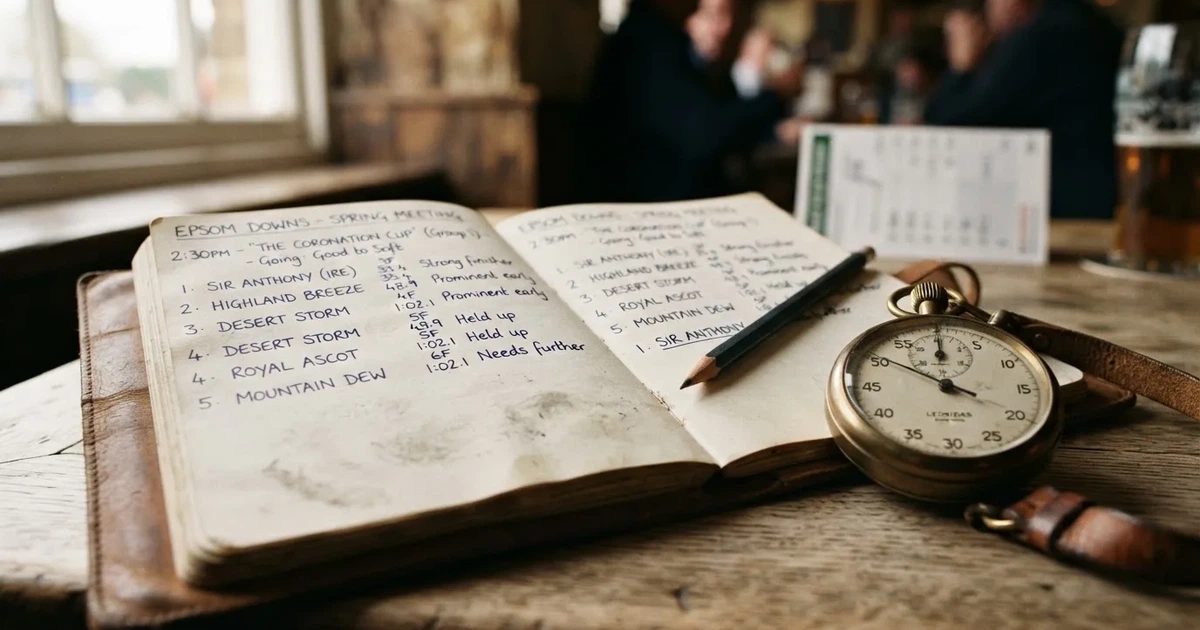
A prediction is a claim that a particular horse will win a particular race, dressed up as a tip. Most tipsters sell the dress, not the claim. The honest version starts somewhere else: with the form, the going, the field, the market’s own view of the race, and the difference between them.
Reading form
A horse’s form is its record. Recent runs are weighted more heavily than older ones because ability drifts — a horse coming back from injury, a horse stepped up in class, a horse trying a different surface. The going — the condition of the ground, from firm to heavy — matters because horses are built for certain surfaces, and a soft-ground horse on fast ground, or the reverse, is a different proposition. The class of the race sets the standard: a maiden is full of horses who have not won, a conditions race gathers proven performers at set weights, a handicap gives each horse a different weight to level the field. A reader who has not read form before should start there, and the Racing Post, the owners’ websites and the racecards on every bookmaker site all carry it.
What the market already knows
Once form is read, the next step is to look at what the betting market already says about the race. The favourite at odds-on is, by definition, the horse the market thinks is most likely to win. That view is built from the bets of thousands of punters and professional money, and it is rarely wrong by a wide margin. The point of a tip is not to overturn the favourite; it is to find a price the market has mispriced.
A misprice is what the trade calls a value bet — a price that is bigger than the chance the horse actually has of winning. The favourite at 1.50 implies a 66.7 % chance (1 ÷ 1.50), and if a serious reading of the form says the horse’s real chance is 70 % the favourite is the wrong price to back — at 1.43 it would be fair, and at 1.50 the punter is being asked to take less than the horse is worth. The opposite case is more common: a horse at 10.00 implies a 10 % chance, and the market has decided, on the weight of money, that the horse is roughly a one-in-ten shot. If the reader’s own work says the horse’s chance is closer to one in four — no — that is a value bet at 10.00, and the size of the edge is the gap.
That calculation is what makes a tip useful and what makes a tipster honest. A tipster who prints “Nap of the day: Horsename, 5/1” and walks away is selling a name and a price; a tipster who prints the nap, the price, the implied chance and the reader’s own estimate of the chance is selling the comparison. The first is a coupon; the second is analysis. The page below is built around the second.
Why no tip is ever certain
The form might be wrong, the going might change, the horse might not handle the track, the jockey might get the run of the race badly, another horse might improve past it. Even the favourite at odds-on loses roughly a third of the time at 1.50, and at 1.20 the favourite still loses one in six. The shorter the price, the rarer the winner, the bigger the disaster when the favourite gets beat: a £100 bet at 1.20 returns £120 if it wins and £0 if it does not, and the punter has spent £100 to learn the lesson.
A reader who treats a tip as a certainty has misunderstood the bet. The market already gives every horse a probability in its price. A tip is a claim that the market is wrong, on this horse, in this race, at this price. Sometimes the market is wrong; usually it is right; on no day does it hand over certainty.
Staking and bankroll
A bankroll is the amount of money a punter has put aside for betting, set against a budget that lets it be lost. A stake is the share of that bankroll risked on any one bet. The rule is simple and mechanical: a stake should be a small percentage of the bankroll, so that a long losing run does not exhaust it. One in twenty bets at a flat 5 % stake is the rough position a recreational punter can survive; a sharper punter running a value model may stake a smaller share on more bets at higher confidence.
The discipline matters precisely because tips are uncertain. A punter who stakes half the bank on the specific bet turns a one-in-three shot into a coin flip on whether to reload. The punter who stakes 2 % on each of fifty bets is in a position to judge the model across those fifty bets and adjust it. Bankroll discipline is what makes a model testable; without it, every result is either a vindication or a catastrophe, neither of which is information.
Ten bookmakers taking bets on British horse racing
The set below is the ten operators whose remote betting licences are on the Gambling Commission’s public register and whose terms name horse racing. The order is the set’s order; nothing in it is a ranking. Each write-up closes with a verdict that turns on what the section above has actually established about that brand.
| Brand | Licence (account number and holder) | What the operator’s own terms say about horse racing |
|---|---|---|
| Tote | 54779 — TDCO Limited | Pool betting on British and Irish racing; SP-based markets on every race |
| Fitzdares | 400 — Fitzdares Limited | Ante-post, Lucky 15s, accumulators, specials; in-play live odds |
| Bar One Racing | 56516 — Bar-One Racing Limited | Irish independent; sponsorships at Dundalk, Fairyhouse, Navan, The Curragh, Curraheen Park and Cork |
| 10bet | 43173 — Blue Star Planet Limited | Horse racing among football and tennis; cash out, bet builder, live streaming |
| Fafabet | 57385 — Taichi Tech Limited | Best Odds Guaranteed on UK and Irish racing from 9am on race days |
| DragonBet | 64908 — DragonBet Ltd | Cash out pre-match and in-play; live streaming of racing |
| bet365 | 55148 — Hillside (UK Sports) ENC | In-play, live streaming worldwide; bet trackers for following bets in play |
| Matchbook | 39504 — Triplebet Limited | Exchange — back and lay on racing; live streaming of horse racing and greyhounds |
| Smarkets | 39173 — Smarkets (Malta) Limited | Exchange with two-factor authentication, order book view, quick trade-out |
| Betboro | 44181 — Webmedia Development N.V. | Cash-out on racing; boosted odds on selected singles from £10 stakes |
Tote
Tote runs pool betting on British and Irish racing under Gambling Commission account 54779, held by TDCO Limited. The pool model is the point: instead of taking a fixed-odds price against the punter, the operator pools every stake on a race, takes a deduction for its take and the course, and pays the pool out to the winners. The starting price on every race is the SP the pool has set. The product is built around the format racing has used on-course for two centuries and is now the only pool-betting remote product with serious British liquidity. A punter who wants SP without taking a fixed-odds line can take it directly from the pool.
The verdict: Tote suits the punter who wants to bet into the market rather than against it, and who is happy to give up fixed-odds certainty for the pool’s take-out structure. For the reader who wants to lock in a price early, the pool is the wrong tool.
Fitzdares
Fitzdares, account 400 held by Fitzdares Limited, runs an app that puts horse racing, football, tennis, rugby, cricket, golf and American football on the same screen, with cash out, accumulators, Lucky 15s, specials and ante-post markets, and in-play live odds. The product is built for the punter who shops across sports and wants the racing menu on the same slip as the football.
The verdict: Fitzdares is the right fit for a multi-sport punter who likes an ante-post book and a long specials menu. A racing-only customer looking for Best Odds Guaranteed will not find it here in the standard form.
Bar One Racing
Bar One Racing, account 56516 held by Bar-One Racing Limited, is an Irish independent bookmaker with shops across Ireland and racing sponsorships at Dundalk, Fairyhouse, Navan, The Curragh, Curraheen Park and Cork. The brand has rebranded to BAR 1 Betting. The Irish roots shape the menu: Irish racing takes precedence, British racing sits alongside, the rest of the sportsbook fills in around it. A British customer is welcome, but the heart of the product is on the other side of the Irish Sea.
The verdict: Bar One Racing suits the reader whose racing diet is mostly Irish and who likes to back a sponsor at its own meetings. The British-only punter has no particular reason to single the brand out.
10bet
10bet, account 43173 held by Blue Star Planet Limited, lists football, tennis and horse racing as its three core sports, with cash out, bet builder and live streaming as the tools around them. The product is broad rather than deep — three sports done well, with the same toolset on each. Racing sits inside that structure alongside the football.
The verdict: 10bet is for the punter who wants football and racing on the same book with cash out and live streaming on both. A racing specialist will want a deeper menu elsewhere.
Fafabet
Fafabet, account 57385 held by Taichi Tech Limited, runs Best Odds Guaranteed on UK and Irish horse racing from 9am on race days: if the starting price on the race beats the price the punter took, the bigger odds are paid. Win and each-way bets both qualify. The BOG is the feature that defines the brand’s racing product, and the 9am trigger is among the earlier cut-offs the British market offers.
The verdict: Fafabet suits the punter who backs singles and short-priced favourites, where BOG is the difference between a small win and a small loss. The reader who bets each-way into place markets gets the same protection.
DragonBet
DragonBet, account 64908 held by DragonBet Ltd, offers cash out both in-play and pre-match, and live streaming of racing. The product sits close to the British racing core and uses the standard toolset — cash out, in-play, a streaming window — without trying to be the cheapest price or the biggest menu. It is a straightforward book.
The verdict: DragonBet fits the punter who wants cash out and live streaming of racing on a UK-licensed book without paying for extras. A reader who bets exchange or who wants BOG needs a different product.
bet365
bet365, account 55148 held by Hillside (UK Sports) ENC, runs in-play betting and live streaming of events worldwide, with Bet Track, Match Live and a Live Golf Tracker as the three live-following tools. Horse racing is one of several sports on the in-play menu; the trackers are the brand’s signature feature, and they extend across sports rather than being racing-specific. The scale of the operation makes the in-play liquidity among the largest in the British market.
The verdict: bet365 is the right book for a punter whose betting life is split across several sports and who wants the live tracker experience. A racing-only punter pays for product he does not use.
Matchbook
Matchbook, account 39504 held by Triplebet Limited, runs as a betting exchange under a remote betting intermediary licence — the customer bets against other customers rather than against the house. The exchange carries back and lay markets, a bet builder, multiples, in-play betting and live streaming of horse racing and greyhounds. Commission is the exchange’s take, set against the customer’s net winnings; the price on a horse is set by what other customers will back and lay it at, and a sharper punter can trade out at a profit if the price moves the right way.
The verdict: Matchbook is the book for the reader who wants to lay horses as well as back them, and who is comfortable with exchange mechanics. The recreational back-only punter pays for liquidity he will not use.
Smarkets
Smarkets, account 39173 held by Smarkets (Malta) Limited, also runs as an exchange, with two-factor authentication, live charts and an order book view, a quick trade-out option and 24/7 live chat support. The product is exchange-native: order book, charts, a trade-out button for closing positions in one click. Horse racing is on the menu alongside other sports.
The verdict: Smarkets suits a punter who treats the exchange like a trading screen rather than a betting slip. The reader who wants a one-click accumulator has the wrong product.
Betboro
Betboro, account 44181 held by Webmedia Development N.V., runs in-play markets and cash out on football, racing and tennis, with boosted odds on selected singles from £10 stakes and responsible-gambling tools covering deposit limits, reality checks and self-exclusion. The racing product is part of a broader sportsbook rather than a standalone racing shop.
The verdict: Betboro fits a recreational punter who wants a small-stakes price and the standard safer-gambling tools on a UK-licensed book. A racing specialist looking for BOG and ante-post depth will want a more focused product.
How the market prices a horse race
A race is a market, and a market is a set of prices. The bookmaker lays each runner at a price — the decimal odds — and the punter backs one or more of them. The trick is that the prices are not fair: they are built so that the bookmaker keeps a slice of every pound bet, whatever the outcome.
Margin: the slice the bookmaker keeps
Consider a two-way market, a match-race between two horses of apparently equal chance, with decimal odds of 1.90 on each. The implied probabilities are 1 ÷ 1.90 = 52.63 % for horse A and the same for horse B, adding up to 105.26 %. The 5.26 percentage points above 100 are the bookmaker’s overround, the slice the bookmaker keeps of every unit staked — known in the trade as the margin or the vig.
That is the simplest case. Real horse races are multi-runner markets with twelve or more horses, and the overround sits inside every runner’s price. A typical win market on a twelve-runner handicap carries an overround in the region of 110 to 130 %, which is a margin of 10 to 30 % before the race starts. The favourite at 4.00, with everything else smaller, is a market where the bookmaker is taking a serious cut; even with the favourite well-found, the rest of the field is laid in such a way that the bookmaker wins on the long shots losing, and on the favourite winning fewer times than its price implies.
The arithmetic is direct: for a market with outcomes priced at odds o₁, o₂, …, oₙ, the payout share — the fraction of total stakes that would be returned to winning punters if every outcome won in proportion to its implied probability — is 1 ÷ (1/o₁ + 1/o₂ + … + 1/oₙ). The margin is 1 minus the payout share. The same arithmetic works for any market: a simple win bet, an each-way bet (which is in fact two bets), a forecast or tricast, a bet builder. The bookmaker’s edge is the same shape every time.
A reader can spot the margin by adding the implied probabilities of every runner and subtracting 100. A bookmaker’s win market that adds to 115 is keeping a 15 % margin; one that adds to 108 is keeping 8 %. The difference between the two is the difference between a market where the punter pays heavily for the privilege of betting and one where the punter pays less.
Worked example: a two-way market
A simple example makes the arithmetic concrete. Suppose a bookmaker lays two horses at decimal odds of 1.90 each — an example, not a quoted price, used here to show the calculation. The implied probabilities are:
Horse A: 1 ÷ 1.90 = 0.5263, or 52.63 %.
Horse B: 1 ÷ 1.90 = 0.5263, or 52.63 %.
Added together, the implied probabilities are 1.0526, or 105.26 %. The payout share is 1 ÷ 1.0526 = 0.95, or 95 %. The margin is 1 − 0.95 = 0.05, or 5 %.
In other words, for every £100 staked across both horses in this market, the bookmaker keeps about £5 on average and returns about £95 to winning customers. That 5 % is what the bookmaker earns for taking the bet, running the platform, paying for staff and licences and submitting to regulation. It is also what the punter is paying, on every bet, for the privilege of having a price to take.
Real markets run higher than 5 %. A twelve-runner handicap at 115 % overround is a 15 % margin; the bookmaker keeps 15 pence in every pound bet. A place market at 110 % is a 10 % margin. Even the cleanest exchange markets, where customers bet against each other and the platform takes a commission on net winnings, are not free — the commission replaces the margin but does not abolish the cost of betting. The arithmetic is the same in shape, only the slice is taken differently.
Best Odds Guaranteed as a price floor
Several British bookmakers — William Hill from 8am on race days, Fafabet from 9am — guarantee that if the starting price on the race beats the price the punter took earlier, the bigger price is paid. The mechanism is an explicit hedge for the punter: the punter takes a price early in the day and is paid as if he had waited and taken the SP. For favourites and second favourites, BOG is often the difference between a small win and a small loss, and it is one of the more concrete features a racing punter can compare across bookmakers.
The exact trigger time varies by operator and is set in each one’s terms. The mechanism does not apply to ante-post bets, tote bets, pari-mutuel pools or any market that is not a fixed-odds win or each-way bet on a named race.
Each-way and combination bets
A win bet pays out if the horse wins. An each-way bet is two bets at equal stake: a win bet and a place bet. The place bet pays if the horse finishes in the places — usually first, second, third or fourth, depending on the race and the operator. The stake is doubled, so a £5 each-way bet costs £10.
Place terms
The place terms — the fraction of the win odds paid for a place, and the number of places paid — depend on the type of race and the number of runners. The standard UK each-way place terms run as follows. Handicaps with more than fifteen runners pay 1/4 odds for four places; twelve to fifteen runners pay 1/4 for three places; other races with more than seven runners pay 1/5 for three places; five to seven runners pay 1/4 for two places; fewer than five runners pay win only. The place terms are set by the bookmaker and printed on the betting slip; for non-handicap races the terms can vary, and an each-way bet into a small field can return only the win part if the horse does not win.
A worked example shows the arithmetic. A £10 each-way bet on a horse at 10/1 with 1/4 place terms for three places costs £20: £10 on the win part, £10 on the place part. If the horse wins, the win part pays £10 × (10 + 1) = £110 in returns, and the place part pays £10 × (10/4 + 1) = £35. Total return: £145, of which £125 is profit. If the horse only places — second or third — the place part pays £35 and the win part is lost. Total return: £35, of which £15 is profit. If the horse finishes out of the places, both bets lose: £20 is gone.
The doubling of the stake is the key. An each-way bet is not a cheaper way to back a horse; it is two bets, one of which pays out on a place. For a strong favourite the place part is uninteresting; for an outsider at a big price the place part can be a useful hedge against the horse finishing second without winning.
Combination bets
A combination bet links several selections into one bet. A double is two selections, both of which must win. A treble is three. An accumulator — an “acca” — is four or more. The odds multiply: a treble at 3.00, 4.00 and 5.00 pays 3.00 × 4.00 × 5.00 = 60.00. The catch is that every leg must win; one loss kills the bet. The full-stake multiple bets are sets of combinations across several selections — Trixie (4 bets), Patent (7), Yankee (11), Lucky 15, Super Yankee or Canadian (26), Heinz (57) and Goliath (247). The total stake is the unit stake times the number of bets, so a Lucky 15 at £1 a bet costs £15. The structure spreads risk across combinations, with at least one combination paying out if at least two selections win, and the singles paying out on any individual winner.
The arithmetic of a combination bet is the multiplication of the leg odds into one price, then the stake calculation on that combined price. A punter running a Lucky 15 wants at least one strong leg to anchor the singles, and enough legs at decent prices to make the combinations meaningful.
The legal frame
Betting on horses in Great Britain is licensed by the Gambling Commission under the Gambling Act 2005. Northern Ireland sits outside the Act and has its own law, so a GB licence does not regulate Northern Ireland. The Commission is a non-departmental public body sponsored by the Department for Culture, Media and Sport. Since the Gambling (Licensing and Advertising) Act 2014 an operator whose remote facilities are used in Great Britain needs a Commission licence wherever it is based, and a Curaçao, Maltese or Gibraltar licence is not a substitute. There is no state monopoly and no cap on the number of licences.
Checking a licence
The Commission’s public register can be searched by business name, trading name, domain or account number. It is the whole test of who holds a licence. To check a brand, search the register by the business name on its terms page and confirm the licence category — for horse racing the relevant category is “remote general betting standard (real events)” — and the licence holder. A licence for a betting exchange is “remote betting intermediary”. A brand whose domain ends in .com can still be GB-licensed; the domain proves nothing. Never call a single brand “the only” licensed one — a register lists far more than any article features, and the absence of a competitor from a list is not a finding about that competitor’s status.
The set in the table above is a sample, not a closed list. Each licence number and account number is taken from the Commission’s register at the snapshot date this page was checked.
What may be bet on
There is no statutory list of permitted bets or markets. An operator holds a licence for a category and offers markets under its own rules and the Licence Conditions and Codes of Practice. In-play betting is offered by GB bookmakers under their own licence conditions; whether a particular market is offered is the operator’s call, not a legal one. Esports are treated like any other event; virtual events are a separate licence category. Bets on politics, TV shows and novelty markets are offered by some GB bookmakers and there is no statutory prohibition. Spread betting that is not a financial product sits inside General Betting Duty. Off-course pool betting on horse or dog racing is a separate licence and duty.
There is no statutory cap on stakes in sports betting. Operators set their own maximum stakes and may restrict individual customers.
Player protection
GAMSTOP is the national multi-operator online self-exclusion scheme and a mandatory licence condition for online operators since 31 March 2020. The exclusion covers six months, one year, five years, or five years with auto-renewal; after the minimum period the exclusion runs on for a further seven years unless the customer asks GAMSTOP to remove it. GAMSTOP covers online sites and apps; betting shops use a separate service. The financial vulnerability check applies to licensed remote betting once a customer’s deposits minus withdrawals cross £150 in a rolling 30 days, in force since 28 February 2025; the check is a public-record search rather than an income or credit check. Announced, more recently still, are staged financial risk assessments — the press’s “affordability checks” — with a Commission article of 7 July 2026 setting out the schedule and no start date. Deposit limits have applied in their first phase since 31 October 2025; a second phase was postponed to 30 September 2026.
Minimum age is 18. Name, address and date of birth are verified before the customer can deposit or gamble, including with a free bet or bonus, in force since 7 May 2019.
Payments
Credit cards are banned for gambling in Great Britain since 14 April 2020, including credit-card-funded payments through an e-wallet. Debit cards and bank-based payments are not covered by the ban. Identity verification before the first deposit means no anonymous play at a licensed site. A British named-account rule, a state list of permitted payment methods and any rule for or against cryptocurrency deposits at licensed operators are not established; describe payments qualitatively and only from each operator’s terms.
Advertising and bonuses
Advertising is not licensed by the Commission. It runs through the CAP Code (non-broadcast) and BCAP Code (broadcast), enforced by the ASA, alongside the LCCP marketing conditions. CAP Code section 16 says marketing must be socially responsible, must not be of strong appeal to under-18s, and no one who is or seems to be under 25 may be featured gambling or play a significant role in marketing placed where a bet can be made directly; the rule is about who appears in the advertisement, not who may bet. Promotion rules in force since 19 January 2026 cap wagering requirements on bonuses at 10x and ban mixed-product promotions. “Whistle-to-whistle” is an industry code rather than law; from 1 August 2019 betting advertisements are not shown on TV from five minutes before a live sporting event to five minutes after it, before the 9pm watershed, with horse and greyhound racing excluded. The Premier League clubs’ withdrawal of gambling sponsorship from the front of matchday shirts from the 2026/27 season is voluntary, not law. Operators are responsible for marketing by their affiliates. No promo code is printed on this page.
Tax
The player pays no tax on betting winnings in Great Britain (general information, not tax advice; a professional gambler should ask HMRC or an adviser). General Betting Duty is the operator’s tax on gross profits, currently 15 %; from 1 April 2027 a new remote betting rate of 25 % applies within it, while remote bets on UK horse racing, self-service betting terminals in licensed premises, pool betting and in-person betting stay at 15 %. Until 1 April 2027 the remote rate stays at 15 %. Spread betting has its own rates (3 % financial, 10 % other). Whether operators pass duty on through odds is not established; never write that the player is charged duty.
The offshore alternative
Providing gambling facilities in Great Britain without the licence the Act requires is an offence under section 33 of the Gambling Act 2005 — on summary conviction up to 51 weeks’ imprisonment, a fine up to level 5, or both; six months in Scotland. The offence is aimed at the operator, not the customer. A customer who bets on an unlicensed site loses the protection the licence brings: no GAMSTOP coverage, no Commission complaints route, no approved dispute-resolution body, no British consumer redress if funds are withheld, no cap on bonus wagering requirements and no £150 vulnerability check. Enforcement is disruption — cease-and-desist notices, search-engine referrals, work with registrars, hosts and payment providers — and the Commission has been given, or is about to receive, court-order DNS blocking powers.
A fair framing of the choice: a licensed brand means checks, limits, GAMSTOP and a bonus cap, and a verified identity before the first bet; an unlicensed brand means none of those protections, and possible loss of funds. Neither is “the safe choice” by default.
The shape of British racing
British racing falls into two broad codes. Flat racing is run directly between two points around a straight or oval track; jump racing — steeplechasing and hurdling — is called National Hunt racing in Great Britain and Ireland. Flat races range from 440 yards (400 m) to more than four miles (6.4 km), with five to twelve furlongs (1.0 to 2.4 km) the most common distances. Jump races tend to be longer, run over obstacles, and are scheduled through the winter months when the ground takes the strain.
In a handicap race each horse is assigned a different weight to carry based on its ability, the better horses carrying more weight to level the field; in a conditions race horses carry the same weight with allowances for younger and female horses. The British Triple Crown consists of the 2000 Guineas, the Derby and the St Leger — three flat races for three-year-olds run across the spring and autumn. Each of the three is a Group 1 race in its own right; winning all three in the same year is the achievement that defines the Crown.
The shape of the racing year matters because the form book is a moving target. A horse entered in the 2000 Guineas is a different horse in October, and the punter who treats early-season form as gospel pays for it later.
Reading odds the British way
British racing is priced in fractions: 5/1, 11/4, evens, 6/4. The first number is the profit per unit staked; the second is the unit stake. 5/1 pays £5 profit for every £1 staked, plus the £1 stake back, £6 in total. 11/4 pays £2.75 profit per £1. Evens is 1/1: £1 profit per £1 staked, £2 in total. Odds-on — shorter than evens, like 4/6 or 1/2 — pay less profit than the stake.
The conversion to decimals is direct: a/b in fractions is (a ÷ b) + 1 in decimals. 5/1 becomes 6.00, 11/4 becomes 3.75, evens becomes 2.00, 4/6 becomes 1.67. The decimal price is what the betting slip multiplies the stake by to give the payout. Most British bookmakers now price in both formats on the slip; the fractional form is what the racecourse and the racing press still use.
The return on a winning bet at decimal odds is stake × odds. The net profit is stake × (odds − 1). A £10 bet at 6.00 returns £60, of which £50 is profit; a £10 bet at 1.67 returns £16.70, of which £6.70 is profit. The formula is the same whether the bet is a single, an each-way bet, a combination bet or a bet builder: stake × odds, with the each-way and combination bets paying on their own structure rather than on a flat win.
Where a punter’s edge actually comes from
The form book is the public record. The market is the public price. The edge is whatever gap opens between them.
The first gap is information: a horse that has been trained for a particular race, a trainer-jockey combination that runs well at a particular course, a horse whose recent form hides an unlucky run. The market will price most of this in, but it will not price all of it in, and a punter who reads form carefully and consistently can find a misprice on a small fraction of races.
The second gap is discipline: a punter who bets only when there is a value bet, and who refuses to bet when the price is wrong, runs a smaller volume of bets at a higher average edge. A punter who bets every race runs a larger volume of bets at a smaller average edge and ends up paying the bookmaker more in margin than he wins in edge. The discipline is not glamorous but it is the difference between a long-term loser and a long-term winner.
The third gap is patience: the value bet does not appear every day, and the punter who waits for it is the punter who finds it. The punter who bets because there is a race on, and because a tipster named a horse, is the punter who pays the margin without the edge.
A tip is a hypothesis, not a conclusion. The hypothesis is that the price on this horse is bigger than the chance of the horse winning. The punter’s job is to test the hypothesis on the form and the market before placing the bet, and to walk away if the test fails. Most tips fail the test. The bookmaker’s margin is the reason.
Frequently asked questions
What is a value bet and why is no tip ever certain?
A value bet is a price that is bigger than the chance the horse actually has of winning. The favourite at 1.50 implies a 66.7 % chance; if a reading of the form puts the horse’s real chance at 70 %, the favourite at 1.50 is a value bet. No tip is certain because every horse can lose: the favourite at odds-on still loses one race in three at 1.50, the form might be wrong, the going might change, the run of the race might go badly. A tip is a claim that the market is mispriced, and the claim is sometimes right and usually wrong.
What is the bookmaker’s margin and how can it be seen in the odds?
The margin is the slice of every pound staked that the bookmaker keeps, on average, across a market. For a market with outcomes priced at odds o₁, o₂, …, oₙ, the margin is 1 − 1 ÷ (1/o₁ + … + 1/oₙ). In a simple two-way market at 1.90 / 1.90 the implied probabilities sum to 105.26 % and the overround is 5.26 %. A reader can spot the margin by adding the implied probabilities of every runner and subtracting 100 — anything over 100 is the bookmaker’s overround.
How is the return on a bet worked out from the stake and the odds?
For a single win bet, the return is stake × decimal odds. A £10 bet at 6.00 returns £60, of which £50 is profit. For an each-way bet, the stake doubles and the calculation runs on the win and the place part separately, using the place terms for the place part. For a combination bet the odds of the legs multiply into one price and the stake calculation runs on the combined price; a treble at 3.00, 4.00 and 5.00 pays 60.00.
How can it be checked that a bookmaker holds a Gambling Commission licence?
The Commission’s public register can be searched by business name, trading name, domain or account number. A licence for horse racing fixed-odds betting is “remote general betting standard (real events)”; a licence for an exchange is “remote betting intermediary”. The register lists the licence holder as well as the trading name, and the account number is the easy search term if the punter already has it.
Which tools for controlling play does a licensed bookmaker have to offer?
Deposit limits, set by the customer against a chosen time window, are the workhorse. Reality checks pop up during a session. Time-out takes the account offline. Self-exclusion through GAMSTOP removes the customer from every licensed online operator for a chosen period. Account history is downloadable. Several bookmakers add product restrictions, Player Profile tests and live-chat support on top. The Commission sets the floor; the bookmaker decides what extras to add.
How do fractional odds such as 5/1 convert to decimal odds such as 6.00?
The rule is a/b in fractions becomes (a ÷ b) + 1 in decimals. 5/1 is (5 ÷ 1) + 1 = 6.00. 11/4 is (11 ÷ 4) + 1 = 3.75. Evens is 1/1, or 2.00. 4/6 — odds-on — is (4 ÷ 6) + 1 = 1.67. The decimal price is what the betting slip multiplies the stake by to give the payout.
Horse racing & greyhounds – Best Betting Tips
Content created by the «Best Betting Tips» team
