
Darts betting tips 2026: a guide, not a guess
 Available in US
A “tip” in darts is not a hunch dressed up as analysis. It is a price — the number a bookmaker offers on a player — set against your own read of how likely that player is to win, with the bookmaker’s commission taken out before you even start. A tip that ignores the margin is a tip that hands the bookmaker a head start; a tip that ignores form, head-to-heads and the format of the match hands the form book the same thing. What follows is a guide to building the side of the bet you control: how to read a price, what a value bet really is, why no tip is certain, and where the UK bookmaker market stands in 2026.
Current as of 27 October 2026 against the Gambling Commission’s public register and the operator terms cited in the operator reviews.
Live darts betting and the case for watching before you bet
Darts is one of the few televised sports where a single leg is over in seconds, and a single tournament can run from the early rounds of the afternoon to a late-evening final. That shape is why in-play betting has become the most distinctive way to bet on the sport: the prices move leg by leg, and the more televised darts you watch, the better you can read what a mid-match collapse actually looks like.
The 2026 PDC World Championship at Alexandra Palace ran 11 December 2025 to 3 January 2026 with 128 players, and rounds stretched from first to three sets in the early rounds to first to seven in the final. That is enough televised legs across a tournament for an in-play bettor to settle into a rhythm — but it is also a tournament where momentum is fragile, and a player who is two sets up can lose the next four in twenty minutes. The trade-off is real: live betting lets you wait for the price you want, but the very thing you waited for is the thing a 3–0 lead can erase in the time it takes to confirm a bet.
What live darts prices actually reflect. A bookmaker’s in-play price is a function of the scoreboard, the players’ recent form, the format left to play, and — underneath all of that — the margin the operator takes on the whole event. A player who is 2–0 up in sets, playing best of five, with two breaks of throw, will be priced accordingly shorter than the same player when the match began. A useful test before laying a live bet: work out what the price would be if the match started from that score, and compare it to what the bookmaker is showing. A gap between the two is the operator’s in-play margin sitting on top of the same read of the game you had.
The second move live betting opens up is cash out. Cash out lets a bookmaker settle a bet before the match is over, at a price the operator itself sets. The price is the operator’s, and on a market with thin liquidity — a mid-table Premier League Darts night, an early-round BDO event — that price can be markedly worse than the live price on the outright. A reader who plans to bet live should know the cash-out margin before they need it, because the moment the bet looks uncertain is the moment the bookmaker is least likely to give a fair cash-out.
What to do before a live dart goes off. Three quick things: check whether the price has tightened since the match started (a sign the operator has seen sharp money), check the format left to play (a player serving at 2–0 in a best of five is in a different position from 2–0 in a best of nine), and check whether the operator’s in-play policy is “suspends on every visit to the board” or “accepts bets between legs”. The first is a tighter market and a fairer price; the second is faster but a thinner book. Neither is wrong on its own — they suit different readers.
Where UK bookmakers sit on live darts in 2026. Every operator reviewed here offers in-play betting on televised PDC events, and most price a match from the first leg to the trophy lift. The differences are in the side markets: how many 180s markets, how many highest-checkout markets, and whether the operator offers a same-game multi that can be built and cashed out during a match. Paddy Power, Midnite and DAZN Bet all run an in-play product that includes player and match-combination markets. Fitzwilliam Sports and BetGoodwin take a more traditional shape — fewer in-play markets but a steadier in-play book on the headline match. Spreadex sits on a different axis entirely, regulated by the FCA for spread betting and by the Gambling Commission for fixed-odds, and the loss on a spread bet can exceed what was deposited.
Predictions, strategy and why “tips” is the wrong word for what you are buying
The search for “darts betting tips” is rarely a search for a tip in the ordinary sense. It is a search for a way to decide which side of a price to back, with the searcher knowing that the tipster industry has a long history of selling certainty the sport does not provide. The honest version of that search is a small set of habits.
The first habit is a price-first habit. You do not start with a player; you start with a price. A player at 4.00 (3/1) on a market you have priced at 3.00 (2/1) is a value bet, because the price the bookmaker is offering is longer than the price you would have offered. A player at 1.50 (1/2) on a market you have priced at 1.40 (2/5) is a bad bet even if the player wins, because the operator’s margin is wider than the edge you had. The arithmetic is the same in both cases, and the searcher who skips the price loses to the margin every time.
The second habit is a sample-size habit. A player who has won three legs in a row is not the same player they were at 0–0. A player who has hit three 180s in a row is not necessarily about to hit a fourth — but a player who has missed three doubles in a row at the same target is probably about to switch target. These are reads, not predictions. A read you can convert into a price is a value bet; a read that does not survive conversion is a story you are telling yourself.
The third habit is a bankroll habit. Staking is the part of betting nobody enjoys writing about, and the part that decides whether the reader still has a bankroll in three months. The flat-stake approach — the same stake on every bet, set at one to two per cent of the bankroll — is the boring one and the one that survives. Increasing the stake to “chase” a loss is the rule every tipster tells the reader not to follow, and the one almost every reader follows at least once.
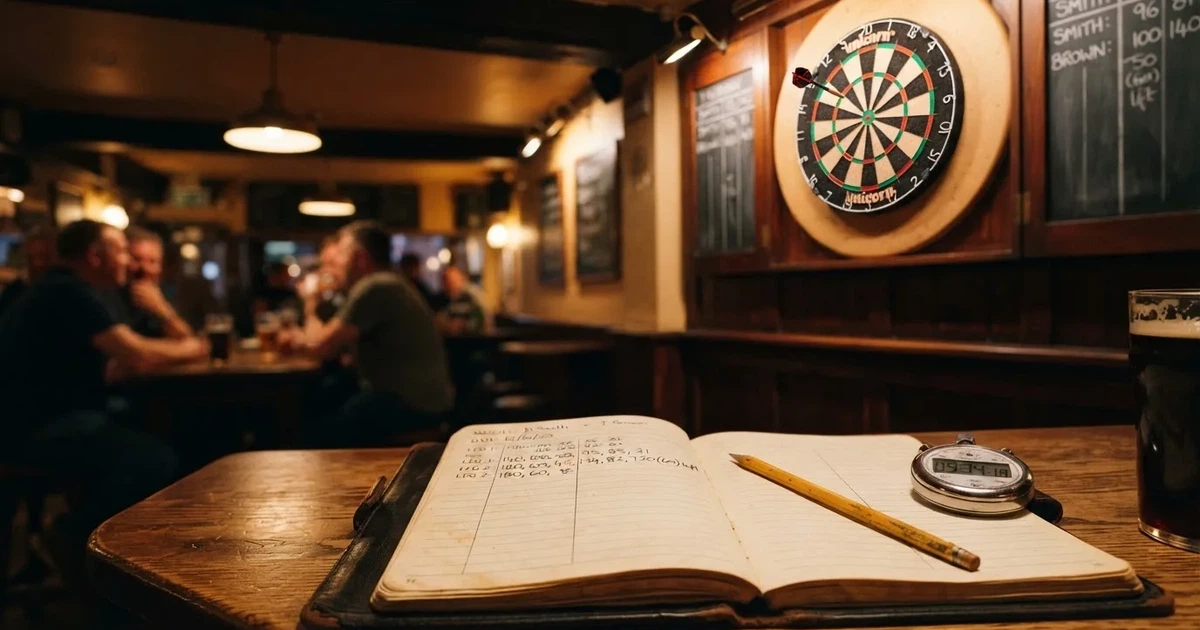
The fourth habit is a record habit. A ledger of every bet, with the price, the stake and the reasoning, is the only way to know whether a reader is making a profit on a market or slowly bleeding to the margin. The reader who bets without a record is the reader who believes they are winning when they are not, and the difference between the two is the number of bets over which the gap is averaged out.
The fifth habit is the hardest one. No tip is certain. A 1.20 (1/5) favourite loses roughly one match in six over a long run; a 4.00 (3/1) underdog wins one in five. A tip that promises certainty is a tip that has stopped being a tip, and a tipster who claims to have a system that wins is a tipster who is selling what the sport does not sell. The reader who treats darts as a market, not as a forecast, is the reader who keeps the bankroll long enough for the edge — if they have one — to show.
Staking plans in plain language. A level-stake plan bets the same amount on every selection. A Kelly-style plan bets a fraction of the bankroll proportional to the edge; it makes more when right and loses more when wrong, and it punishes misjudged edges fast. A tiered plan (a small stake on the long shots, a larger stake on the short ones) is a compromise. None of them turn a bad price into a good one. The plan decides how the edge, if it exists, is converted into profit; the plan never supplies the edge.
The market’s view of the next event is in the odds. A bookmaker’s outright is a snapshot of the field, with a margin layered on top. Comparing outrights across two bookmakers is a useful sanity check: a player at 12.00 (11/1) on one site and 8.00 (7/1) on another is either a market in flux or a market with a misprint, and a misprint on an outright settles as a void at most operators. The honest search for value compares prices, not players, and is willing to walk away from a price that is shorter than the read would justify.
Bet types, odds and the prices you actually see
Darts markets are shorter than football markets and longer than horse-racing markets. The headline market on a televised match is the match winner; underneath it sit the markets that make darts distinct: highest checkout, most 180s, total 180s in the match, race to a set or leg, handicap on sets, and — in the televised Premier League — the weekly mini-market on which leg opens with a 180.
The two-way match winner. The simplest market in the book. A 1.91 (10/11) shot and a 1.91 shot would imply a 52.4 per cent chance of either player winning, and the sum of the implied probabilities is 104.8 per cent, which is the bookmaker’s margin on the match. On a televised PDC event with two well-priced players, a margin of four to six per cent is ordinary; on a match-up with one clear favourite, the margin sits higher because the operator runs a thinner book on the underdog side.
To compute the margin on a two-way market at illustrative odds 1.90 and 1.90 (about 9/10 each way), take the implied probabilities: 1 ÷ 1.90 = 0.5263 for each side, the sum is 1.0526, the payout share is 1 ÷ 1.0526 = 0.95, and the margin is 1 − 0.95 = 0.05, or about five per cent. A bookmaker who can hold a margin of three to four per cent on a televised match is a sharper book than most, and a bookmaker who runs a margin of seven per cent on the same event is a book a value bettor avoids.
The three-way outright on a tournament. The World Championship and Premier League Darts outrights price every player in the field, and the implied probabilities across the field sum to well over 100 per cent — usually 110 to 130 per cent on a wide field, and 105 to 115 per cent on a short one. The takeaway for a reader is that a bookmaker’s outright is a worse market on average than a single match, and the long-shot prices are the worst part of it. A reader who bets the outright should treat the long end of the market as a small-stake lottery, not as a value hunt.
The 180 market. Most 180s in a match, most 180s in a tournament, the player to hit the first 180, the player to hit the most 180s in a leg. The 180 market is a market of recency and sample size. A player who has averaged two 180s a leg over the last three months is a different proposition from one who averaged 1.4, and the price on the most-180s market moves with that read. The bookmaker’s margin on a 180s market tends to be a percentage point or two wider than on the match winner, because the 180s market is harder to price and easier to underwrite.
The handicap market on sets. A player −1.5 sets means the favoured player must win by two clear sets; the underdog +1.5 wins if the underdog wins or loses by one set. Handicaps on sets are the cleanest way to back a short-priced favourite, because the operator’s margin on a handicap is usually tighter than on a heavy-favourite match winner.
The highest-checkout market. The highest checkout in a match or tournament. This market rewards the reader who knows the players’ checkout ranges, and it is the market most exposed to a single leg: one 170 finish moves the price sharply, and a long tail of high checkouts through a tournament can leave the price on the favourite looking generous before the late rounds.
Bet builders, accumulators and same-game multis. A bet builder combines multiple selections on one match into one price; the legs multiply, and the operator’s margin stacks. A four-leg builder on a match with each leg at 1.91 (10/11) prices up at 1.91⁴ = 13.28, but the margin on the combined book is wider than the margin on any single leg, and the longer the builder, the wider that margin becomes. A reader who likes a builder is paying for a single ticket that the operator has priced as a single book, and the price reflects that.
Each-way and outright places. The outright winner market on a major can be backed each-way on some operators, paying out a fraction of the win price for a place finish (usually the semi-finals at a major). Each-way doubles the stake — one bet on the win, one on the place — and is a way of softening a long-shot bet. The trade-off is that each-way doubles the stake and the place terms vary; a reader should check the place fraction before laying the bet.
How a return is worked out. Return equals stake multiplied by the decimal odds. Net profit equals stake multiplied by the decimal odds minus one. A £10 stake at 3.75 (11/4) returns £37.50, profit £27.50. A combination bet multiplies the odds of the legs: two legs at 1.91 and 2.50 give a combined price of 4.78, a £10 stake returns £47.75, profit £37.75 — but the margin on the combination is the combination of the margins on the two legs, and the longer the combination, the more the bookmaker earns on average.
Sports, tournaments and what the calendar actually looks like
Darts has two governing bodies whose events matter to a UK bettor: the Professional Darts Corporation (PDC) and the World Darts Federation (WDF). The PDC runs the televised calendar: the World Championship, the Premier League, the World Matchplay, the Grand Slam, the World Grand Prix, the Players Championship Finals, the European Championship and a packed floor-tour underneath. The WDF runs the BDO-adjacent circuit, the World Masters and the Lakeside World Championship, which is televised but on a smaller footprint.
The 2026 PDC World Championship. The tournament ran 11 December 2025 to 3 January 2026 at Alexandra Palace, with 128 players (up from 96) and a £5,000,000 prize fund (£1,000,000 to the winner). The format stretched from first to three sets in rounds one and two, to first to four in rounds three and four, to first to five in the quarter-finals, first to six in the semi-finals and first to seven in the final. Luke Littler beat Gian van Veen 7–1 in the final. The expanded field is the operative change: more early-round matches, more televised legs, and a longer outright book in the autumn as the field is filled.
The Premier League Darts. A weekly night of darts from February to May, with eight players in a round-robin before the play-offs. The Premier League is the in-play bettor’s calendar — eight matches a night, every week, for sixteen weeks — and the outright market runs from December to May. The Premier League is also the tournament where the most 180s market is most reliably priced, because the sample size per player per night is large.
The World Matchplay, Grand Slam and World Grand Prix. The three majors of the summer and autumn. The World Matchplay in July is a “double-in, double-out” tournament (different from the 501 format that the rest of the tour uses), and the format is the kind of detail that moves the outright market. The Grand Slam of Darts in November is a cross-code event, with BDO and PDC players in the same field, and the early rounds produce mismatches that the outright market sometimes prices too generously.
The Players Championship and floor tour. A weekly double-session of Players Championship events across the UK and Europe, running from February to November. The floor tour is the engine of the world rankings, and the televised coverage is limited, which means the outright markets on the bigger Players Championship events are sometimes softer than on the televised majors. A reader who follows the floor tour closely is a reader with an edge on the outrights of those events.
The Champions League of Darts. A short-format invitational run by the PDC in the autumn, with the field of the top eight on the ProTour order of merit. The format is short enough that a single leg can swing the match, and the outright market tends to price the top two or three at very short numbers.
What the calendar means for a bettor. The televised events are the easiest to price, because the sample size is large and the markets are deep. The floor-tour events are the hardest, because the coverage is thin and the outright book is shallow. A reader who bets on both has accepted that the floor-tour book carries a wider margin and a thinner price. A reader who bets only on the televised events is a reader who has chosen the easier side of the trade.
The standing of the game. The PDC is the highest governing body alongside the World Darts Federation, and the World Darts Championship is the sport’s flagship event, held annually over the Christmas and New Year period. The sport is regulated by the same bodies that govern boxing and snooker in the UK, and the betting on darts sits inside the Gambling Commission’s remote general betting standard (real events) category for licence purposes.
The ten UK-licensed bookmakers reviewed
| Brand | Licence & Holder | Key Terms |
|---|---|---|
| Paddy Power | 039439, PPB Counterparty Services | Same-game multi, deep in-play, player stats |
| Betmaster | 065699, BM Solutions GB Ltd | Clean, modern focus on major sports |
| BetGoodwin | 002927, Goodwin Racing Limited | Racing-led with steady darts price |
| Sporting Index | 027343, Sporting Index Limited | Fixed-odds and spread-betting hybrid |
| LiveScore Bet | 056859, LiveScore Betting & Gaming | Strong live-score data feed |
| Midnite | 101839, Midnite Limited | Mobile-first, accumulator builder |
| DAZN Bet | 048756, DZBT Limited | Broadcaster-backed sports product |
| Lottoland | 038991, EU Lotto Limited | Lottery-led with sports add-on |
| Fitzwilliam Sports | 048760, SBKI Limited | Phone/chat focus, steady book |
| William Hill | 039225, WHG (International) Ltd | High-street brand, competitive match prices |
The shortlist below is built from one test: a current remote licence on the Gambling Commission’s public register, in the remote general betting standard (real events) category, and a UK-facing site or app that takes real-money darts bets. Order is editorial and not a ranking of value or quality.
1. Paddy Power — the high-feature book
Paddy Power runs a sportsbook with Bet Builder+, popular bet builders, a Super Sub feature (a bet rolls over to the replacement if a selected player is substituted), expanded Win More markets and player and accumulator stats. The product is built for the bettor who likes a same-game multi, a price boost, and a deep in-play book. Paddy Power is licensed under Gambling Commission account 39439.
For the reader who wants a same-game multi on a televised match and the option to cash out between legs, Paddy Power is the strongest of the ten on feature depth. The price on the outright may not be the sharpest in the field, and the operator’s margin on a long outright book is wider than on a single match, but the same-game and the in-play product are the reason the book sits where it does on this list.
2. Betmaster — the smaller UK-licensed book
Betmaster is operated by BM Solutions GB Ltd, registered in Malta, and states it holds Gambling Commission account 65699. The book sits inside the Commission’s public register under the remote general betting standard (real events) category, and the product is a clean, modern sportsbook with a focus on the major sports.
For a darts bettor, Betmaster is a useful second book — the place to compare a price on the outright or on a 180s market before laying the bet. The feature set is shallower than Paddy Power or Midnite, and the in-play markets on a televised PDC event are narrower, but the licensing is in order and the price on the long-shot end of a major’s outright has been competitive in the run-ups of the last two World Championships.
3. BetGoodwin — the racing-led book with a darts offer
BetGoodwin pays Best Odds Guaranteed on all UK and Irish horse and greyhound racing, up to £1,000, and the brand’s heart is in racing. Darts is on the menu, but the in-play book on a televised PDC event is shallower than the racing-led product. The book is licensed under Gambling Commission account 2927, with Goodwin Racing Limited as the licence holder.
For a darts bettor whose main interest is the televised majors and who wants a steady price on the match winner, BetGoodwin is a sensible single-book choice. For a bettor who wants a same-game multi or a deep 180s market, the in-play and the side markets are thinner than the high-feature books at the top of this list.
4. Sporting Index — the spread and fixed-odds hybrid
Sporting Index is licensed by the Gambling Commission under account 27343, and the product combines a fixed-odds sportsbook with a spread-betting product. A new-customer fixed-odds offer: a £10 fixed-odds bet at minimum odds of 1/2 unlocks three £10 fixed-odds free bets, three £5 Total Goals spread bets, three £5 Winning Favourites spread bets and a £1 Race Index spread bet. The qualifying bet cannot be placed in play or cashed out early.
For a darts bettor, Sporting Index’s appeal is the spread-betting product (most 180s in a match as a spread, highest checkout as a spread) and the fixed-odds product on the same card. The shape is unusual, and the qualifying rule on the offer is the kind of detail a reader should read before laying the bet. Spreadex sits on a different axis, regulated by the FCA for spread betting and by the Gambling Commission for fixed-odds, and the loss on a spread bet can exceed what was deposited; the same warning applies to Sporting Index’s spread product.
5. LiveScore Bet — the live-data-led book
LiveScore Bet accepts debit cards (Visa and Mastercard), Apple Pay, PayPal, Pay by Bank (Open Banking) and Revolut Pay, and the product is built around the live-score data the LiveScore brand has carried for two decades. The sportsbook is licensed under Gambling Commission account 56859, with LiveScore Betting and Gaming (Gibraltar) Limited as the licence holder.
For a darts bettor, LiveScore Bet is the book whose in-play data is the strongest of the ten, and the in-play product on a televised PDC event is one of the deepest. The outright book on the majors is competitive, and the price on a televised match has held close to the rest of the high-street field in the last two World Championships. A reader who bets in-play and who values a clean in-play data feed will find this book fits the habit.
6. Midnite — the modern mobile-first book
Midnite’s UK site cites Gambling Commission account 101839 and the product is mobile-first, with an in-play section, an accumulator builder, popular accumulators, price boosts with maximum-stake limits and a sports welcome offer. The welcome offer: new customers who bet £5 or more on pre-match odds of EVS (2.0) or greater within 14 days of sign-up receive £25 in free bets and 50 free spins, valid for 7 days. Midnite Limited is the licence holder.
For a darts bettor who bets on a phone, Midnite is one of the cleanest products on the list. The accumulator builder is a useful same-game-multi tool, the in-play product covers the televised majors, and the maximum-stake limits on the price boosts are a constraint a reader should know about before chasing a boost. The 7-day window on the welcome free bets is short, and a reader who plans to claim the offer should know the bet they will lay when the offer is in front of them.
7. DAZN Bet — the broadcaster-led book
DAZN Bet deposits start at £5 by debit card, Apple Pay, Paysafecard, Trustly and Skrill, and at £20 by PayPal, with no processing fees. The product is licensed under Gambling Commission account 48756, with DZBT Limited as the licence holder, and the brand sits inside the DAZN sports-broadcasting group.
For a darts bettor, DAZN Bet is a useful third book — the place to take a price on a televised match or a 180s market when the headline book on the list is shorter than the reader wants. The deposit minimum at PayPal is £20, which is higher than the rest of the field, and a reader who uses PayPal should know the floor before they sign up.
8. Lottoland — the lottery-led book with a sports product
Lottoland’s UK app combines casino, lottery betting, sports betting and scratchcards, and the company states it is licensed by the Gambling Commission for customers in Great Britain. The licence account is 38991, with EU Lotto Limited as the licence holder. The sports product sits inside a much larger lottery and casino product, and the in-play book on darts is shallower than the dedicated sportsbooks above it.
For a darts bettor, Lottoland is the book for the reader who also plays the lottery and the casino and who wants a single account for all three. The sports product on its own is not the strongest of the ten, and a reader who bets darts seriously will probably use a dedicated sportsbook as their main book and Lottoland as a side.
9. Fitzwilliam Sports — the Irish-roots book with phone and chat
Fitzwilliam Sports offers phone and live chat with the office open 09:00 to 21:00, Monday to Sunday, and messenger replies generally within 90 seconds. The book is licensed under Gambling Commission account 48760, with SBKI Limited as the licence holder, and the brand’s roots are in Irish independent retail.
For a darts bettor, Fitzwilliam Sports is the book for the reader who wants to talk to a person before laying a bet, and the office hours are the longest of the ten. The in-play product is steadier than deeper: the headline televised match is priced, the 180s market is priced, and the outright on the major is priced, but the same-game-multi and the accumulator-builder are not the feature. A reader who values the phone line over the feature set will find this book fits the habit.
10. William Hill — the high-street brand with Best Odds Guaranteed on racing
William Hill pays Best Odds Guaranteed on UK and Irish horse racing from 8 AM on the day of the race, on both single and multiple bets; it does not apply to ante-post, tote or pari-mutuel bets. The book is licensed under Gambling Commission account 39225, with WHG (International) Limited as the licence holder, and the product is the largest of the ten by retail footprint.
For a darts bettor, William Hill is the high-street name whose darts product is steady rather than spectacular. The price on a televised match is competitive, the in-play book on a major is deeper than the smaller books, and the Best Odds Guaranteed rule does not apply to darts, so the racing-led feature does not carry over. A reader who values the brand and the retail footprint will find this book fits the habit; a reader hunting the sharpest price on a televised match will probably find a sharper book at LiveScore Bet or Midnite.
What darts betting is and how the fundamentals work
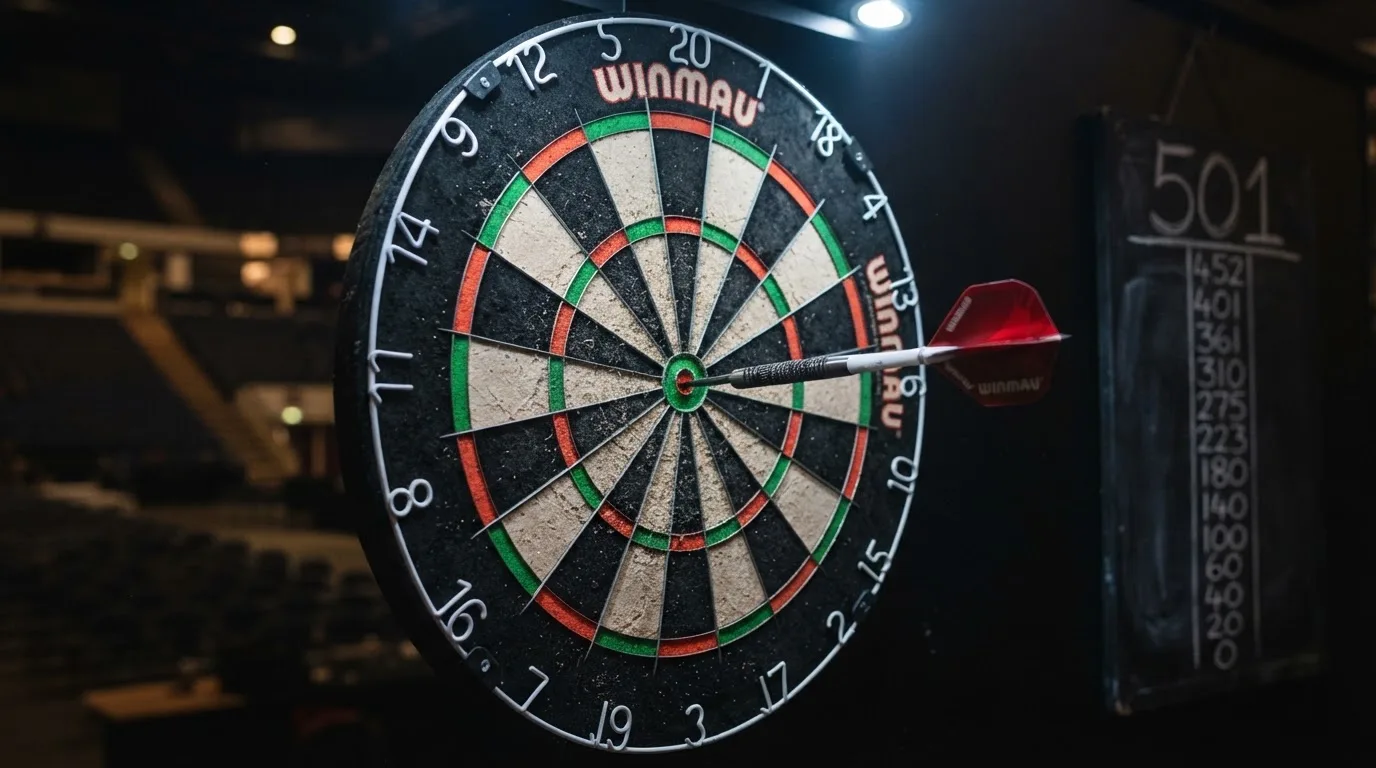
Darts is a 501 game at the highest level. Players start at 501, throw three darts per visit, and must finish on a double or on the bullseye. The highest possible three-dart finish is 170 (treble 20, treble 20, bullseye). The minimum possible leg in professional darts is nine darts — a perfect leg, with two 180s and a 141 checkout that finishes on double 18 — and the average leg at the top of the PDC tour is around 18 to 22 darts. A standard dartboard has 20 numbered segments, each with a single, double and treble area, plus the bullseye (worth 50) and the outer bull (worth 25).
The standard throw distance is 2.37 m (7 ft 9 in), with the bullseye 1.73 m above the floor. Those numbers are not trivia: they are the dimensions a televised match is filmed at, the dimensions a player trains at, and the dimensions an in-play bettor should know to read what they are watching.
A bet on darts is a contract with a licensed bookmaker. The bookmaker offers a price on a market — the match winner, the highest checkout, the most 180s, the outright winner of a tournament. The reader backs a selection at the price, and the bet is settled when the event is over. A winning bet pays stake multiplied by the decimal odds; a losing bet pays nothing. A free bet, where the stake is not paid back with a win, pays profit multiplied by the odds on the selection, and the value of the free bet is the free-bet amount multiplied by (odds minus one) divided by the odds, multiplied by the market’s payout share.
The 180 is the unit of offence in professional darts. A player who averages two 180s a leg is a different proposition from one who averages 1.4, and the difference is the difference between a player who can break a throw on the first visit and one who has to grind through a 24-dart leg to win. The 180s market is a market of averages and recency, and a reader who follows the floor tour knows the difference between a hot streak and a season-long trend.
The checkout is the unit of finishing. A player who has hit 40 per cent of their doubles over the last six months is a different proposition from one who has hit 28 per cent, and the highest-checkout market prices the difference. A 170 finish is the highest possible three-dart finish, and a player who has hit three 170s in the last twelve months is a more reliable candidate for the highest-checkout market than a player who has hit one.
The format is the unit of the match. A first-to-five match is a different market from a first-to-nine, and the price on a short-priced favourite is tighter in the longer format (more legs, more variance, less chance of a one-off upset). A reader who bets on the format of a match — first to N sets or first to N legs — is a reader who is pricing the variance of the match, not just the players.
Legality, the Gambling Commission and the offshore question
A bookmaker serving customers in Great Britain needs a Gambling Commission licence, and it has needed one since the Gambling (Licensing and Advertising) Act 2014. The Commission is a non-departmental public body sponsored by the Department for Culture, Media and Sport, and the framework is the Gambling Act 2005 (England, Scotland and Wales; Northern Ireland is outside the Act and has its own older law). There is no state monopoly, no cap on the number of licences, and a Curaçao, Maltese or Gibraltar licence is not a substitute for a Commission licence.
The Commission’s public register is the test of who holds a licence. It can be searched by business name, trading name, domain or account number, and the categories on the register — remote general betting standard (real events), remote general betting standard (virtual events), remote general betting limited, remote pool betting and remote betting intermediary (the licence for betting exchanges) — are the categories under which an operator offers markets. Every brand reviewed above appears on the register, and every GB-licensed online operator takes part in GAMSTOP, the national multi-operator online self-exclusion scheme.
The minimum age is 18, and identity is verified before the first deposit, including with a free bet or bonus. A bookmaker that does not verify identity before a customer gambles is a bookmaker that is not licensed in Great Britain. A reader who is asked for a passport, a driving licence and a proof of address before placing a first bet is being asked by a licensed operator; a reader who is asked for nothing is at an unlicensed site.
In-play betting is allowed in Great Britain and is offered by every operator reviewed here; the controls are the operator’s licence conditions and customer-protection duties, and no statutory list of permitted markets exists. Esports are treated like any other event, virtual events are a separate licence category, and bets on politics, TV shows and novelty markets are offered by GB bookmakers with no statutory prohibition found.
The credit-card ban. Credit cards have been banned for gambling in Great Britain since 14 April 2020 (LCCP condition 6.1.2), including credit-card-funded payments through an e-wallet. Debit cards and bank-based payments are not covered by the ban. A reader who tries to deposit by credit card at a licensed operator will be refused, and a reader who tries to deposit at an unlicensed site is the one taking the risk on whether the operator takes credit cards at all.
The bonus and free-bet rules. Wagering requirements on bonuses are capped at 10x (a £10 bonus at 50x needs £500 of bets; under the cap no more than £100), and mixed-product promotions — an offer that requires gambling on two or more product types such as betting, casino, bingo and lottery — are banned. The cap applies to bonuses, and the position of free bets with no wagering condition is not established. A reader who sees an offer that promises a “200% bonus” or a “100% match with no wagering” is looking at an offer that may not be compliant with the rule, and the safer test is the operator’s own terms page.
The offshore trade-off. A GB licence is compulsory at the point of consumption, and providing gambling facilities in Great Britain without the licence the Act requires is an offence under section 33 of the Gambling Act 2005 (on summary conviction up to 51 weeks’ imprisonment, a fine up to level 5, or both; six months in Scotland) — aimed at the operator. There is no offence aimed at a customer who merely bets on an unlicensed site, and the honest framing is the loss of protection: no GAMSTOP coverage, no Commission complaints route, no approved dispute-resolution body, no British consumer redress if funds are withheld, not bound by the 10x bonus cap and not bound by the £150 financial vulnerability check. A reader who bets at an unlicensed site is a reader who has given up those protections voluntarily, and the framing is not “legal to use” — it is “no recourse if the operator does not pay”.
The new remote rate. General Betting Duty is the operator’s tax on gross profits, currently 15%, and from 1 April 2027 a new remote betting rate of 25% applies within it, while remote bets on UK horse racing, bets on self-service betting terminals in licensed premises, pool betting and in-person betting stay at 15%. Until 1 April 2027 the remote rate stays at 15%, and whether operators pass duty on through odds is not established. The player pays no tax on betting winnings in Great Britain; General Betting Duty is the operator’s tax, not the player’s.
Responsible gambling and the tools a licensed operator must offer
GAMSTOP is the national multi-operator online self-exclusion scheme and a mandatory licence condition for online operators since 31 March 2020. Periods are six months, one year, five years, or five years with auto-renewal, and after the minimum period the exclusion stays in place for a further seven years unless the customer asks GAMSTOP to remove it. GAMSTOP covers online sites and apps; betting shops use a separate service. A reader who has self-excluded through GAMSTOP and tries to open a new account at any of the ten operators above will be refused.
The financial vulnerability check. LCCP condition 3.4.4, in force since 30 August 2024, applies to licensed remote betting when a customer’s deposits minus withdrawals exceed £150 in a rolling 30 days (since 28 February 2025). The check is a public-record check (for example bankruptcy or county court judgments), not an income check and not a credit reference check. A reader whose deposits cross the threshold will be asked for a public-record check, and the operator is required to do it.
Financial risk assessments — the “affordability checks” of the press — are announced in a staged plan (Commission article of 7 July 2026), with no start date. A reader who sees a headline about “affordability checks in force” should treat the headline as premature: the position is “announced, staged, no start date” until the Commission sets a start date.
Deposit limits. Operators must offer a gross deposit limit on a fixed time frame, and the first changes have applied since 31 October 2025, with a second phase postponed to 30 September 2026. There is no state-set deposit or loss ceiling for betting: limits are the customer’s choice, and a reader who wants a daily, weekly or monthly ceiling can set one at any of the ten operators above. A reader who wants a ceiling that holds across operators should set the same limit on each book and consider GAMSTOP for a longer exclusion.
The help lines. GamCare runs the National Gambling Helpline, and the charities and clinics that work with gambling harm in Great Britain include GambleAware, NHS gambling clinics and Gamblers Anonymous. Unibet’s safer-gambling tools include deposit limits, a Player Profile test, product restrictions and self-exclusion, with live-chat support and links to BeGambleAware, GamCare, GAMSTOP, Gambling Therapy and the BGC; this kind of toolset is the floor for a GB-licensed operator, and every book reviewed above runs an equivalent set. BetWright states it is licensed in the UK and provides responsible gaming tools, and its customers must be aged 18 or over. London Bet is published by Thistle Bet Limited, states it is licensed and regulated in the UK, and its app has a 17+ App Store age rating.
Why this section is short. The responsible-gambling tools are the same shape across every GB-licensed operator, and the law behind them is the same law. The useful sentence is the one that points the reader to the tools and the help lines, and the rest of the section is a list of regulations the reader can find in the Commission’s own materials. A reader who is past the help-line stage should be reading this section with the operator’s safer-gambling page open in the next tab.
Bonuses, free bets and what a “100% bonus” actually costs
The marketing word a reader meets most often in darts is the “free bet”. A free bet is a token the operator credits to a customer’s account, and the stake is usually not paid back with a win. A £10 free bet at 3.00 (2/1) returns £30, profit £20 — the £10 stake is the operator’s, not the customer’s. The “free” in “free bet” is the bet, not the stake, and a reader who reads “free bet” as “free money” is reading the marketing, not the contract.
The wagering requirement. A bonus or a free bet with a wagering requirement (the “rollover” or “playthrough”) requires the customer to bet a multiple of the bonus or the deposit before any winnings become withdrawable. A £10 bonus with a 10x wagering requires £100 of bets at the operator’s qualifying conditions before the bonus and any winnings are withdrawable; a £10 bonus with a 5x wagering requires £50. The cap on wagering is 10x in Great Britain (a rule in force since 19 January 2026), and any offer that asks for more is non-compliant with the rule.
The minimum price. Most wagering requirements only count bets at or above a minimum price, often 1.50 (1/2) or 1.72 (7/10). A reader who clears a wagering requirement with bets at 1.20 (1/5) will find that the bets do not count, and the wagering requirement will not reduce. A reader who clears with bets at 1.91 (10/11) will find the requirement reduces at the rate the operator states, and the bonus becomes withdrawable when the requirement is met.
The deadline. A free bet or a bonus with a deadline is the free bet or bonus that expires. A 7-day deadline is short; a 30-day deadline is the ordinary length at most operators. A reader who claims a free bet and forgets the deadline forfeits the free bet, and the operator’s terms usually make the forfeit explicit.
The cap on free-bet winnings. Some free bets and bonuses cap the amount that can be won from the offer. A £10 free bet with a £200 cap on winnings pays the customer up to £200 from the offer, and any winnings above that are forfeited. A reader who sees a cap on the offer’s terms should know what the cap is before laying the bet, because the cap is the difference between a winning bet and a winning bet that pays out at the cap.
The price boost. A price boost is an enhanced price on a market, usually an outright or a same-game multi. A boosted price from 3.00 to 4.00 (2/1 to 3/1) looks generous, and on a one-off bet it is a real edge, but the boost is usually capped by a maximum stake and is limited to a single market. A reader who likes a price boost should know the maximum stake, because the boost’s value is the difference between the boosted price and the unboosted price, multiplied by the stake.
Accumulator insurance. An accumulator insurance refunds the stake as a free bet (not as cash) if one leg of a multi-leg accumulator loses. A £10 five-fold with insurance returns a £10 free bet if one leg loses, and the customer loses the stake on a multi-leg loss. The insurance is a real edge on a long accumulator, and the cost is the wider margin the operator runs on the multi compared to a single bet.
Cashback. A cashback is a percentage of net losses over a period, returned as cash or as a free bet. A 10% cashback on net losses of £100 over a week returns £10, and the cap on cashback, the period and the form (cash or free bet) vary by operator. A reader who sees a cashback offer should know whether the cashback is cash or a free bet, because the value is different in the two cases.
The arithmetic the reader can do at home. Assume a market margin of 5% on the qualifying bets, a wagering requirement of 5x on the bonus, and a bonus of £10. Required turnover is £10 × 5 = £50. At a margin of 5%, the expected cost of the turnover is £50 × 0.05 = £2.50. The offer is worth the bonus minus the expected cost, £10 − £2.50 = £7.50, and the offer is a positive-value offer on those numbers. The same offer at a 10x wagering has a required turnover of £100 and an expected cost of £5.00, and the offer is break-even. The same offer at a 10x wagering and a market margin of 8% has an expected cost of £8.00, and the offer is a loss of £3.00 against the bonus. None of this counts the time it takes to clear, the minimum price on the qualifying bets, or the deadline on the offer.
How a betting tip is built, end to end
A tip on a televised PDC match is built in roughly the same way a tip on a Premier League football match is built, and the shape of the build is worth describing once because most of what is sold as a tip is one of these steps in isolation.
Step one: the field. Who is playing, what is the format, what is the surface (the stage at the World Matchplay, the Ally Pally stage at the World Championship, a PDC floor event in Wigan), and what is the rest of the day’s card. The card matters because a player who has played a late match the night before and a midday match the next day is a different proposition from a player who has had a day off.
Step two: the form. The last six months of results, weighted by the quality of the opposition. A player who has beaten three top-10 players in the last month is a different proposition from a player who has beaten three top-50 players, and the difference is the difference between a 3.00 (2/1) shot who is in form and a 3.00 shot who is on a quiet run against weaker players.
Step three: the head-to-head. The record between the two players, with the same weighting by recency. A player who has beaten the opponent four times in the last year is a different proposition from a player who beat them four times in the last five years, and the recency of the head-to-head matters.
Step four: the price. The bookmaker’s price on the match winner, on the outright, on the most 180s, on the highest checkout, and on the handicap. The price is the output of the bookmaker’s own model, and the model is updated as the betting comes in. A price that has shortened since the morning is a sign the operator has seen sharp money; a price that has drifted is a sign the operator is taking the other side.
Step five: the value. The price compared to the reader’s own read of the match. A reader who prices the favourite at 1.80 (4/5) and sees the bookmaker offering 1.91 (10/11) has found a value bet, because the price the operator is offering is longer than the price the reader’s model would have offered. A reader who prices the favourite at 1.50 (1/2) and sees 1.40 (2/5) has found a bad bet, and the bad bet is bad even if the favourite wins.
Step six: the stake. The stake is set by the bankroll, the edge and the plan, not by the price or the match. The flat-stake rule of one to two per cent of the bankroll is the boring rule that survives. A reader who increases the stake to chase a loss is the reader who loses the bankroll, and the chase is the rule every tipster tells the reader not to follow.
Step seven: the record. The bet is logged with the price, the stake, the reasoning and the result. The ledger is the only way to know whether the reader is making a profit on a market or slowly bleeding to the margin. A reader who bets without a record is a reader who believes they are winning when they are not, and the difference is the number of bets over which the gap is averaged out.
Step eight: the review. The ledger is reviewed weekly, the markets are re-priced, and the plan is adjusted. A reader who reviews the ledger is a reader who knows which markets are working and which are not, and a reader who does not is a reader who will be surprised by the end of the season.
What a tipster is selling. A tipster is selling a price plus a stake. The price the tipster quotes is the tipster’s read of the match, and the stake is the tipster’s bankroll. A tipster who sells a “winning system” is selling a price plus a stake plus a claim that the price is a winning one, and the claim is the part that does not survive the audit. A reader who follows a tipster is the reader who has outsourced step five to the tipster, and the reader who has not read the tipster’s record is the reader who is buying on trust.
Why no tip is ever certain. A 1.20 (1/5) favourite loses roughly one match in six over a long run. A 4.00 (3/1) underdog wins one in five. The favourites and the underdogs are the same favourites and underdogs at the end of the run, and the tip that promised certainty is the tip that was wrong about the sport. The honest tip is the one that says the favourite is the favourite, the underdog is the underdog, and the price is the price.
Frequently asked questions
How do I bet on darts?
Open an account with a UK-licensed bookmaker, verify your identity (passport, driving licence and proof of address), deposit by debit card, Apple Pay, PayPal or a bank-based method (credit cards are banned for gambling in Great Britain), and find the darts market — usually under “Darts” in the sports menu. Pick a market, click the price, enter the stake, confirm the bet. The bet is settled when the event is over, and a winning bet pays stake multiplied by the decimal odds.
What is darts betting?
Darts betting is wagering on professional darts events, from the televised PDC World Championship at Alexandra Palace to the floor-tour Players Championship events and the Premier League nights. The headline market is the match winner, with the most 180s, the highest checkout, the total 180s, the handicap on sets, the race to a set, the outright winner of a tournament and the same-game multi underneath it. A licensed UK bookmaker offers the markets; a bet is a contract with the bookmaker at the price offered.
How does handicap betting work in darts?
A handicap on a darts match gives one player a head start of a set or a leg. A favourite −1.5 sets must win by two clear sets; an underdog +1.5 sets wins the bet if the underdog wins the match or loses by one set. The handicap is a way of betting a short-priced favourite at a longer price, and the price on the handicap is usually tighter in margin than the price on a heavy-favourite match winner. The handicap is the cleanest way to back a short-priced favourite on a televised match.
What is a value bet, and why is no tip ever certain?
A value bet is a price offered by the bookmaker that is longer than the reader’s own read of the probability, once the bookmaker’s margin is taken out. A reader who prices a player at 3.00 (2/1) and sees the bookmaker offering 3.75 (11/4) has found a value bet, because the bookmaker is offering more than the reader’s model would have offered. A tip is never certain because a 1.20 (1/5) favourite loses roughly one match in six, a 4.00 (3/1) underdog wins one in five, and a sport played by humans has variance that no model removes. The honest tip is the one that says the favourite is the favourite, the underdog is the underdog, and the price is the price — not the one that promises a win.
What is the bookmaker’s margin, and how can it be seen in the odds?
The bookmaker’s margin is the share of every pound bet on a market that the bookmaker keeps on average, and it is the reason the implied probabilities on a market sum to more than 100 per cent. On a two-way match at illustrative decimal odds of 1.90 and 1.90 (about 9/10 each side), the implied probabilities are 52.6 per cent for each side, the sum is 105.3 per cent, the payout share is 95.0 per cent, and the margin is 5.0 per cent. A bookmaker who runs a margin of 3 to 4 per cent on a televised match is sharper than average; a bookmaker who runs 7 per cent is offering a worse price on average. The margin is the cost of betting, and a tip that ignores the margin is a tip that hands the bookmaker a head start on every bet.
How is the return on a bet worked out from the stake and the odds?
Return equals stake multiplied by the decimal odds, and net profit equals stake multiplied by the decimal odds minus one. A £10 stake at 3.75 (11/4) returns £37.50 and the net profit is £27.50. A combination bet multiplies the odds of the legs: two legs at 1.91 and 2.50 combine to 4.78, a £10 stake returns £47.75, profit £37.75. A free bet whose stake is not paid back returns profit only — a £10 free bet at 3.00 returns £20 profit, not £30, and the £10 stake is the operator’s. The decimal odds are the work; the fractional odds are a habit of the high street and the betting shop.
Tennis, darts & cue sports – Best Betting Tips
Content created by the «Best Betting Tips» team
