
Curling Betting Tips in 2026: How to Build a Pick Without Buying One
 Available in US
Current as of 27 October 2026, verified against the Gambling Commission’s public register of remote operating licences. The numbers in this article come from each operator’s own terms or from named reference material. A tip sheet hands you a name; this guide hands you the way the name was reached, and the cost of getting it wrong.

Curling is a strange sport to bet on, and that strangeness is the opening. There is no Premier League of curling, no Saturday afternoon rhythm, no team in the public mind that the headline price of a match can hang on. What there is, instead, is a small, well-defined season: the World Curling Championships in the spring, the European Curling Championships in the autumn, and — every four years — the Olympic Winter Games, with mixed doubles added in 2018. The bookmakers who take curling seriously price these events; many others don’t list them at all. That single fact shapes everything that follows. A reader searching for *curling betting tips 2026* usually wants two things, and a page that gives only one of them is half-written. They want to know which team to back, and they want to know how to know which team to back. The first cannot honestly be supplied — anyone who supplies it is guessing, and the guess will be wrong more often than not. The second can be.
This page is the second. It walks through what a curling bet actually is, what markets the bookmakers offer, how a tip is built from form and statistics, what a *value bet* means once the bookmaker’s margin is taken out, and how staking and bankroll discipline turn a tip into a process rather than a punt. It then sets out a shortlist of ten UK-licensed bookmakers that take curling bets, with the licence number and the headline offer from each. The arithmetic of a curling market — the margin, the payout share, what a value bet is worth — is worked through with a worked example. The legal frame is in the back: Great Britain’s licence regime, the responsible-gambling checks, what an unlicensed book costs the bettor in lost protections, and where to get help. Throughout, the assumption is the one a betting editor has to keep: a tip is a hypothesis, not a forecast, and a bookmaker’s price is a number with the operator’s take already inside it.
The Shape of Curling: What the Punter Needs to Know
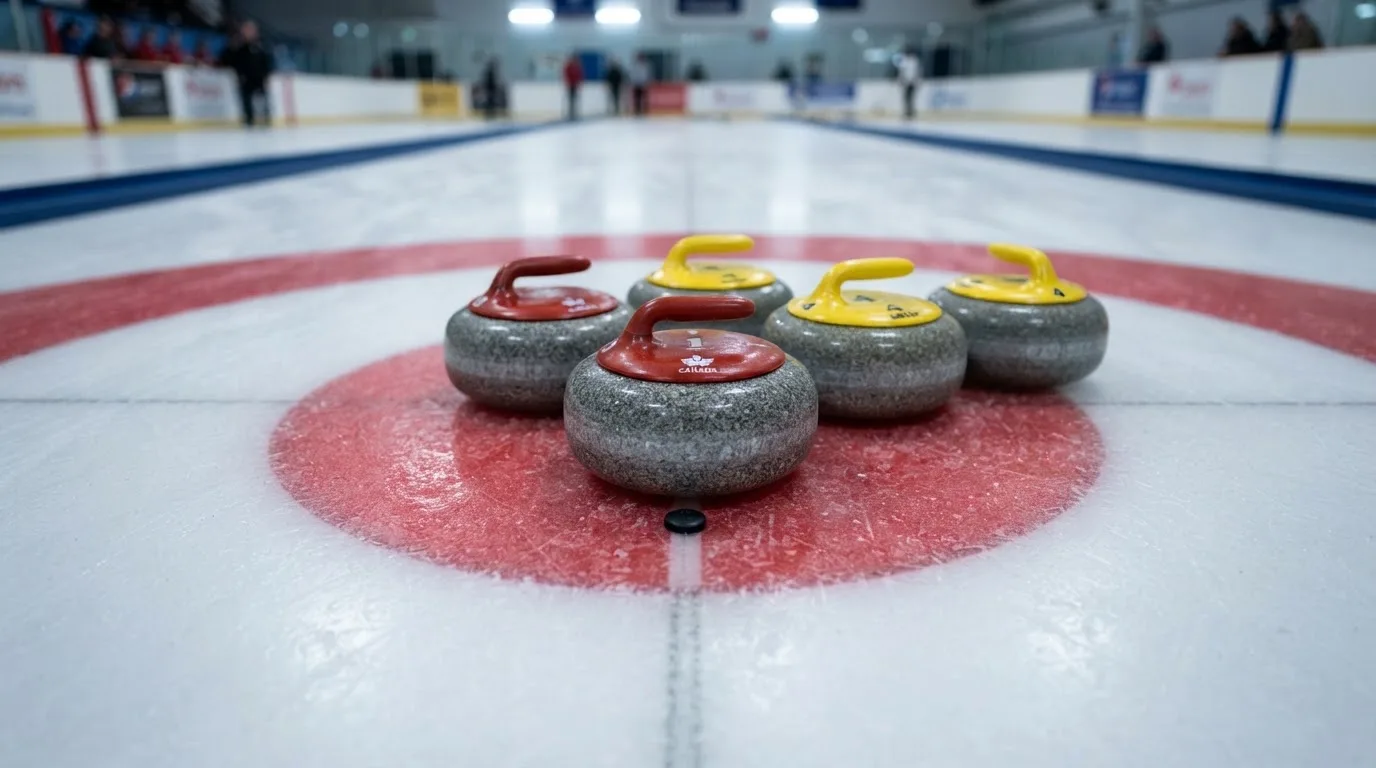
A curling team has four players (two in mixed doubles), and each player throws two of the team’s eight stones. That is the whole squad, and the whole game, on one line. The eight stones travel down a sheet of ice about 45 metres long toward a circular target called the *house*, marked by a button at the centre. After all 16 stones of an end are thrown, the team with the stone closest to the button scores one point for each of its stones closer than the opponent’s nearest stone. Only stones in the house count. Tied games go to extra ends, and the *hammer* — the last stone of an end — goes to the team that did not score in the previous end. If an end is *blanked* (no score), the hammer stays where it was.

These are not decorative facts. They are the levers a tip turns on. A team that scores two in an end has just given the hammer to the other side; a team that blanks an end keeps the hammer. A team that has the hammer in the last end is, all else equal, the favourite to win it. The skip — the captain who throws the last two stones — is the single most important player on the ice, and team rankings, where they exist, are built around the skip. The lead, the vice and the second are positions, and the order of the team matters because the better throwers are saved for the decisive stones.
Game length is fixed in shape but variable in execution. Curling games usually last 8 or 10 ends; international competitive games are generally 10 ends. The 2018 Winter Olympics introduced mixed doubles, played over 8 ends. A match in 8 ends is a different proposition from a match in 10 — the same teams, with the same form, will produce different scorelines, and the *over/under* lines on total points that some bookmakers offer move accordingly. A reader chasing totals tips has to know which format is being played before the price means anything.
The stones themselves are heavy. Under World Curling Federation rules, a curling stone weighs between 17.24 and 19.96 kilograms, and the pebble of frozen droplets on the ice that the stone rides on is part of the sport’s vocabulary. None of that helps a bettor directly. It is worth knowing because the things that decide a curling match — draw weight, take-out, sweeping, the line of a *raise*, the timing of a *hit-and-roll* — are the things a viewer learns to read over a winter, and the things a tip built only on last result will miss. Form in curling is a longer record than form in football. A team’s last four or five results, against varied opposition, tells you more than a single tournament win.
Curling became an official Olympic medal sport at the 1998 Winter Olympics, with Sweden taking men’s gold and Canada taking women’s gold. Mixed doubles was first held at the Olympics in 2018. For a tip in 2026, that means the next major is the Winter Olympics in February 2026, and the markets that surround it — outright, group, head-to-head, correct score, total points, the 1X2-style moneyline on individual ends — are the ones the licensed bookmakers on the shortlist below are most likely to list. Outside the Olympic window, the World Men’s, World Women’s and World Mixed Doubles Championships are the events the price moves on.
How a Curling Bet Is Built
A curling bet is a hypothesis. The punter forms a belief about the probability of an outcome, finds a price that the bookmaker offers, and asks whether the price is bigger than the probability the belief suggests. If it is, the bet has *value*. If it is not, it does not, and the bettor is paying for the privilege of losing more often than the price implies. The bookmaker’s margin is the gap that turns a fair game into a losing one in aggregate, and the punter’s job is to pick spots where the bookmaker has mispriced the outcome.
The first job is form. A team that won the World Championship in 2024 and the Europeans in 2025 is, in the absence of retirement or absence, a strong favourite for the next event they enter. Form is read from results, but curling’s calendar makes that patchier than in summer sports. The men’s and women’s World Championships run annually, with continental championships in between, and a team that has played twenty competitive games in a year is well-tested. A team that has played four is not. International curling has fewer matches per year than professional football, and a tip built on a small sample is, in a strict sense, a guess about a small sample.
The second job is the line-up. Curling teams change. A skip moves to a different team, a lead is replaced, and the chemistry of the four players matters. Where no published line-up for a side can be found, the tip degrades from a probability to a hunch. The World Curling Federation publishes team entries and, for the bigger events, the confirmed athletes; bookmakers price the match once they have the line-up. A bet on an event whose line-ups are not yet announced is a bet on the field, not on the teams.
The third job is the surface. Curling is played on different ice. The pebble is different, the temperature is different, and a team that has been on the European tour for two months is more comfortable on arena ice than a team that has trained on a small club rink. The sheet of ice is the closest thing curling has to a *home advantage*, and the venue matters more than in many other sports.
The fourth job is the draw. In knockout play, the path matters. A team that has drawn the world number one in the semi-final is a different price than the same team with a quarter-final against a qualifier. A reader of a betting tip built on the *outright* market needs to know whether the tip covers the outright or the individual match, and a tip that blurs the two is built on sand.
The fifth job, and the one that decides whether the bet is value, is the price. A 1.60 favourite is a 1.60 favourite — the bookmaker’s take is already inside it, and a 60 per cent chance the price implies is, in fact, a 55 or 58 per cent chance after margin. A tip that does not look at the price is a tip about a name, not a probability.
What a Value Bet Actually Is
A value bet is a bet whose price is bigger than the true probability of the outcome. A 2.00 (even money) price implies a 50 per cent chance. If the punter’s model gives the outcome a 55 per cent chance, the bet is value: the price pays 2.00, the model says 1.82 is fair, and the extra 0.18 in expected return per unit is the edge. If the model gives 45 per cent, the bet is not value: at 2.00 the punter is paying 0.18 per unit for the privilege of losing more often than the price implies.
The bookmaker’s margin is what makes the comparison worth doing. A *fair* bookmaker would price a two-way market at odds that imply 100 per cent in total — both sides summing to 1.00 in implied probability. A real bookmaker prices the two sides to sum to more than 1.00, because the overround is where the operator makes its money. The margin is the gap. A 5 per cent margin means the implied probabilities of the two outcomes sum to 1.05, and the punter is paying 5p in every pound for the privilege of betting.
A worked example, with the page’s illustrative two-way market at decimal odds of 1.90 and 1.90, makes the arithmetic plain. The implied probability of each side is 1 ÷ 1.90, which is approximately 52.63 per cent. Add the two sides: 52.63 + 52.63 = 105.26 per cent. The 5.26 percentage points above 100 per cent is the overround, and the margin is 5.26 per cent of the stake — in a fair book, the two sides would each be at 1.953 (which is 1 ÷ 0.512 + a fraction). At 1.90/1.90, the punter’s *true* return per pound staked is 1 ÷ 1.0526, which is approximately 95 pence per pound, before the price of the bet itself is judged. That is the definition of a 5 per cent margin in the round sense — the operator keeps about 5p in every pound, on average, across the two outcomes.
Where the margin bites: a tip that says “this team is a 1.90 shot” is, in a 5 per cent margin market, saying the team’s fair price is closer to 2.00. The 0.10 of decimal odds the bookmaker is shaving is the punter’s hurdle. A reader of curling tips who treats 1.90 as fair is paying the bookmaker 5p for every pound and wondering why the long run is flat. A reader who treats 1.90 as a starting point — and only takes the bet when the model gives a probability above 53 per cent — is the reader who has a chance of being ahead once the variance of curling has had its say.
No tip is ever certain. A value bet is a positive expected value under the punter’s model. A 1.90 shot with a 60 per cent model probability is value on paper, and a 0-2 scoreline in the first two ends of the match wipes the value clean. Variance is the tax on the long run, and curling, with its small samples and its momentum, taxes the punter harder than a sport with 38 rounds. A 100-unit bank, bet at 1 per cent of bank per bet, will survive a 10-bet losing streak with 90 units intact. A 100-unit bank, bet at 5 per cent of bank per single tip, will be in trouble by the third loss in a row. Staking discipline is the half of the value-bet story that the marketing pages never write, and it is the half a tip built on a single name never mentions.
Curling Markets the Bookmakers List
The shape of a curling market is narrower than the shape of a football or tennis market, and the punter who treats it as a smaller version of either will be surprised. The mainline market, where one exists, is the match winner: Team A to beat Team B, at decimal odds, with extra ends counted. The draw — a tie after extra ends — is rare but possible, and the 1X2 in the football sense translates to a two-way moneyline plus an outside tie in some books. The over/under on total points is offered by the bigger books for the bigger events. The correct-score market, on a 5-4 or 6-5 scoreline, sits inside the same events and pays accordingly.
Outright markets — the winner of the World Championship, the winner of the Olympic gold — are the markets a curling punter lives in for most of the year. The Olympic gold outright in 2026 will be priced by every UK bookmaker on the shortlist, and the outright price on Canada, Sweden, Switzerland, Norway and Great Britain (for the men’s) and Canada, Sweden, Switzerland, South Korea, the United States, Japan and Great Britain (for the women’s) is the price that has the most money behind it. The price moves on form, line-up news, and the surface; a tip on the outright is a bet on the whole tournament, not on a single match, and the bankroll it consumes is the bankroll the punter is willing to lose on a single event.
Head-to-head matches are priced at the bigger events. The group-stage match between Sweden and Canada at the World Men’s is a 1.70–2.30 kind of price, and the margin on that market, on the bigger books, is in the 4 to 6 per cent range — wider than the mainline football market, narrower than the niche sports. A reader who is comparing bookmakers for a curling bet should be comparing the margin, not the headline offer.
A short word on in-play. The licensed bookmakers listed below all offer some form of in-play, and a curling end lasts long enough — 15 to 20 minutes of stones and sweeping — that an in-play market is feasible. The odds update is not the second-by-second stream of a football match, but a price on the next-end winner, the next-stone winner, or the match winner after the current end is feasible at the bigger events. A punter who bets in-play on curling without a model for the next-end probability is, in practical terms, paying the bookmaker’s margin twice: once on the in-play spread, once on the longer-run losing streak. The in-play price is not a value price; it is a trader’s price.
The Margin, Worked as a Band
The page’s worked example is the illustrative two-way market at 1.90 / 1.90. The margin of that market is 5.26 per cent, and the punter’s true return per pound is 94.7 pence. A real curling bookmaker will price the two-way market at somewhere between 1.83 / 1.83 and 1.95 / 1.95, depending on the event, the day and the operator. That is the band — a 4 per cent margin at the tightest and a 6 per cent margin at the loosest, with a 5 per cent mid-point that is the figure the rest of the article works to.
The band matters because the punter who compares bookmakers on a single price — say, Canada at 2.20 to win the men’s Olympic gold — sees one operator at 2.20 and another at 2.10 and has, on the surface, a 5 per cent difference in expected return. The actual difference depends on where the rest of the market sits. An operator that prices the favourite at 2.20 and the field at 1.10 has a tighter margin than one pricing the favourite at 2.20 and the field at 1.20, and the punter who only looks at the headline price is reading half the page. The honest comparison is the one on the margin across the whole market, and the margin is the number a value bet is measured against.
For curling, a 5 per cent margin is a normal market. A 4 per cent margin is a sharp book, and a 6 per cent margin is a softer book on a niche event. The punter who bets curling on a soft book is paying for the privilege, and the punter who bets curling on a sharp book is paying less. The bookmaker shortlist below is built with the margin as one of the comparison points, and the operator-by-operator section carries the published offer as the headline figure the page leads with.
Responsible Gambling: The Frame the Page Sits Inside
A guide that does not name the safeguards is a guide to losing. The framework is a UK-licensed bookmaker’s, and the framework is what makes the comparison on the next pages meaningful: a licensed book is required to check the customer’s age and identity, take part in GAMSTOP, set social-responsibility duties into its licence conditions, and offer deposit limits. The unlicensed book, by definition, offers none of those. The punter who treats the two as a single market is treating a regulated product as if it were unregulated, and the long-run cost of that confusion is paid in lost protections, not lost pounds.
GAMSTOP is the national multi-operator online self-exclusion scheme and a mandatory licence condition for every UK-licensed remote bookmaker. Self-exclusion periods are six months, one year, five years, or five years with auto-renewal. After the minimum period, the exclusion stays in place for a further seven years unless the customer asks GAMSTOP to remove it. GAMSTOP covers online sites and apps; betting shops use a separate service, and a self-exclusion on one side does not automatically cover the other. A punter who wants to stop betting online, full stop, registers with GAMSTOP and the exclusion applies to every UK-licensed bookmaker. A punter who wants to stop at one book uses that bookmaker’s own self-exclusion.
The financial vulnerability check, in force since 30 August 2024 and applied to all licensed remote betting since 28 February 2025, is a public-record check — a search of records such as bankruptcy or county court judgments — triggered when a customer’s deposits minus withdrawals exceed £150 in any rolling 30-day period. It is not an income check and it is not a credit reference check; the trigger is the activity, not the affordability. A punter whose deposits cross the £150 mark will be asked a series of questions, and a punter who cannot answer them will find their account restricted. The check exists to catch the customer who is betting more than they should, and a punter reading this article is, by definition, a punter who can plan ahead: the right response to the £150 threshold is to set a personal deposit limit below it, on a bookmaker’s own safer-gambling page, and to keep the limit at a level that fits the bankroll.
Deposit limits are the customer’s tool. Every UK-licensed bookmaker offers them, and the operator’s terms state how the limit is set, raised or lowered. A limit can be tightened immediately; a relaxation of the limit takes 24 hours or more, and that delay is the design. The punter who sets a daily limit of £20, and the punter who sets a weekly limit of £50, is the punter who is reading the margin of the book and not the headline offer.
The other half of the frame is help. GamCare runs the National Gambling Helpline. GambleAware funds treatment and research. The NHS runs gambling clinics in several regions. Gamblers Anonymous runs group meetings. A punter who feels the betting is no longer a choice is not failing at the betting; the betting has failed them, and the right next step is a call, not a stake.
Sports and Tournaments: Where the Bets Live
The curling calendar is small but predictable. The European Curling Championships run in the autumn; the World Men’s and World Women’s Championships run in the spring; the World Mixed Doubles Championship runs in the spring; the Continental Cup, the World Junior Championships and various Grand Slam events fill the rest of the year; the Olympic Winter Games run every four years, with curling a medal sport since 1998 and mixed doubles since 2018. For 2026, the Winter Olympics in February are the headline event, and the markets that surround them — men’s gold, women’s gold, mixed doubles gold, group winners, head-to-head matches, correct score on a per-game basis, total points — are the ones the bookmakers on the shortlist will list.
Outside the Olympic window, the World Curling Championships are the next-biggest events, and the outright markets on them open weeks ahead. The 2025 World Men’s Championship, held in late March, was won by Scotland — a result that resets the outright market for the 2026 championship. The 2025 World Women’s Championship, in late March, was won by Switzerland. The men’s and women’s fields for 2026, in the absence of confirmed entries, are an open book, and the bookmakers’ prices will harden once the entries close.
Mixed doubles is the format that has grown fastest since 2018, and the mixed-doubles market is the one the bookmakers’ margin tends to be tightest on — the smaller team count, the clearer form lines, the wider range of competing nations (Italy, Norway, the United States, Sweden, Switzerland, Canada) all help. A reader looking for value in curling is more likely to find it in the mixed-doubles outright than in the men’s or women’s outright, and the bookmakers’ price on a mixed-doubles match is a fairer starting point than the same bookmaker’s price on a 10-end men’s match.
The club and tour circuit — the World Curling Tour events, the Grand Slam of Curling, the European Curling Tour — are listed in season, but the markets on them are thinner, and the bookmakers’ margin is wider. A reader who bets on a club match without a bookmaker’s price is, in practical terms, reading the team sheets and guessing. The Grand Slam of Curling is the exception, and the bigger bookmakers will price the Tour Championships.
The handicap and total-points markets are offered by the bigger books. A -1.5 end handicap on a men’s match means the favourite has to win by two ends; a +5.5 total-points line means the favourite has to clear 5.5 points in total. The handicap and totals are the markets a sharp bettor plays, because the margin on a niche event’s mainline match-winner market can hide inside a wider handicap price. A reader comparing bookmakers for curling bets should compare the handicap and totals lines as well as the match-winner, because that is where the bookmakers’ prices diverge the most.
The Shortlist: Ten UK-Licensed Bookmakers
Ten licensed operators are listed below. None is “the only” option; the Commission registers many others, and brand absence here is not an endorsement or denial. The reader verifies each by name, domain, or account number on the Commission’s public register.
| Brand | Licence & Holder | Terms Summary |
|---|---|---|
| Kalooki Sportsbook | 057730-R-333396-005 (Kalooki Sportsbook Ltd) | Sportsbook-focused, no casino floor |
| Octobet | 062545-R-337248-006 (Octopus Game Ltd) | 50% partial refund up to £50 + £10 casino bonus |
| William Hill | 039225-R-319373-015 (WHG (International) Ltd) | Depth in racing, extensive sportsbook |
| Bet Ahoy | 100094-R-341742-003 (Bet Ahoy Ltd) | £10 free-bet package (single + acca) |
| Betfred | 039544-R-319290-010 (Petfre (Gibraltar) Ltd) | Wide sportsbook + casino floor |
| Matchbook | 039504-R-319407-024 (Triplebet Ltd) | Betting exchange model, commission-based |
| Star Sports | 009177-R-104555-019 (Star Racing Ltd) | Personal trader service |
| BetUK | 039198-R-319450-029 (LeoVegas Gaming PLC) | Four £10 free bets on football accas |
| Tote | 054779-R-331321-008 (TDCO Ltd) | Pool betting racing product |
| Midnite | 101839-R-342850-001 (Midnite Ltd) | Acca builder, price boosts |
A reader comparing the ten will notice three things. First, the welcome offers are presented in the form the operator’s own terms state them — a £10 in free bets, a 50 per cent back as a free bet up to £50, a £25 in free bets and 50 free spins — and the headline number is the headline, not the value. The value of a free bet is the free bet’s stake times the price minus one, divided by the price, times the market’s payout share. A £10 free bet at 2.00 on a 95 per cent payout market is worth, on average, £4.75 in real money. Second, the offers are not the point of the comparison; the licence, the licensee and the on-site experience are. Third, the operators vary in what they offer beyond the headline — bet builder, cash out, in-play, exchange-style markets — and the comparison below flags the differentiators, not the duplicates.
Kalooki Sportsbook
Licence: Gambling Commission remote licence 057730-R-333396-005, account 57730, held by Kalooki Sportsbook Limited. Kalooki Sportsbook is operated by Kalooki Sports Book Ltd (company number 12938274) and is a GAMSTOP member. The operator’s site is a sportsbook-first product with a smaller casino, and the brand’s differentiator is the focus on the sportsbook without the wider casino floor. For a curling punter who wants a bookmaker that lists the sport without the noise of a casino lobby, Kalooki is one of the smaller, more focused names on the register. The headline offer is the operator’s standard terms; the licence, the GAMSTOP membership and the narrower product are the comparison points.
A Kalooki Sportsbook account is a small-bookmaker experience. The brand does not run a betting exchange, does not run a financial spread-betting arm, and does not run a lottery or scratchcard product alongside the sportsbook. The narrower product is the comparison: a reader who wants the depth of a bet builder on a niche sport will not find it here, and a reader who wants a clean sportsbook with a UK-licensed operator and a GAMSTOP membership will. The verdict for a curling punter: a credible alternative to the bigger books, with the licence and the safeguards in place, and a smaller product on the niche sports.
Octobet
Licence: Gambling Commission remote licence 062545-R-337248-006, account 62545, held by Octopus Game Limited. Octobet’s sportsbook welcome offer is 50 per cent back as a free bet up to £50, plus a £10 casino bonus for new customers. The first figure is a partial refund on the first bet’s stake, paid in free-bet form, with a £50 ceiling. The £10 casino bonus is a separate credit outside the sportsbook. The sportsbook is the focus for curling.
For a curling punter, Octobet is a mid-size bookmaker with a standard sportsbook product. The brand runs an in-play product, a bet builder on selected sports, and the usual outright markets on the bigger events. The 50 per cent back as a free bet is a common shape: a partial refund on a losing first bet, paid in free-bet form, with a ceiling. The reader treats the headline as the headline and the licence as the licence. A curling bet at Octobet is a curling bet at a UK-licensed bookmaker, with the standard safeguards. This choice suits bettors seeking a partial-refund offer structure.
William Hill
Licence: Gambling Commission remote licence 039225-R-319373-015, account 39225, held by WHG (International) Limited. William Hill is the long-established name in British betting, and the brand’s differentiator is the depth of the horse-racing product and the in-store / online split. For curling, the brand is a bigger book that lists the bigger events and offers the standard markets — match winner, outright, group, head-to-head, total points. The headline offer is the brand’s terms. William Hill’s Best Odds Guaranteed, as published on the help centre, pays Best Odds Guaranteed on UK and Irish horse racing from 8 AM on the day of the race, on both single and multiple bets; it does not apply to ante-post, tote or pari-mutuel bets. The BOG is a horse-racing product, and it is not a curling product.
A William Hill account is a well-established British bookmaker experience. The site is fully featured, with an in-play product that is mature. For curling, the brand will list the World Championships and the Olympics. This remains a stable, mature environment for major events.
Bet Ahoy
Licence: Gambling Commission remote licence 100094-R-341742-003, account 100094, held by Bet Ahoy Ltd. Bet Ahoy’s welcome offer is *Bet £10 & Get £10 in Free Bets*, composed of a £5 sports bet and a £5 acca. The value is the total £10, with free-bet value dependent on stake and price. The brand is a smaller UK-licensed operator, currently showing limited curling-specific depth.
For a curling punter, Bet Ahoy is a smaller bookmaker with a standard sportsbook product. The brand lists the bigger curling events and offers the standard markets. The welcome offer is a small free-bet package; the value of the free bets is in the form, not the headline. A reader who bets curling on Bet Ahoy is betting on a UK-licensed bookmaker with the standard safeguards, on a smaller product. It remains an option for punters preferring a lightweight, focused interface.
Betfred
Licence: Gambling Commission remote licence 039544-R-319290-010, account 39544, held by Petfre (Gibraltar) Limited. The Betfred Sports, Casino & Games app is published by Done Brothers (Cash Betting) Ltd and covers 21 sports plus over 2,000 casino-style games. The brand’s differentiator is the depth of the sportsbook and the casino-floor product alongside it. For curling, Betfred is a bigger book that lists the bigger events, with the standard markets, and the wider product on the rest of the sportsbook. The brand’s headline offer is the operator’s terms; the comparison is on the product, not the bonus.
A Betfred account is a veteran British bookmaker experience, with a sportsbook and a casino floor. The platform is well-developed, with an in-play product that is mature. For curling, the brand lists the World Championships and the Olympics. Reliability for mainstream coverage is their strength.
Matchbook
Licence: Gambling Commission remote licence 039504-R-319407-024, account 39504, held by Triplebet Limited. Matchbook is a betting exchange where customers bet against other users, with Bet Builder, multiples, in-play betting and live streaming of horse racing and greyhounds. The brand’s differentiator is the exchange model: the backer’s price and the layer’s price are set by other customers, and Matchbook takes a commission on net winnings. For curling, an exchange is a different product from a bookmaker: the price is the market’s price, and the margin is the commission, not the overround.
A Matchbook account is a betting-exchange experience. The backer’s price on Canada to win the men’s Olympic gold is the highest back price the market offers, and the layer’s price is the lowest lay price. The brand’s Bet Builder, multiples and in-play product are run alongside the exchange. For a curling punter, Matchbook is a different sort of choice: an exchange punter places a back bet at the backer’s price or a lay bet at the layer’s price, and the comparison is on the commission, not the margin. It is an excellent alternative for those who prefer to trade rather than take a bookmaker’s price.
Star Sports
Licence: Gambling Commission remote licence 009177-R-104555-019, account 9177, held by Star Racing Limited. Star Sports’ differentiator is the personal-service model: customers can speak to a trader directly on 08000 521 321 to open an account, place bets or ask customer queries, with support at [email protected]. The brand runs a sportsbook-first product with a smaller casino. For curling, the brand is a UK-licensed bookmaker that lists the bigger events, with the personal-service model as the comparison point.
A Star Sports account is a personal-service bookmaker experience. The site is intuitive, the in-play product is mature on major events, and the trader service is the primary comparison: customers can speak directly to a trader to place bets. For curling, Star Sports is a credible choice for larger events. Their service model clearly differentiates them from automated platforms.
BetUK
Licence: Gambling Commission remote licence 039198-R-319450-029, account 39198, held by LeoVegas Gaming PLC. BetUK’s sports offer requires a £10 deposit and qualifying bet within 7 days for four £10 free bets (two football accumulators, two multiples), valid for 7 days, with opt-in required. These are pre-allocated to football events. Pure curling specialists may find the structure restrictive.
A BetUK account is a mid-size bookmaker experience. The brand runs an in-play product, a bet builder, and the standard outright markets on the bigger events. For curling, the brand will list the bigger events, and the welcome offer is shaped around football. A curling punter reading the BetUK welcome offer should read the offer as a football-shaped product, not a curling-shaped one. It is not our primary recommendation for pure curling specialists.
Tote
Licence: Gambling Commission remote licence 054779-R-331321-008, account 54779, held by TDCO Limited. The Tote is the long-established pool-betting brand in British racing, and the brand’s differentiator is the pool-betting product. For curling, the Tote is a sportsbook that lists the bigger events alongside its pool-betting racing product; the brand does not run a betting exchange, does not run a financial spread-betting arm, and runs a smaller casino floor. The headline offer is the operator’s standard terms.
A Tote account provides a sportsbook and pool-betting experience. Their pool product is extensive on horse racing, and the sportsbook covers major curling events. This platform works effectively as a niche specialist within the broader betting landscape.
Midnite
Licence: Gambling Commission remote licence 101839-R-342850-001, account 101839, held by Midnite Limited. Midnite’s site cites Gambling Commission licence 101839 and shows in-play events, an acca builder, popular accas and price boosts with maximum-stake limits. The brand’s differentiator is the acca builder and the price-boost product. Midnite’s sports welcome offer, as published in the App Store listing, is: new customers who bet £5 or more on pre-match odds of EVS (2.0) or greater within 14 days of sign-up receive £25 in free bets and 50 free spins, valid for 7 days. The shape is a free-bet-and-spins package tied to a £5 qualifying bet at minimum odds of evens, with a 14-day window.
A Midnite account is a sportsbook and casino experience with a robust acca-builder. The platform is modern, the in-play product is mature for major events, and their price boosts with stake caps are a key feature. For a curling punter, Midnite is a credible choice for larger events. Their acca-builder tool is a highlight for those focused on complex markets.
What a Bookmaker’s Licence Actually Means
A Gambling Commission remote licence is a permission to provide remote betting facilities in Great Britain. It is a condition of the Gambling Act 2005, as amended by the Gambling (Licensing and Advertising) Act 2014, that an operator whose remote facilities are used in Great Britain needs a Commission licence wherever the operator is based. A Curaçao, Maltese or Gibraltar licence is not a substitute. Since the 2014 Act, a brand serving customers in Great Britain from a Gibraltar or Maltese holding company needs a Commission licence on top of the home jurisdiction’s licence, and the Commission’s public register is the test of who holds one.
The licence categories matter. The ten operators above hold a remote general betting standard (real events) licence; Matchbook, additionally, holds a remote betting intermediary licence, which is the licence for a betting exchange. A brand that holds a remote general betting standard (virtual events) licence is licensed to offer virtual events, and the price on virtual events is a different product. A brand that holds a remote pool betting licence is licensed to offer pool betting on horse or dog racing, and the Tote’s licence category is the example. The Commission’s public register lists the categories, and a reader comparing two bookmakers for a curling bet should check that both hold the same category, because a virtual-events licence does not cover a real curling match.
The licence is not a recommendation. The Commission licenses the operator; the operator’s products are the operator’s. A licensed bookmaker can offer a curling market with a 6 per cent margin or a 10 per cent margin, and the licence does not adjudicate the price. The licence does require the operator to verify the customer’s age (18 or over), verify the customer’s identity before the first deposit, take part in GAMSTOP, follow the social responsibility code, and offer deposit limits. The licence is the floor, not the ceiling, and the comparison between two licensed bookmakers is on the product, not the licence.
The Commission’s public register is searchable by business name, trading name, domain or account number. The reader who wants to check that a brand holds a licence goes to the register, enters the brand’s name or domain, and reads the result. A brand that is on the register is licensed, in the categories stated, as of the access date. A brand that is not on the register is not licensed, and the punter who bets on it is outside the protection of the framework described in this article.
What an Unlicensed Book Costs the Punter
A GB licence is compulsory at the point of consumption. Providing gambling facilities in Great Britain without the licence the Act requires is an offence under section 33 of the Gambling Act 2005 — on summary conviction up to 51 weeks’ imprisonment, a fine up to level 5, or both; six months in Scotland. The offence is aimed at the operator. No offence aimed at a customer who merely bets on an unlicensed site was found in the framework; the cost of betting unlicensed is the loss of the protections the licence requires.
The lost protections are: no GAMSTOP coverage, so a punter who has self-excluded cannot enforce the exclusion against the unlicensed book; no Commission complaints route, so a complaint about a withheld withdrawal has no British regulator to escalate to; no approved dispute-resolution body, so the dispute is between the punter and the operator; no British consumer redress if funds are withheld; no coverage of the 10x bonus cap, so an unlicensed book can offer a bonus with a 50x wagering condition without breaking any rule the punter can enforce; no coverage of the £150 vulnerability check, so the unlicensed book is not obliged to ask the financial-vulnerability questions; no source-of-funds obligations under the money-laundering rules, so the unlicensed book is not required to ask where the deposit came from.
Enforcement is disruption, not blocking. The Commission issues cease-and-desist notices, refers unlicensed sites to search engines, works with registrars, hosts and payment providers, and has been given, or is about to receive, court-order DNS blocking powers. ISP blocking is not in operation as of the date above, and a punter who can reach an unlicensed site from a British IP address is not, in practical terms, being blocked. The honest framing: licensed = checks, limits, GAMSTOP, the bonus cap, but also identity verification before the first bet; unlicensed = none of those protections, and the loss of funds is a real cost. Neither is the safe choice by default.
Reading a Curling Tip
A tip is a hypothesis. The first job of the reader is to ask what the tip is about — outright, match, total, correct score — and on what event. The second job is to ask what the form is — last four results, line-up news, surface. The third job is to ask what the price is, and what the price implies once the bookmaker’s margin is taken out. The fourth job is to ask what the stake is — a per-bet stake, a fraction of the bank, a fixed unit — and whether the stake is in the bankroll’s range. The fifth job is to ask what the offer is — a free bet, a partial refund, a price boost — and whether the offer is value, or whether the offer is the marketing talking.
A tip that answers the first three and not the last two is a tip about a name. A tip that answers all five is a tip about a process, and the punter who follows the process is the punter who is in with a chance. The punter who follows the name is buying a guess.
Staking and Bankroll
A bankroll is the money the punter has set aside for betting, separate from rent, food, and the rest of life. A stake is a fraction of that bankroll, bet on a single selection. A common staking rule is one per cent of bank per bet, on a value bet only, with a stop-loss at a defined number of bets. A 100-unit bank, bet at 1 per cent, loses 10 units on a 10-bet losing streak. A 100-unit bank, bet at 5 per cent, loses 50 units on a 10-bet losing streak, and the punter is now below the staking rule’s range.
The bankroll’s size is the punter’s call. A bankroll of £100 is a bankroll of £100, and the punter who sets it at £100 and bets at £1 per selection is the punter who is reading the margin and not the marketing. A bankroll of £1,000 is a bankroll of £1,000, and the punter who sets it at £1,000 and bets at £10 per selection is the same. The staking rule is independent of the bankroll’s size; what it requires is consistency, and the consistency is what turns a tip into a process.
The punter who chases — increases the stake after a loss to recover, or bets more on a “sure” tip — is the punter who is buying the marketing. The arithmetic does not support a chase: a £10 bet at 1.90 has the same expected return per pound as a £20 bet at 1.90, and the punter who doubles the stake on a loss has doubled the variance without doubling the edge. The variance will catch up.
The Legal Frame, in Full
The Gambling Act 2005 covers Great Britain (England, Scotland and Wales). Northern Ireland is outside the Act and has its own older law, and a GB-licensed bookmaker’s licence does not regulate betting in Northern Ireland. The Commission licenses the whole commercial market under the Act; there is no state monopoly, and there is no cap on the number of licences. The Commission’s public register is the test of who holds a licence.
The 2014 Act extended the licensing requirement to operators based outside Great Britain, and a Curaçao, Maltese or Gibraltar licence is not a substitute. The licence categories are: remote general betting standard (real events); remote general betting standard (virtual events); remote general betting limited; remote pool betting; remote betting intermediary (the licence for a betting exchange). The minimum age is 18; name, address and date of birth are verified before a customer can deposit or gamble, including with a free bet or bonus, since 7 May 2019. Credit cards are banned for gambling in Great Britain since 14 April 2020 (LCCP condition 6.1.2), including credit-card-funded payments through an e-wallet. Debit cards and bank-based payments are not covered by the ban.
There is no state-set deposit or loss ceiling for betting; operators set their own maximum stakes and may restrict customers. The financial vulnerability check (LCCP condition 3.4.4, in force since 30 August 2024) applies to licensed remote betting when a customer’s deposits minus withdrawals exceed £150 in a rolling 30-day period (since 28 February 2025); it is a public-record check, not an income check. Financial risk assessments (the “affordability checks” of the press) are announced in a staged plan, with no start date as of the date above. The deposit-limit rules (RTS 12) require operators to offer a gross deposit limit on a fixed time frame; the first changes have applied since 31 October 2025, a second phase was postponed to 30 September 2026, and whether it is live is not established as of the date above.
The bonus cap, in force since 19 January 2026, is 10x — a £10 bonus at 50x needs £500 of bets; under the cap no more than £100 in wagering. Mixed-product promotions — an offer that requires gambling on two or more product types such as betting, casino, bingo and lottery — are banned. The 10x cap is on the bonus’s wagering requirement; whether it applies to a free bet with no wagering condition, and any cap on the money value of a bonus, are not established. Operators are responsible for marketing by their affiliates. The reader never sees a promo code on a licensed bookmaker’s site; the operator’s own terms state the offer.
The player pays no tax on betting winnings in Great Britain (general information, not tax advice; a professional gambler should ask HMRC or an adviser). General Betting Duty is the operator’s tax on gross profits, currently 15%; from 1 April 2027 a new remote betting rate of 25% applies within it, while remote bets on UK horse racing, bets on self-self-service betting terminals in licensed premises, pool betting and in-person betting stay at 15%. Until 1 April 2027 the remote rate stays at 15%; whether operators pass duty on through odds is not established, and the page does not write that the player is charged duty. The Commission’s statutory levy is a separate charge, not a tax.
Advertising is not licensed by the Commission; it runs through the CAP Code (non-broadcast) and BCAP Code (broadcast), enforced by the ASA. CAP Code section 16: marketing must be socially responsible, must not be of strong appeal to under-18s, and no one who is or seems to be under 25 may be featured gambling or play a significant role (with an exception for marketing placed where a bet can be made directly). That rule concerns who may appear in the advertisement, not who may bet. The whistle-to-whistle ban — no betting ads on TV from five minutes before a live sporting event to five minutes after it, before the 9pm watershed, since 1 August 2019 — is an industry code, not law, and horse and greyhound racing are excluded. The Premier League clubs’ withdrawal of gambling sponsorship from the front of matchday shirts (from 2026/27) is voluntary, not law.
Help, If the Betting Stops Being a Choice
GamCare runs the National Gambling Helpline. GambleAware funds treatment and research. The NHS runs gambling clinics in several regions. Gamblers Anonymous runs group meetings. A punter who feels the betting is no longer a choice is not failing at the betting; the betting has failed them, and the right next step is a call, not a stake. Self-exclusion is a tool, not a punishment; GAMSTOP is a tool, not a barrier. A punter who uses the tools is a punter who is reading the page.
Frequently Asked Questions
How do you bet on curling?
A curling bet is a wager on a specific event in a specific format. The most common markets are the match winner (Team A to beat Team B), the outright tournament winner (Team A to win the gold), the head-to-head match, the correct score on a per-end basis, and the total points over a defined number of ends. In-play markets are offered at the bigger events, with prices on the next-end winner and the match winner after the current end. The punter picks the market, picks the selection, decides the stake, and places the bet. The punter does not pick the team and hope the bookmaker’s price moves in their favour; the price is the price at the time of the bet.
Can you bet on curling?
Yes, at UK-licensed bookmakers. The bigger events — the World Curling Championships, the European Curling Championships, the Olympic Winter Games, the World Mixed Doubles Championship, the Grand Slam of Curling events — are listed by the bookmakers on the shortlist in this article. The smaller club and tour events are listed by some, and not by others, and the bookmakers’ margin on the smaller events tends to be wider. A punter who wants to bet curling in Great Britain does so on a UK-licensed bookmaker, with the safeguards that come with the licence, and on a brand whose domain is on the Gambling Commission’s public register.
What is a value bet, and why is no tip ever certain?
A value bet is a bet whose price is bigger than the true probability of the outcome, once the bookmaker’s margin is taken out. A 2.00 (even money) price implies a 50 per cent chance; if the punter’s model gives the outcome a 55 per cent chance, the bet is value. No tip is ever certain because the model is a model: it is built on form, line-ups, surface, and the draw, and any of those can shift. Variance is the tax on the long run, and curling, with its small samples and its momentum, taxes the punter harder than a sport with 38 rounds. A value bet is a positive expected value under the model, not a guaranteed win.
What is the bookmaker’s margin, and how can it be seen in the odds?
The bookmaker’s margin is the gap between the implied probabilities of all outcomes in a market and 100 per cent. In a two-way market priced at 1.90 / 1.90, the implied probabilities sum to 105.26 per cent, and the margin is 5.26 per cent. The punter’s true return per pound staked, in the round sense, is 1 ÷ 1.0526, which is approximately 95 pence per pound. The margin is the operator’s take, and the punter’s hurdle: a tip that treats 1.90 as fair is paying 5p in every pound to the bookmaker. The margin is the number a value bet is measured against, and the margin is the number that decides whether the bookmaker is sharp or soft on a given event.
How is the return on a bet worked out from the stake and the odds?
The return on a winning bet is the stake multiplied by the decimal odds. A £10 bet at 2.00 returns £20 — the original £10 stake plus £10 in profit. A £10 bet at 1.90 returns £19 — the original £10 stake plus £9 in profit. A combination bet’s odds are the multiplication of the legs’ odds; a double at 2.00 and 3.00 is a 6.00 price, and a £10 double returns £60 if both legs win, with a £50 profit. The return is the gross figure; the profit is the return minus the stake. The bookmaker’s margin is inside the price, and the punter’s hurdle is the margin’s share of the stake.
How can a punter check that a bookmaker holds a Gambling Commission licence?
A punter goes to the Gambling Commission’s public register, searchable by business name, trading name, domain or account number. The register lists the licensee, the licence number, the licence categories, and the brand’s domain. A brand on the register is licensed, in the categories stated, as of the access date. A brand not on the register is not licensed, and the punter who bets on it is outside the protection of the framework described in this article. The register is the test, and the punter who checks it before the first deposit is the punter who has done the diligence the framework requires.
Tennis, darts & cue sports – Best Betting Tips
Content created by the «Best Betting Tips» team
