
UFC Betting Odds in Great Britain
 Available in US
27 October 2026 · Cross-referenced with the Gambling Commission’s public register and the operator terms each brand publishes.
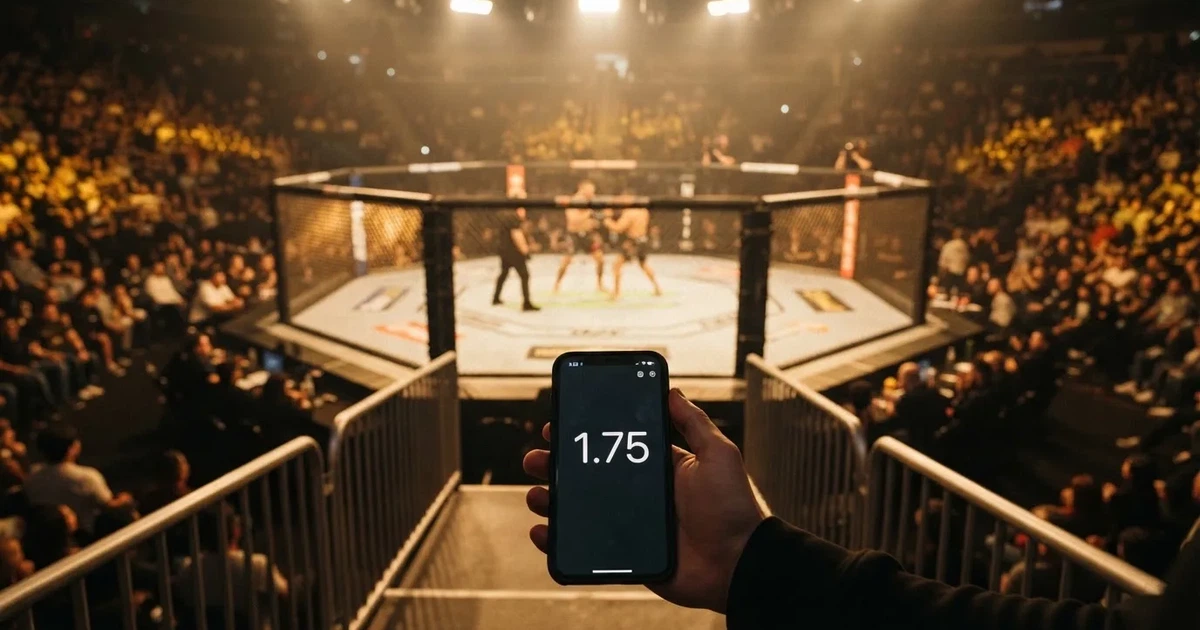
The Ultimate Fighting Championship sits on most British bookmakers’ A-list of combat-sports fixtures, and the odds attached to a fight card carry more information than the digits on the screen suggest. Every price has the bookmaker’s margin baked into it, every market settles by a specific rule, and the difference between a licensed operator and one that is not is wider than a price comparison lets on. This page works through how UFC prices are built, what markets are routinely on offer, where the margin lives, and which bookmakers hold a Gambling Commission remote licence to take bets from customers in Great Britain.
The fundamentals of a UFC fight and why they shape the odds
A UFC bout is a contest scheduled for three rounds of five minutes each, with one minute’s rest between rounds. Championship bouts and non-title main events run the same five-minute format but extend to five rounds. A fight ends by submission, knockout, technical knockout, judges’ decision (unanimous, majority, split or technical) or disqualification; a no contest is also a possible official verdict. Where the judges go the distance, three of them score every round under the ten-point must system: ten to the round-winner, nine or fewer to the round-loser, with 10-8 the usual line for a dominant round.
Those rules matter to anyone pricing a bout, because every market a bookmaker offers settles by one of them. The moneyline (who wins) pays on any of the stoppage routes listed above. Over/under rounds is structured around the three-round schedule and how many rounds a likely stoppage might run through. Method of victory (KO/TKO, submission, decision) puts a price on which route the fight finishes by. The method-of-victor market is the place where the round length and the judging rules do the most silent work: a decision lands after three full rounds pass, and a stoppage in round one settles on the clock.
A point worth holding onto is the title-fight draw rule: if a UFC title fight ends level on the judges’ cards, the champion retains the belt. That shifts what “draw” pays on the betting line, because the relevant “draw” outcome for the titleholder is effectively narrower than the rule itself.
UFC held its first event on 12 November 1993 in Denver, Colorado, and now runs more than eight men’s divisions and three women’s divisions, with over 750 events staged by 2026. The roster runs to roughly six hundred fighters across those divisions. The promotion is owned and operated by TKO Group Holdings, and Dana White has been its president since 2001. Two forthcoming UK-time-relevant fixtures research has anchored: UFC 334 (Gane vs. Hokit) on 14 November 2026 at Madison Square Garden, and UFC 335 (Oliveira vs. Lopes) on 12 December 2026 at T-Mobile Arena, Las Vegas.
How UFC betting odds are built: price, margin and what the bookmaker keeps
Decimal odds carry two pieces of information at once: how much a winning stake returns, and what slice of every pound bet the bookmaker keeps. On a two-way market at decimal odds 1.90 / 1.90, the implied probabilities add to 1/1.90 + 1/1.90, which comes to roughly 1.0526. The reciprocal, the payout share, is 1 ÷ 1.0526, or about 95%. The margin is 100% minus that, or roughly 5%, in this example. That 5% is what the bookmaker expects to keep on every unit staked on this market in the long run; the rest is returned to winning punters in proportion to their stakes.

A 5% margin is illustrative, not a number taken from any one bookmaker. On a UFC card, margins move around both by market and by operator. A heavy-favourite moneyline carries more margin on the favourite and less on the dog once bookmakers balance their books; method-of-victory and over/under rounds are more specialised markets and tend to run less efficient from the punter’s side. The fairest reading of “what margin does this bookmaker charge on UFC” is to check several markets side by side on the same card and look at the spread, not the single headline price.
The same payout-share arithmetic reads a three-way market (fighter A wins, fighter B wins, draw) just as easily. Take a hypothetical title fight at 1.45 / 3.10 / 26.00: the implied probabilities sum to roughly 1.069, putting the margin close to 6.9% and the payout share near 93.1%. The headline favourite price (1.45) looks generous, but the longshot price (26.00) on the draw is where meaningful margin hides, because very few punters back it and the operator can afford to clip it harder.
The margin is a statistical estimate over many bets at stated assumptions, not a guaranteed outcome for any individual punter. A single price can be read directly: stake × odds = return, and net profit on a win is stake × (odds − 1). That is the calculation a winning payout rests on, and it does not depend on what anyone else has staked or what the margin is on the wider market. The margin matters when the punter is shopping between bookmakers, not when settling one bet.
Where UFC betting stands in Great Britain
The Gambling Commission’s public register is the whole test of who holds a licence to take bets from customers in Great Britain, and that licence is required by the Gambling Act 2005 (and the 2014 amendment to it) wherever the operator is based. There is no statutory list of permitted sports: a licence holder for “remote general betting standard (real events)” may offer UFC markets at its own discretion, subject to the Commission’s Licence Conditions and Codes of Practice (LCCP) and its own house rules. Any figure stating how many operators are licensed is only as current as the day it was checked; the register moves.
Any operator serving customers in Great Britain without a Commission licence is committing an offence under section 33 of the Act, not the customer who bets with them. The risk of betting on an unlicensed site is not criminal. The risk is the loss of protection that comes with licensing: no GAMSTOP membership, no Commission complaints route, no approved alternative dispute resolution body, and no British consumer redress if funds are withheld. The £150 vulnerability-check rule (a public-record check, not an income check) and the 10x bonus wagering cap do not apply offshore. A site licensed in Curaçao, Malta or Gibraltar is not a substitute for a GB licence: that point is worth holding onto, because licensed operators use .com as well as .co.uk and the domain proves nothing.
Identity verification before the first deposit is a licence-condition standard for GB-licensed operators since 7 May 2019, so anonymous play is no longer the option it once was at a British site. A punter who values the absence of verification above other features will not find it at a licensed bookmaker, and should understand that the choice is also a choice to step outside the protections listed above.
Financial spread betting on UFC is a separate product from fixed-odds betting. Spreadex, for instance, is regulated by the Financial Conduct Authority for spread betting and by the Gambling Commission for fixed-odds betting, and it states that spread betting losses can exceed the deposit. Spread bets are not a suitable entry point for a punter whose question is “where do I put £10 on a main event”.
Responsible gambling: what every licensed UK bookmaker is required to put in place
GAMSTOP is the national multi-operator online self-exclusion scheme, a mandatory licence condition for online operators since 31 March 2020. A self-exclusion period is six months, one year, five years, or five years with auto-renewal. After the minimum period has run, the exclusion stays in place for a further seven years unless the customer asks GAMSTOP to remove it. GAMSTOP covers online sites and apps; betting shops run a separate in-shop self-exclusion arrangement.
The financial vulnerability check (LCCP condition 3.4.4, in force since 30 August 2024) applies when a customer’s deposits minus withdrawals exceed £150 in a rolling 30 days (since 28 February 2025). It is a public-record check (bankruptcy, county court judgments), not an income check and not a credit reference check. The “affordability checks” widely reported in the press sit as financial risk assessments under a separate, staged Commission plan announced on 7 July 2026; the start date has not been set, and it would be wrong to write that those checks are in force.
Deposit limits are a customer-set tool: every GB-licensed operator must offer them, and operators must apply a gross deposit limit on a fixed time frame under RTS 12. The first changes have applied since 31 October 2025; a second phase was postponed to 30 September 2026, and whether it is in force on the day a punter opens an account is worth checking against the operator’s own rules on the day. There is no state-set ceiling on deposits or losses: limits are the customer’s own.
Help exists outside the betting site. GamCare runs the National Gambling Helpline. GambleAware funds treatment and research. The NHS runs gambling clinics. Gamblers Anonymous runs local support meetings. A punter who feels the bet is no longer entertainment has more than one route to ask for help.
Crypto and UFC betting in Great Britain
“UFC crypto betting” is searched by punters who want to deposit in bitcoin or another cryptocurrency, and the British licensing frame makes that question sharper than it would otherwise be. No GB licence prohibits a customer from funding an account with bitcoin at a licensed operator; it is the operator’s own acceptance policy that decides. Where a licensed brand does not list cryptocurrency among its deposit methods, the customer is steered toward debit cards or instant bank transfer — both untouched by the credit-card ban in force since 14 April 2020.
An unlicensed site accepting bitcoin offers the speed and the pseudonymity that licensed sites structurally cannot offer. The trade-off is the one in the previous section: no GAMSTOP, no Commission complaints route, no approved ADR body, no British consumer redress, and no £150 vulnerability-check or 10x bonus-cap mechanism applying to the operator. A punt who values a low-friction deposit above consumer protection has decided something, and the decision is theirs to make knowingly.
The more informative framing is to separate two things. One is the asset used to fund the account. The other is the operator’s licence status. Mixing the two — “a licensed operator with crypto” and “an offshore operator with crypto” are not the same product — leads to a misread of the choice. Research has not anchored either as a routine fixture at GB-licensed brands; the practical action is to check the cashier at the brand in question rather than to assume.
What makes crypto relevant in the UFC space on the unlicensed side is the speed it permits. A punt funded in bitcoin, settling at the bookmaker end in a wallet the operator does not hold in the customer’s name, gets faster in-flight turnaround than a bank-transfer deposit can offer. The same speed is a feature for a punter who wants a last-minute live bet and who has accepted the loss of the protections a GB licence attaches. That trade-off is the substance of the question, and the page leaves it there because it is the punter’s to weigh.
UFC betting offers, bonuses and what a free bet is actually worth
“UFC betting offers” is the umbrella phrase, and inside it sit three distinct products that get bundled. A deposit match is a percentage of the customer’s own deposit credited as bonus funds, almost always with a wagering requirement. A free bet is a stake the bookmaker credits as a one-shot wager whose stake is usually not paid back on a win. A price boost is a one-off enhancement on a specific selection, settling on the same terms as a regular bet.
The wagering cap in force in Great Britain since 19 January 2026 is 10x: a £10 bonus at 50x is no longer permitted to require £500 of qualifying bets; under the cap no more than £100 of qualifying bets is allowed on that bonus. Mixed-product promotions (an offer requiring gambling on betting and casino together, for example “bet on a UFC card to get free spins”) are banned under the same rules. Promo codes, voucher codes and printed redemption paths are not printed on this page; the offer is described from each operator’s own terms.
The arithmetic of what a free bet is worth lives in a single line. Where the free-bet stake is not returned on a win, value equals the free-bet amount multiplied by (odds minus 1), divided by odds, multiplied by the payout share of the market. A £10 free bet at 3.00 on a market with a 95% payout share is worth roughly £10 × 2 ÷ 3 × 0.95, or about £6.33, on average. The “on average” qualifier is doing real work: any single bet either wins at the bookmaker’s return or loses entirely, and only across many such bets at varying prices does the average settle in.
Bonus types stay what they are. A cash bonus is a cash bonus. A free bet is a free bet whose stake is not paid back with a win. A “risk-free” bet refunded as a free bet is not a refund in money, and the description of the offer as “risk-free” is the marketing word rather than the substance, since the loss of the stake is not made whole. A price boost is a price boost. An acca insurance is a stake refund on a one-leg loss in an accumulator, usually capped and price-minimumed. A cashback is a percentage of net losses credited back, usually as bonus funds with a turnover. None of these descriptions is interchangeable.
The bet credit attached to a UFC card on the night is no different in its mechanics from the credit attached to a Premier League Saturday. The numbers move around, but the structure is the same: a headline figure, a wagering load, a minimum price on qualifying bets, an expiry window. The wagering load is the line a punter should read first; the minimum price is the line they should read second; the expiry window is the line that quietly costs most punters the most.
UFC betting apps and how the choice shows up on a phone
The market’s most downloaded sports-betting app in the UK sits on the App Store as bet365, and it is also the official global betting partner of the UEFA Champions League. The brand’s offering on the app is the strongest example of two features a UFC punter may want on the night: Bet Builder+ (markets from one event into a single bet, available pre-match and in-play) and a roster of Super Boosts, Winnings Boosts on Bet Builders and selected singles, plus daily Bet Boosts.
Those features exist at other operators in different shapes. A bet builder is a same-game multi: a market that lets the customer combine selections from one bout (method of victory and over/under rounds, for instance) into one priced bet. An acca builder is a cross-fight accumulator with selections spanning the card. Both sit inside the app or in the mobile browser, and the difference between them in the punter’s hand is the order of taps, not the nature of the bet.
A subtle but real distinction is the in-app experience of live markets. A bookmaker whose in-play prices update in flight on a 4G signal is a different product from one whose update lags or whose in-play markets are limited to winner markets only. The two factors that govern that experience are the app’s refresh speed and the bookmaker’s in-play pricing engine, and the second of those is the more important one. A fast app behind a thin in-play book is still a thin in-play book.
A few practical pointers:
- Check the deposit flow on the app before match night — first deposits on the night often queue behind verification, and verification is a licence condition.
- Check the bet-builder availability for the specific bout, not the brand in general: build availability is event-specific.
- Check whether in-play cash-out is offered on UFC, since several operators gate cash-out by sport.
Live UFC betting and cash-out
In-play UFC is structurally different from in-play team sports. A fight has discrete short rounds (five minutes, one minute’s rest), and the betting opportunities compress into the gaps between rounds, where most bets clear before the next round starts. A bookmaker’s in-play margins run wider than pre-match in this sport, and the reason is the volatility of an unfinished fight: a single strike can swing the method-of-victory market, and the pricing engine tries to keep up.
Cash-out is the operator-offered option to settle an open bet mid-fight at a quoted figure, locking in profit if the bet has moved the punter’s way or limiting loss if it has moved against them. Cash-out is offered at the operator’s discretion, and the quoted figure rests on the same in-play margin that governs live prices on the same fight. Most operators gate cash-out by market: a moneyline bet offers cash-out through most of the fight; method-of-victory bets usually do not offer it after round one; over/under rounds is rarely cashed out at all.
The smart framing for live UFC is this: in-play is a feature a punter can use selectively (pre-fight bet, watch the fight, react in real time) and a bookmaker can price more conservatively. The punter who treats in-play as a casual add-on tends to lose more than they expected, because the wider margin on a close fight is invisible on a small screen. The punter who treats in-play as a structured tool — pre-set maximum stake, pre-decided markets — gives themselves a better read of the same product.
Watching the fight and betting on it are two activities that pull against each other. The bookmaker’s in-play prices are built to assume the customer’s attention; the customer’s attention is the resource that makes those prices useful. A pre-match bet on the main event, with in-play used to trade out if the picture changes, is the most disciplined pattern.
UFC betting tips and what a tip actually is
A “UFC betting tip” is somebody’s forecast about who wins, expressed as a selection with an argument. The argument is the only part worth reading, and the only part that survives the next fight. A tip with no argument is closer to a toss of a coin from the reader’s side: the tipster’s record is the only signal, and a record alone is unreliable because it is rarely audited by anyone other than the tipster.
What works in this market is not tips as a product. What works is reading the form book, knowing the camps, and understanding the rule effects. A fighter who has lost three in a row by submission is a different betting proposition than the headline record suggests; a champion returning from a long injury layoff is a different proposition than the same fighter at full fitness. Those are the readings a tipster’s argument should produce on the page, and they are the readings a punter can apply without paying for the tip.
The honest framing for any “best UFC bets today” page is that nobody can know who wins a fight in advance. A reader who bets on a predicted one loses real money on the page’s word. The pages this site writes about UFC explain how a market, a bet and an offer work and what they cost the punter — not who wins and not what the reader should back. The same line holds for accumulator tips: an acca multiplies prices and it multiplies the margin along with them, so the line that pays best on the headline almost always pays worst in expected terms.
What a structured punter looks at instead of tips is opportunity, not prediction. Markets whose prices look soft (heavy-favourite moneyline where the favourite is overpriced, method-of-victory where the favourite’s stoppage pattern is underpriced) are opportunity. Value is identified on a price-by-price basis, not on a tip-by-tip basis, and the page’s job is to equip the reader to do that reading, not to do it for them.
Bet types on UFC markets and what each one settles on
The lineup a punter sees on a UFC card runs longer than just the main event. Each market type settles by its own rule, and the settle rule is what defines the bet.
Moneyline (winner). Pays if the selected fighter wins by any route. The price reflects the implied probability of winning plus the bookmaker’s margin. The favourite at 1.40 looks generous; the longshot at 6.50 looks generous too. Neither price is generous on its own — it is the margin around them that decides.
Method of victory. Pays if the selected fighter wins by the selected method (KO/TKO, submission or decision). A price for a decision win on a heavy striker is often overpriced on the method-of-victory market because the punter is implicitly betting against the fighter’s preferred route.
Over/under rounds. Pays if the fight goes over or under the rounds line, which is set as a half-round (1.5 rounds, 2.5 rounds, and so on). The line is built around the likely stoppage round and the round length, and a 1.5 over is a different question on a three-round fight than on a five-round title fight.
Winning round. Pays if the selected fighter wins in the selected round. A “round 1” group win is a different market than a “any other round” group, and the prices reflect the fighter’s stoppage history by round.
Fight to go the distance. Pays if the fight goes to the judges’ scorecards. This market exists at most major operators and settles only on a completed decision; a no contest or a disqualification in the closing seconds usually means the bet settles as a loss.
Draw. Pays if the judges score the fight level. As noted earlier, the title-fight draw rule keeps the title with the defending champion, so a draw bet on a title fight is implicitly a bet against the challenger winning.
Method of victory and winning round both lean on the round structure — five-minute rounds, one-minute rest — and on the stoppage rules. A punter who prices a bout by combining a moneyline read, a method-of-victory read and an over/under-rounds read is pricing the same fight three ways; if the three reads agree, the price is well-grounded, and if they disagree, one of the three is wrong, and the argument says which.
Bet builder. A same-game multi built from markets on one fight. A bet builder on UFC combines markets like moneyline, method of victory, over/under rounds and “to go the distance” into one priced bet. Margins on bet builders run wider than the singles they combine, because the bookmaker is pricing the correlation between selections.
Accumulator (acca). A multi-leg bet across several bouts on the card. The odds multiply across legs, and the margin along with them. An acca insurance offer refunds the stake as a free bet if one leg loses, usually capped at a maximum refund and subject to a minimum number of legs and a minimum price per leg.
Betting exchange markets. A betting exchange matches punters against one another rather than pricing against the house, with a commission taken on net winnings. Matchbook is the exchange on the comparison, and it offers back and lay betting, in-play markets and live streaming on selected sports (horse racing and greyhounds named in the App Store description). The price a punter sees on an exchange is the market-cleared price; the margin is in the commission, not in the price.
The sports and the fixtures: where UFC sits in a UK bookmaker’s offer
UFC is the headline MMA promotion, but it is not the only one. Bellator, ONE Championship, PFL and regional promotions run on a busy calendar, and a bookmaker’s MMA menu tends to follow the live promotions. A brand that markets itself as “the home of UFC” is a different proposition from one that offers a wider MMA menu with UFC as the headliner. The punter whose interest sits on a specific promotion should check that promotion is live on the brand before match night.
Event numbering — UFC 334, UFC 335 — is how the promotion labels its pay-per-view main cards. Numbered events run on a calendar with pay-per-view and ESPN in the United States; in Great Britain, the broadcast has moved between providers in recent years, and the operator’s live-streaming offering is the punter’s route on fight night. Live streaming of UFC is offered by some operators under their own licence conditions; it is not a universal feature, and availability is event-specific.
The volume of events is worth holding onto: over 750 events to date, with two titles lined up in late 2026 (UFC 334 and UFC 335). A punter who treats UFC as a one-event-a-month sport under-prices it; the action is on the Fight Night cards in between, and that is where the bookmaker’s in-play product earns its keep.
The comparison: ten licensed bookmakers on the same UFC fixtures
The table below lists ten operators licensed by the Gambling Commission for remote general betting (real events). Each card shows the licence as it appears on the Commission’s public register, the licensee of record and the position the operator’s own terms take on the most material UFC-related question for a punter. No licensee in this set offers a different deal on that material question on principle — that is what the licensed frame enforces — but several points of difference show on what each operator chooses to offer alongside the licence.
| Brand | Gambling Commission remote licence number and licence holder | Position on the page’s subject |
|---|---|---|
| Bet600 | 044731-R-323941-016; Tyche Tech Limited | Pays Best Odds Guaranteed on horse racing: where the starting price beats the price taken, the bet settles at the SP |
| BoyleSports | 039469-R-319383-025; Boylesports Enterprise | Sports welcome in free bets for new UK players tied to an opening wager |
| Matchbook | 039504-R-319407-024; Triplebet Limited (remote general betting standard and remote betting intermediary) | A betting exchange where customers bet against one another, with back and lay, in-play and Bet Builder on the listed sports |
| Betboro | 044181-R-324363-007; Webmedia Development N.V. | Sports welcome in free bets on the first qualifying wager, debit-card deposit floor and a minimum price per selection |
| Tote | 054779-R-331321-008; TDCO Limited | A pool-betting heritage with a remote general betting standard (real events) licence and Best Odds Guaranteed across UK and Irish racing |
| Fitzwilliam Sports | 048760-R-335434-009; SBKI Limited | A Dublin bookmaker with capped membership, fast deposits and withdrawals, plus safer-gambling tools in every account |
| Bet Ahoy | 100094-R-341742-003; Bet Ahoy Ltd | A welcome offer split between a sports single and an accumulator of equal value |
| Unibet | 045322-R-324275-019; Platinum Gaming Limited | Operated since 1999, with a sports welcome in free bets subject to a minimum stake and minimum price, expiring seven days from issue |
| Kalooki Sportsbook | 057730-R-333396-005; Kalooki Sportsbook Ltd | Operated by Kalooki Sports Book Ltd (company number 12938274), with a GAMSTOP membership that is mandatory for online operators |
| Copybet | 053774-R-330743-010; Copybet UK Limited | Best Odds Guaranteed all day, every day, on all UK and Irish racing, with payment on first past the post |
The licence number on a Commission card is the same number a punter can search on the public register, by business name, trading name, domain or account number. A licence card the brand has not published on its own site is a routine feature; the test is whether the card matches the register, and the register is the whole test. Several brands can run under one licensee, and they are not independent operators for that reason.
The right column is not a “best UFC bookmaker” ranking, because the page has no test on which to draw that line, and no bookmaker here has stood out as a UFC specialist on the materials research has anchored. UFC is on the menu at every brand in the table, and the menu depth is roughly comparable across them. A punter who has already decided to bet at one of these brands on other sports has decided to bet on UFC there in the same transaction.
Bet600
Tyche Tech Limited holds the licence, and the brand gates the headline horse-racing offer behind the standard qualifying-bet structure: take an early or show price, and the bet pays at the SP if the starting price is larger. The structure is for horse racing, not UFC, but the punter who also bets on racing has the BOG on the same account they will use to back a main event. The brand’s UFC offer is the standard menu of moneyline, method of victory, over/under rounds and round groupings, and it does not market itself as a UFC brand.
For a punter whose betting life is split roughly between horse racing and a few UFC cards a year, the BOG adds a steady layer of value on the racing side. The UFC side is functional without being the punter’s headline reason for the account.
BoyleSports
Boylesports Enterprise is the licensee of record, with a sports welcome aimed at new UK players through free bets tied to an opening wager. The mechanics are the post-19 January 2026 standard: a wagering load under the 10x cap, a minimum qualifying stake and an expiry window. The UFC coverage is the broad menu, and BoyleSports has no UFC-specific product that research has anchored. The welcome is the obvious reason to consider this brand for a first account; the rest of the offer settles into the routine for the operator set.
For a punter comparing welcome offers across several brands in the same week, BoyleSports is in the running on the headline figure alone. The wagering load, the minimum price per selection and the expiry window are where the comparison actually sits, and those three numbers are not the same across brands.
Matchbook
Triplebet Limited holds both the remote general betting standard licence and the remote betting intermediary licence, the only betting-exchange entry in the table. Back and lay betting, in-play markets and a Bet Builder product feature in the App Store description, alongside live streaming of horse racing and greyhounds. UFC coverage on the exchange follows the same principle as elsewhere: prices clear on supply and demand rather than the operator’s margin, with commission charged on net winnings instead.
For a punter who prices fights by laying outcomes as well as backing them, an exchange is a different product from a fixed-odds bookmaker and the right tool sits in the same account. The catch is commission: a price that beats the bookmaker’s price may still be a worse net trade once commission is taken out, and the commission structure is worth reading on the account’s first day.
Betboro
Webmedia Development N.V. is the licensee, with a sports welcome that pays a matched free bet on the first qualifying wager, subject to a debit card deposit of at least £10 and a first bet of £5 to £25 with at least three selections each at 3/5 (1.60) or higher. The minimum-price rule on each selection is the structural point: 1.60 looks lax, but it is per selection, and three selections at 1.60 are a less generous price-meets-minimum than a single bet at 1.60. The £25 ceiling is the cap that keeps the welcome modest.
For a punter who already has a Bet Builder pattern, three selections on a UFC fight card at 1.60 is easy to clear. For a punter who backs favourites only, the minimum price is the constraint, and the welcome is narrower than the headline suggests.
Tote
TDCO Limited holds the licence, with a pool-betting heritage that the brand carries over to its fixed-odds menu. The remote general betting standard (real events) licence covers the modern offer, and the Best Odds Guaranteed concession is paid on UK and Irish horse racing from 8 AM on the day of the race, on both singles and multiples, with the exclusions the operator sets: no ante-post, no tote, no pari-mutuel. UFC sit on the menu as the broader bookmaker offer, and the brand has no UFC-specific product that research has anchored.
For a punter who also bets on racing, the BOG is the headline feature of the account; the UFC side is functional and no more. For a punter whose interest is UFC alone, the racing-side concession is no value at all.
Fitzwilliam Sports
SBKI Limited is the licensee, with the brand describing itself as a Dublin bookmaker with capped membership. The capped-membership framing is the headline point: the account ceiling is a feature rather than a leak, because the bookmaker runs a tighter book with fewer customers. Faster deposits and withdrawals, deposit limits and timeouts, plus links to GambleAware, GAMSTOP and Gamblers Anonymous sit in every account. The welcome is a “High Stakes Welcome” subject to compliance criteria, and the headline figure is not the read of what a punter will clear.
For a punter whose stake size is at the higher end of a normal betting account, the High Stakes Welcome is the feature that justifies an account; for a punter whose stakes sit at the lower end, the welcome is gated behind criteria the brand does not publish, and that punter is better served elsewhere.
Bet Ahoy
Bet Ahoy Ltd is the licensee, with a welcome offer that splits £10 in free bets into a £5 sports bet and a £5 accumulator. The split is the structural point: a £5 single and a £5 acca are not interchangeable wagers; the acca carries the multiplied margin, and the single carries the single price. The headline figure looks like the standard free-bet welcome; the split changes the value distribution between two bets.
For a punter who already keeps an accumulator running across a UFC card, the acca portion of the welcome lines up with the habit. For a punter who does not bet accumulators, the £5 acca portion is the friction, and the welcome is closer to a £5 single than the headline.
Unibet
Platinum Gaming Limited is the licensee, and the brand states that it has operated since 1999. The welcome pays £40 in free bets on a £20 qualifying bet at minimum odds of 2.0 (1/1), with the free bets expiring seven days from issue. New GB customers funding with a debit card or instant bank transfer are eligible. The credit-card ban in force since 14 April 2020 is the licence-condition posture; Unibet’s payment set is the routine licensed set.
For a punter comparing welcome offers in headline terms, Unibet sits near the front of the comparison; the minimum-price rule, the seven-day expiry and the funding-method constraint are the structural points behind the headline figure. The seven-day window is the field that quietly fails most punters, and a punter who does not bet in that window loses the credit.
Kalooki Sportsbook
Kalooki Sports Book Ltd (company number 12938274) is the licensee, and the brand is a GAMSTOP member. The brand’s headline relevance is the licence-card identity rather than a UFC-specific feature: it is one of the operators in the comparison set with a clean licence draw on the public register, and the GAMSTOP membership is the mandatory condition the operating licence applies to online operators. The UFC menu is standard.
For a punter for whom the licence-card identity is the deciding factor rather than the welcome offer, Kalooki is a defensible choice. A punter drawn by the menu rather than the licence has many more options in the same set.
Copybet
Copybet UK Limited is the licensee, with a Best Odds Guaranteed concession that runs all day, every day on all UK and Irish racing, plus first past the post on horse racing paid even where the winner is later disqualified. The brand has no UFC-specific offering that research has anchored, and the UFC sit on the standard menu.
For a racing-heavy punter, Copybet is in the running on the racing-side concession alone. For a punter whose interest is UFC, the racing-side concession does not earn the account; the standard menu on the UFC side does not differentiate the brand.
What the page’s margin calculation says
Taking an illustrative two-way market at decimal odds 1.90 / 1.90 — an example rather than a quoted price — the implied probabilities add to 0.5263 on each side, or 1.0526 in total. The payout share is 1 ÷ 1.0526, or about 95%. The bookmaker’s margin is 100% minus that, or roughly 5%. The exact figure is on a band: depending on rounding, the figure sits at 4.8% to 5.3%. Condition: this is a band on a constructed example, not a number taken from any one bookmaker.
Reading the band against a punter’s decision: a single bookmaker pricing a UFC moneyline at 1.90 / 1.90 is keeping about 5p of every £1 staked on this market over the long run. Reading the band against the wider comparison: a brand whose UFC moneyline margin sits at 5% beats a brand whose margin sits at 7%; the headline prices on the screen do not always tell the reader which side they are on, because a wide margin can sit on a longshot price the punter never takes. The band is the headline; reading any single price against it requires the other side of the market to be on the screen at the same moment.
How a winning bet is paid out
The mechanics of a settled bet on UFC are the same as the mechanics of any other settled fixed-odds bet. The punter’s stake multiplies by the decimal odds, the product is the total return, and the net profit is the return minus the stake. A £10 stake at 3.50 returns £35, with £25 of profit and the £10 stake returned. A £10 stake at 1.40 returns £14, with £4 of profit and the £10 stake returned. The numbers on the slip match the numbers in the account once the bookmaker settles.
For accumulators, the odds multiply across the legs: a bet with three legs at 1.80, 2.10 and 2.60 has combined odds of 1.80 × 2.10 × 2.60, or about 9.83. A £10 stake returns £98.30. The price looks generous on the slip; the margin that the bookmaker has applied to each leg compounds across the acca, and the punter’s realised margin is wider than the margin on any single leg. That is why accumulators sit at the centre of so many welcome offers: the product is structurally profitable for the bookmaker.
For a free bet whose stake is not returned, value equals free-bet amount × (odds − 1) ÷ odds × payout share of the market. A £10 free bet at 3.00 on a market with a 95% payout share is worth about £6.33 on average. Any single bet either wins at the bookmaker’s return or loses entirely; the average settles across many bets, and the punter who treats one free bet as the test of the offer has not seen what the offer does across a card.
Settling a bet on a UFC bout usually means waiting until the result is official. Method of victory, winning round and fight-to-go-the-distance all settle only once the judges’ scorecards are read or the stoppage is called. In-play bets settle on the moment the market in question is closed; cash-out figures are the bookmaker’s offer at that moment and the punter either accepts or declines.
Reading the rest of the British market
A licensed bookmaker’s identity-card rule on the public register is the structural difference between a GB-licensed operator and a non-GB one. A licensed operator’s identity is on the register, with a Commission licence number, a category (remote general betting standard real events, remote betting intermediary, and so on) and a trading name. The punter’s check is mechanical: open the brand’s homepage footer, copy the licence number, search the register, check the categories.
A licensed operator runs under multiple licence conditions: identity verification before first deposit (since 7 May 2019), no credit-card deposits (since 14 April 2020), GAMSTOP membership (since 31 March 2020), the 10x wagering cap on bonuses (since 19 January 2026) and the £150 vulnerability check after a deposit-minus-withdrawal threshold (since 28 February 2025). Each condition is the licence frame doing what the licensed frame is supposed to do. A non-licensed operator runs outside every one of those conditions.
The remaining practical checks are simple. Open the cashier and confirm the available deposit methods; check the licence card on the operator’s site against the Commission’s public register; check the in-play markets the operator offers on UFC, including cash-out; read the welcome offer’s wagering requirement, minimum price per selection and expiry window before placing the qualifying bet. None of those checks is heroic, but skipping any one of them is the route most punters lose money on a welcome offer.
Choosing where to bet on UFC
The honest framing is that this page has no test on which to draw a single UFC-bookmaker ranking, because research has not anchored any UFC-specific feature at any one brand that the others do not also offer at a comparable level. The choice sits on the routine comparison: licence, payments, live product, offer and price, with the UFC menu being roughly comparable across the licensed set.
A punter who already has a preferred bookmaker on another sport has a defensible reason to keep that account for UFC too. A punter starting from zero has the comparison set above as a starting point; the choice reduces to which welcome offer, which payment set and which live product the punter prefers, since the licence identity is comparable across the set.
A punter who feels the welcome offer is the deciding feature should read the three structural points (wagering cap, minimum price per selection, expiry window) and not the headline figure. A punter who feels the betting exchange is the deciding feature should open an exchange account, since back and lay pricing is not the same product as fixed-odds pricing. A punter who has decided anonymity is the deciding feature has stepped outside the licensed set, and the trade-off is the one in the legality section.
The main event on the night is the main event on every licensed bookmaker’s app. The rest is reading the market and reading the offer, both before the first bell.
Where the data sits, and where it does not
The register snapshot is from the public licence entries research has anchored; the offer headlines and the live-product features are from each operator’s own terms page and App Store description. Two checks a punter should run on the day:
- Confirm the operator’s licence on the Commission’s public register. Card numbers do not expire from the register when the brand updates its terms.
- Read the welcome offer’s wagering requirement, minimum price per selection and expiry window before placing the qualifying bet. None of those numbers were relaxed in 2026; the 10x cap has tightened them in some directions and not in others.
Pricing data on UFC markets is event-specific, and an exact price a bookmaker quotes for a fighter on Monday will not be the same price on Saturday. The margin arithmetic in the previous section is illustrative; the real test is to look at several markets on the same fight at the same bookmaker and read the spread, not the headline price.
Frequently Asked Questions
Where to bet on UFC fights?
At a bookmaker licensed by the Gambling Commission for remote general betting (real events). The Commission’s public register lists every licensed operator by name, domain or licence number, and that register is the whole test of who holds a GB licence. Ten licensed operators sit in the comparison above, and a punter’s choice reduces to which welcome offer, payment set and live product they prefer, since the UFC menu is broadly comparable across the licensed set.
Where to bet on UFC?
The same answer applies as for UFC fights specifically. A bookmaker’s remote general betting standard (real events) licence covers MMA and the UFC card along with every other sport on the menu. There is no UFC-only licence category. An operator with a remote general betting limited licence, by contrast, has a constrained menu and may not carry UFC at all.
Where can I bet on UFC fights?
At a licensed UK bookmaker, via its website or app. Identity verification is required before the first deposit, so a brand offering instant anonymous play is operating outside the licensed frame. The set above covers the routine options; an exchange (Matchbook) is also an option where a punter wants back-and-lay pricing rather than fixed-odds pricing.
How can it be checked that a bookmaker holds a Gambling Commission licence?
Open the Commission’s public register, search by trading name, business name, domain or licence number, and check the categories on the licence card. A licence for “remote general betting standard (real events)” covers UFC. The brand’s own homepage footer usually carries the licence number to copy into the register. A card on the homepage is not proof on its own; the register entry is.
How is the return on a bet worked out from the stake and the odds?
Multiply the stake by the decimal odds. A £10 stake at 3.50 returns £35 in total (£25 profit plus the £10 stake). The same arithmetic holds for accumulators, where the odds across the legs multiply into a single combined price. Where odds are quoted in fractional form (5/1, 11/4), the conversion is the numerator divided by the denominator plus one (5/1 = 6.00, 11/4 = 3.75).
What is the bookmaker’s margin and how can it be seen in the odds?
The margin is what the bookmaker keeps of every unit bet on a market. On a two-way market at decimal odds 1.90 / 1.90, the implied probabilities add to roughly 105%, and the 5% excess over 100% is the margin. The margin is a long-run average: any single bet pays out at the price the punter took, but across many bets the margin is what the bookmaker expects to retain on the market as a whole.
Combat & motorsport – Best Betting Tips
Content created by the «Best Betting Tips» team
