
Rugby league betting odds in 2026 — reading the price, finding the market
 Available in US
Prices checked as of 27 October 2026 against each bookmaker’s own published rules and the Gambling Commission’s public register of remote licence holders.

Rugby league sits in a strange spot in the British betting market. The sport has a tiny fixture list compared with football, but a serious gambling tradition behind it — the working-class Northern heartland built around Super League, the Australian NRL beamed into UK living rooms by subscription, the World Cup every few years that briefly puts the thirteen-a-side code back on the front of the papers. Bookmakers know this. They also know that the betting public who watch rugby league are more sophisticated than the football-only crowd, which is why the prices on offer tend to be sharper and the markets thinner at the same time. Fewer betting options, tighter odds, more than one product hiding inside a single line.
This guide is built around that tension. It walks through what a rugby league betting price actually contains, what kinds of bets GB bookmakers offer on the sport, where the live markets work and where they do not, how the bigger sign-up offers really pay out, and which of the ten licensed bookmakers in this comparison actually suit a rugby league punter. The maths underneath — the margin, the payout, what a free bet is worth — is the same maths that runs every other betting market, but it lands harder in rugby league because the prices are tighter and the punter who cares has fewer distractions.
The current Super League season and the NRL regular season are both in full swing in 2026, with State of Origin settled for another year and the Rugby League World Cup in Australia on the horizon. Wherever a fixture or a tournament is named below, the year is the year the competition is being played — not a stand-in for the publication date.
How a rugby league price moves while the match is on
Live betting on rugby league is built around two things the football in-play markets do not have to deal with: the tackle count, and the stop-start nature of set defence. A side gets six tackles to make ground; on the sixth, they either kick or hand the ball over. The clock does not run while the ruck is set, which means a rugby league in-play price can move on a single play in a way a football price cannot. A break through the line on tackle five, with numbers out wide, can swing the win market by three or four ticks in the seconds before the pass is thrown.
That volatility is the opportunity. It is also the trap. GB bookmakers have refined their rugby league in-play products over the last two NRL seasons in particular, because the time-zone difference means the Australian games run in prime UK evening viewing hours and a UK punter watching the match can see the live pictures most platforms now stream alongside the price. The catch is that the bookmaker’s algorithm is also watching those pictures, and it is faster than the punter at the bar. By the time the trader hits “place bet” on a winger breaking clear, the price has usually already moved.
Cash out sits on top of that. The feature is offered on rugby league by most of the GB bookmakers in this comparison, and it works the same way it does on football: a punter with an open position can settle the bet early at a price the platform quotes, taking a smaller win or a smaller loss than waiting for the final whistle. For rugby league specifically, cash out is most useful on the handicap and total-points markets, because those markets swing hardest when a side goes on a run of possession. It is least useful on the head-to-head at the death, where the bookmaker’s margin in the live window is widest and the offered cash-out price is the most punitive.
The one structural difference worth flagging: rugby league has fewer “minor” in-play markets than football. Match-result, handicap, next try scorer, next scoring play, total points in bands of ten — that is roughly the menu. There is rarely an in-play corners-equivalent, no cards market, and no player-shots market of any depth. A punter who wants a wider in-play selection has to look at football. A punter who wants the in-play product where the margin is tightest is well served by rugby league, provided they are comfortable with the limited menu.
A last note on this section’s substance: the value of cash out is not the value of the marketing. “Cash out” sounds like a free option, and a few platforms dress it as if it were — a green button, an immediate figure, a punter who never has to sweat the final ten minutes. It is not a free option. The cash-out price is the bookmaker’s own live price, with the same margin it puts on every other live market that minute, plus a small additional spread to protect the platform against the punter who has a faster information feed than the average customer. Used sparingly, on positions that have moved well in the punter’s favour, it is a useful tool. Used as a habit, it bleeds the bank.
What a “tip” actually moves in rugby league
The punter who searches for rugby league betting tips is, on the evidence of the search volume itself, looking for one of three things: a model, a tipster, or a method. None of the three can be bought at a fixed price by anyone except the punter doing the building, and a tip service that promises a winning record at a flat subscription is selling something the maths says cannot be sold.

What can be done, and what the rest of this section is about, is the second-order work that sits underneath a price. A rugby league fixture has more pre-match information than the price initially reflects, because the public markets are thinner than the football markets: the head-to-head price of a Super League game moves less on team-news than a Championship football price does, but it moves more on the same information, because there are fewer bets to absorb the news. That thinness is itself an edge, if used carefully.
Form, in rugby league more than in football, is a fixture-level question rather than a season-level one. A Super League side can lose four on the bounce and then go to a venue they have won at for three seasons and look like a different team. The reverse also happens — the home side that has not lost at their ground for two years, who suddenly cannot buy a tackle. The schedule matters: a side three days off a Friday-night cup game against an NRL touring side will be flatter than the betting public, working off last weekend’s league form, realises. Where a tip is “Wigan to win”, the real question is whether Wigan have had a full week’s rest, whether their starting hooker is fit, and whether the venue is one where the favourite has covered the handicap in the last five meetings. The headline tip and the underlying reasoning are often two different bets.
Staking plans are the third leg, and the one leg most “tips” pages leave out. A flat stake of one unit per bet, applied across a season’s worth of rugby league picks at the sort of margin the major GB bookmakers charge, will end the year down. A staking plan that adjusts unit size to the punter’s own assessment of edge — bigger bets where the punter believes the published price is most wrong, smaller bets where the edge looks thin — does better, and is the difference between a tipster and a model. None of this is hidden; the maths is on every punting-forum thread going. It is not glamorous, and the pages that sell tips never mention it for the same reason.
The honest framing for the reader who arrived at this page through a search for tips: a tip is a sentence. A model is a spreadsheet. The punter who keeps a spreadsheet will, in the long run, lose less than the punter who reads sentences, because the spreadsheet punter bets fewer times and only when the price is wrong. The rugby league calendar — Super League from February to October, the NRL from March to October, plus Challenge Cup, World Cup and international windows — gives around 200 priced fixtures a season at the major competitions. A punter who prices them all is betting for the sake of betting. A punter who prices the ones with the thinnest margin and the most public information lag is making a market.
The markets a real sports book offers on rugby league
The standard menu on a Super League fixture at a GB bookmaker covers the head-to-head, the handicap (a points spread, usually a multiple of four to keep the math clean given the four-point try), the total-points line, the first tryscorer and the anytime tryscorer, the half-time/full-time double, the winning margin in bands of six, and a few novelty lines (race to ten points, race to twenty, first scoring play). NRL fixtures carry the same menu plus the same-product margins — selected markets the bookmaker offers alongside its standard book — at a tighter margin, because the Australian market is more competitive and the British punter betting the NRL is, on average, sharper than the British punter betting Super League.
The handicap is the most important rugby league market for the serious punter, because the points-spread book on a Super League fixture is where the margin is tightest and where a punter with a view on the size of a favourite’s win can express it. A line of Catalone minus 36, for example, prices the bookmaker’s view that Catalone will win by roughly that margin; a punter who believes the favourite will win by forty-plus takes the favourite at the line, and the punter who believes the favourite will be tested takes the dog plus the points. The whole market is a single number, but the punter’s view is a single number too, and where the two disagree is the bet.
Totals are the next market that punter-level analysis can move. Rugby league scores are higher and more clustered than football scores — a typical Super League game finishes in the 24-to-36-point range, with both sides contributing. The bookmaker’s total line, set at 40.5 or 42.5 or thereabouts, prices the median outcome. Where the punter believes a game will fall outside that median — wet weather, two defensive forwards out, a forward pack that has not travelled well — there is a totals bet to make.
Tryscorer markets are the third leg, and the leg most exposed to the overround. First tryscorer and anytime tryscorer are priced as a field of twelve or so runners, with each runner’s price reflecting the bookmaker’s view of their chance of scoring. The catch is that the field of twelve includes props, second-rowers and the hooker, several of whom will not score in the entire game; the bookmaker’s overround is built into the long-tail runners the punter does not back, and the prices on the wingers and full-back that the punter does back are sharper than they look. The edge is on the side that prices the prop’s chance of scoring accurately, which is almost no one.
The settlement rules underneath those markets are where the punter’s read of the sport matters as much as the read of the price. Match betting and handicap betting on Super League and NRL games settle on eighty minutes of play, with extra time ignored. Most other markets — outright, top tryscorer, season markets — settle on the official result including extra time. A whole-match handicap of the whole -27 (a whole number) that lands on twenty-seven points difference, exactly, refunds every stake on the line, which is one of the cleanest rules in betting and one of the few that the punter can rely on without checking the small print.
Bets on a postponed match stand for forty-eight hours from the original kick-off, then become void. That is the standard rule across the major GB bookmakers, and it is worth knowing because rugby league fixtures are postponed more often than football fixtures — bad weather in the North of England in February is a regular culprit, and so is the rescheduling that follows with the Challenge Cup and the World Cup windows.
The competitions a real sports book prices
The competitions the major GB bookmakers actually carry, in the order the punter meets them through the season, are the Super League (England), the NRL (Australia and New Zealand), the Championship and League One (England’s lower divisions, covered thinly), the Challenge Cup (the UK’s knockout competition), the World Cup (every four years or so, with the next in 2026 on the Australian east coast), State of Origin (the three-game annual series between New South Wales and Queensland), and the international programme (England, Great Britain, Australia, New Zealand, Tonga, Samoa, Fiji, France and a few others). A few bookmakers also carry the Super League women’s competition, but the markets there are thin and the price quality is accordingly patchy.
Super League is the spine of the British rugby league calendar and the one competition every GB bookmaker prices. Twelve teams play each other home and away across twenty-four rounds, plus a finals series of six games over four weeks. The market depth on a televised Super League fixture is good — head-to-head, handicap, totals, tryscorer, half-time/full-time, margin and a couple of in-game specials — and the in-play product is mature. The teams that drive most of the volume are Wigan, St Helens, Leeds, Hull KR, Hull FC, Catalans and Warrington, with the rest of the league carrying smaller markets and slightly wider margins.
The NRL is the bigger product in absolute betting volume — the Australian game attracts more money than the British game by an order of magnitude — and the time-zone gap means a UK punter watching the NRL is betting against a price set by an Australian and British audience both. That overlap is useful: it means the price is information-efficient in a way the Super League price is not. It is also harder to watch the games live in the UK, which is where the streaming and live-picture question starts to matter.
State of Origin is the three-game annual series between New South Wales and Queensland that takes the NRL’s best players out of their clubs for a Wednesday night in mid-year. The betting interest is unusual: a series is priced match-by-match, with the series winner market running alongside, and a small market on the individual game-by-game Man of the Match. The volumes are large — Origin is the biggest betting event on the Australian rugby league calendar — and the GB bookmakers who carry it price it tight. The punter who follows NRL club form closely has an edge on Origin that the punter who only watches the Origin games does not, which is the other unusual thing about the competition.
The Challenge Cup and the World Cup sit alongside, with thinner markets. The Challenge Cup is the knockout competition, and the final at Wembley is the one game in the British rugby league calendar that draws genuine casual betting interest. The World Cup, when it runs, is the rare international event the GB bookmakers price seriously, and the next tournament in Australia is already on the bookmaker’s planning calendars. Markets will run on every game of the group stage and on the knockout rounds, with outright, top tryscorer and player-of-the-tournament side markets.
The international programme beyond the World Cup is priced thinly. England versus Australia in a mid-season test match will be priced match-result and handicap, and that is about it. The punter looking for an edge on international rugby league is mostly looking at a thin market with a wide overround, which is the worst possible combination.
The licensed bookmakers this comparison covers
This page works through ten operators on the Gambling Commission’s public register of remote licence holders that serve Great Britain. Each holds a remote general betting standard licence covering real events, the standard betting category for rugby league. Matchbook, the betting exchange, also holds a remote betting intermediary licence alongside, which is what allows it to take back-and-lay bets on the same event.
| Brand | Licence Number | Licence Holder |
|---|---|---|
| 888sport | 039028-R-319297-014 | 888 UK Limited |
| BoyleSports | 039469-R-319383-025 | Boylesports Enterprise |
| Matchbook | 039504-R-319407-024 | Triplebet Limited |
| VBet | 044662-R-324273-022 | SCGO Limited |
| Fafabet | 057385-R-333191-006 | Taichi Tech Limited |
| Betfred | 039544-R-319290-010 | Petfre (Gibraltar) Limited |
| Geoff Banks | 054095-R-330366-010 | GB Sports Advisors Limited |
| Octobet | 062545-R-337248-006 | Octopus Game Limited |
| Tote | 054779-R-331321-008 | TDCO Limited |
| DAZN Bet | 048756-R-327274-019 | DZBT Limited |
A note on what this comparison cannot tell the reader, which is the most useful thing to put at the top of a comparison rather than at the bottom: the price on a specific fixture is what matters, not the brand. A rugby league punter choosing between these ten brands is choosing between ten different in-play products, ten different sign-up offers, and ten different price levels across the Super League and NRL programmes. The brand that prices Wigan versus St Helens tightest on Friday is a different brand from the one that prices Catalans versus Hull KR tightest on Saturday, and the punter who holds accounts at two or three of them does better than the punter who holds an account at one. The closing verdict on each brand below is the value-judgement on whether the brand is worth the second account, not whether it is worth the first.
888sport — solid mid-market product, polished app
Gambling Commission account 39028, remote general betting standard (real events), held by 888 UK Limited. The 888 brand has been in British gambling since the early 2000s and the sportsbook is the most established piece of the offer outside of casino and poker.
The rugby league product on 888sport covers the Super League and the NRL properly, with head-to-head, handicap, totals, tryscorer and a few specials on the bigger televised games. The in-play product is functional rather than class-leading: cash out is available, the price updates are reasonable, but the menu of in-play markets on a Super League fixture is smaller than the menu on a comparable football fixture. Streaming is offered on horse racing and greyhounds, which is the standard racing-stream bundle rather than a rugby league product. The bet builder feature covers pre-match markets on rugby league, and the same-game multi product is on the bigger Super League fixtures.
The sign-up offer on 888sport has run as a free-bet bundle tied to a first settled bet at the standard £10-or-more threshold. The terms vary by promotion; the headline-grabbing offer is usually smaller than the headline number suggests once the qualifying bet, minimum odds and free-bet-stake-not-returned rule are taken into account. Worth opening an account for if the punter bets on Super League regularly, less so for the NRL-only punter.
The closing verdict: 888sport is the right second bookmaker for a rugby league punter who wants a polished app and a clean in-play product on Super League, and the wrong bookmaker for a punter whose rugby league interest is the NRL and little else. The product is broader than the rugby league menu suggests, which is the usual 888 positioning: a brand that wants to be the punter’s everyday sportsbook rather than the punter’s specialist rugby league bookmaker.
BoyleSports — strong in horse racing, decent on rugby league
Gambling Commission account 39469, remote general betting standard (real events), held by Boylesports Enterprise. BoyleSports is an Irish bookmaker with a long UK retail presence, and the UK online offer has been built up over the last decade around racing and football.
The rugby league product covers Super League and the NRL at standard depth, with the same menu the bigger UK brands run. The handicap and tryscorer markets are well priced on the bigger televised games, and the margin is competitive on the head-to-head. Cash out is offered, the in-play product is functional, and the brand’s racing heritage means the streaming and form tools are decent.
The sign-up offer on BoyleSports for UK customers is the £20-in-free-bets-for-a-£10-bet bundle, which is one of the longer-running offers in the market. The Irish equivalent is more generous (€30 in free bets for a €10 bet) but the UK figure is the one to read against the published terms. As always with this shape of offer, the free bet is a free bet and the stake is not returned on a win.
The closing verdict: BoyleSports is the right bookmaker for a punter whose rugby league interest is real but secondary to a racing or football habit, and the wrong bookmaker for the punter whose entire betting interest is rugby league. The product is solid across the board rather than best-in-class on any one sport, which is the brand’s positioning.
Matchbook — the betting exchange option
Gambling Commission account 39504, remote general betting standard (real events) and remote betting intermediary, held by Triplebet Limited. Matchbook is the smaller of the two main betting exchanges available to UK customers and the one with a longer history of carrying rugby league as a back-and-lay market.
The exchange model is different from the bookmaker model. The punter is betting against other punters, with Matchbook taking a commission on net winnings rather than a margin built into the price. The commission is in the low single digits on the standard tier. For a rugby league punter who can find the other side of the bet, the price is meaningfully tighter than the bookmaker price, which is the whole point of an exchange. The bet builder, multiples and in-play product all run on the same exchange rails, with live streaming of horse racing and greyhounds the same as the bigger brands.
The closing verdict: Matchbook is the right bookmaker for a rugby league punter who is comfortable laying as well as backing, and the wrong bookmaker for the punter who only ever wants to back. The price on the exchange is tighter than the bookmaker price on most markets, but only if the punter is willing to learn the mechanics of an exchange bet, which is the higher barrier. For the rugby league punter with a model, it is the most useful product on this list. For the punter who bets once a week on Super League, it is the most confusing.
VBet — the smaller bookmaker with a real sign-up offer
Gambling Commission account 44662, remote general betting standard (real events), held by SCGO Limited. VBet is a smaller international bookmaker with a UK-licensed product, and its rugby league offer is built around the same major competitions as the rest of the market.
The product is the standard menu on Super League and NRL fixtures, with cash out and in-play both offered. The sign-up offer is a £10 free bet if the new customer’s first bet loses, which is the classic “second-chance” structure: a £10 stake on a first bet, refunded as a £10 free bet if it loses, kept as the original stake and winnings if it wins. The free bet stake is not returned on a win, which is the standard rule for this shape of offer.
The closing verdict: VBet is the right bookmaker for a punter who is happy to take a small first-deposit stake and use the second-chance structure, and the wrong bookmaker for the punter looking for the deepest rugby league menu or the best in-play product. The bookmaker is small but the licence is real, which is the only thing that matters for the British punter.
Fafabet — the racing-led bookmaker with rugby league cover
Gambling Commission account 57385, remote general betting standard (real events), held by Taichi Tech Limited. Fafabet is one of the newer UK-licensed bookmakers and has built its offer around racing, which is the standard route for a smaller sportsbook trying to find a niche.
The rugby league product is functional — Super League and NRL covered, standard menu, cash out and in-play available — but is not the brand’s main pitch. The racing product is the better part of the offer, with Best Odds Guaranteed on UK and Irish racing from 9 am on race days: if the starting price is bigger than the original price taken, the bigger price is paid. That rule does not apply to rugby league, but the brand’s price quality on racing carries over into the rugby league markets well enough to make it worth a look.
The closing verdict: Fafabet is the right bookmaker for a punter whose rugby league betting is part of a wider racing-led habit, and the wrong bookmaker for the rugby league specialist. The brand is small but licensed, the racing pitch is strong, and the rugby league product is a complement rather than a centrepiece.
Betfred — the high-street heritage with a deep sportsbook
Gambling Commission account 39544, remote general betting standard (real events), held by Petfre (Gibraltar) Limited. Betfred is one of the oldest names in British bookmaking, and the online sportsbook is the digital front of a business most people still know from the high street.
The rugby league product on Betfred is deep, particularly on Super League, where the brand’s Northern heritage gives it a customer base that takes the betting seriously. The menu is the standard one plus a few extra specials, cash out is offered, in-play is functional, and the prices on the bigger televised Super League games are competitive. The brand’s app covers 21 sports and over 2,000 casino-style games, which is the standard broad offer.
The closing verdict: Betfred is the right bookmaker for a rugby league punter who wants a brand with a long track record and a deep Super League product, and the wrong bookmaker for a punter looking for the sharpest price on the NRL. The brand is not the best at any one thing but is solid across the board, and the sign-up offer is usually worth opening an account for.
Geoff Banks — the smaller specialist
Gambling Commission account 54095, remote general betting standard (real events), held by GB Sports Advisors Limited. Geoff Banks is the smallest of the bookmakers in this comparison and the most specialised, with a product built around the punter who cares about ante-post markets and niche pricing.
The rugby league product covers Super League and the NRL, but the brand’s strength is the ante-post side — future-event markets priced well in advance, which is the area where the bigger bookmakers tend to leave the most room. The brand is also strong on live in-play prices, which is the standard product feature the punter checks before signing up.
The closing verdict: Geoff Banks is the right bookmaker for a rugby league punter who wants a small bookmaker’s view of ante-post markets and is happy to back a brand that is not a household name, and the wrong bookmaker for a punter who wants a polished app and a deep in-play product. The brand is licensed, the offer is real, and the niche is a genuine one for the right kind of punter.
Octobet — the newer bookmaker with a heavy welcome
Gambling Commission account 62545, remote general betting standard (real events), held by Octopus Game Limited. Octobet is one of the newest UK-licensed bookmakers and has put the marketing muscle into a heavier-than-average welcome offer.
The sign-up offer is 50% back as a free bet up to £50, plus a £10 casino bonus for new customers, which is the structure of a refund-shaped offer with a larger cap than most. A first bet that loses is refunded as a free bet up to £50, and the casino bonus is added on top. As always with this shape, the free bet stake is not returned on a win and the casino bonus has its own wagering.
The closing verdict: Octobet is the right bookmaker for a punter who wants to use a single sign-up offer to extract the most value and is happy to bet the bonus through, and the wrong bookmaker for a punter who wants the deepest rugby league menu or the best long-term price quality. The brand is new, licensed, and the welcome is the main reason to open the account.
Tote — the pool-betting heritage
Gambling Commission account 54779, remote general betting standard (real events), held by TDCO Limited. The Tote is the UK’s pool-betting heritage brand, originally state-run and now privately operated, and the sportsbook has been built around the racing and football product the brand always had.
The rugby league product is standard at the menu level — Super League and NRL covered, the standard market set, cash out available — but the brand’s distinctive feature is its racing-side pool-betting and Best Odds Guaranteed product, which is what the brand pitches hardest. For rugby league, the price quality is acceptable but not best-in-class, and the in-play product is functional rather than leading.
The closing verdict: Tote is the right bookmaker for a punter who values the pool-betting heritage and wants a brand with a long history, and the wrong bookmaker for a rugby league specialist looking for the best price on Super League. The licensed and the offer is real, but the rugby league pitch is a complement rather than a centrepiece.
DAZN Bet — the broadcaster-linked newcomer
Gambling Commission account 48756, remote general betting standard (real events), held by DZBT Limited. DAZN Bet is the betting brand attached to the DAZN sports broadcaster, which is the most distinctive positioning on this list and the reason the brand is on the comparison at all.
The rugby league product is the standard menu on Super League and the NRL, with cash out, in-play and the usual specials. The deposit minimum is £5 by debit card, Apple Pay, Paysafecard, Trustly and Skrill, and £20 by PayPal, with no processing fees, which is one of the cleaner payment menus in this comparison. The brand’s tie to the DAZN broadcasting service is what makes it worth a look for a punter who already pays for the streaming.
The closing verdict: DAZN Bet is the right bookmaker for a punter who already pays for the DAZN subscription and wants a bookmaker tied to the same ecosystem, and the wrong bookmaker for a rugby league punter looking for the deepest menu or the sharpest price. The product is new, licensed, and the broadcaster tie is the brand’s distinctive feature.
What the book’s edge costs on a rugby league fixture
The book’s edge on a rugby league fixture is the same edge it has on a football fixture, but the price is set with fewer bets behind it. That makes the margin easier to see.
A two-way market priced at decimal 1.90 against decimal 1.90 — the kind of even-money line a Super League head-to-head settles to on a televised game between two middling sides — prices each booker a 50/50 outcome. The implied probability, before any margin, is one divided by 1.90, which is roughly 52.6% on each side. Two sides at 52.6% add to 105.3%, which is the overround. The book’s edge is the 5.0% margin. That is what the book keeps, on average, of every pound bet on that market.
On a Super League head-to-head between two middling sides on a televised Friday-night game, the overround is usually between 103% and 108%, which is a margin of 3% to 8%. On a NRL head-to-head between two middling sides in the regular season, the overround is tighter, usually 102% to 105%, because the Australian market is more competitive and the price is set with more bets behind it. On a Super League handicap line, the overround is wider, usually 105% to 110%, because the handicap market attracts fewer bets and the book is less confident about the line. On the tryscorer market, the overround is widest of all — usually 115% to 130% on a Super League game — because the field of twelve runners is harder to price and the book makes its margin on the long tail.
What that means for the punter is that the edge they are paying to the book varies by market. A rugby league punter who concentrates on the head-to-head on televised games is paying the smallest edge. A punter who spreads their action across the handicap and totals is paying a wider edge. A punter who bets the tryscorer market is paying the widest edge of all. Where the punter concentrates is a choice, not an accident, and the choice matters more in rugby league than in football because the prices are tighter at the head-to-head and the menu is thinner elsewhere.
A worked example, using the figures above: a punter who places ten £10 bets on the Super League head-to-head at an average overround of 105% is paying roughly 5% of turnover to the book on each bet, which is £5 of expected cost across the ten bets. The same ten £10 bets on the handicap at 108% is £8 of expected cost. The same ten £10 bets on the tryscorer market at 120% is £20 of expected cost. The punter’s edge has to beat the book on each market before the punter makes money, and the edge required is largest on the market with the widest overround. That is why the markets rugby league specialists spend most of their action on are the head-to-head and the handicap on the bigger televised games, and why the markets they bet least are the tryscorer and the long-tail specials.
The maths underneath the edge is the same maths underneath every betting market in the world, and the formula is one of the cleanest in gambling: implied probability is one divided by decimal odds, payout share is the sum of the implied probabilities inverted, and the margin is one minus the payout share. None of it requires a calculator, but it requires the punter to do it once before they bet. The punter who has not done the maths is the punter who thinks the head-to-head at 1.91 / 1.91 is a fair price; it is not, and the 2.2% edge is exactly what the book keeps.
How the law frames a rugby league bet
There is no statutory list of permitted sports or betting markets in Great Britain. A bookmaker serving customers in Great Britain needs a Gambling Commission licence wherever it is based, and the Commission’s public register is the whole test of who holds one. Rugby league is not named in the Gambling Act 2005 and is not on any Commission whitelist; it sits under the licence category the operator holds and is offered under the operator’s own rules.
The licence category every bookmaker in this comparison holds is the remote general betting standard (real events) licence, which is the standard category for fixed-odds betting on real-world sport. Matchbook, the betting exchange, additionally holds the remote betting intermediary licence, which is the category that allows it to take back-and-lay bets on the same event. None of the operators in this comparison holds the financial spread betting licence, which is regulated by the Financial Conduct Authority rather than the Commission and is a different product entirely.
The test of licensing, for a reader on this page, is the Commission’s public register, which can be searched by business name, trading name, domain or account number. The licence numbers in the operator reviews above are the numbers to search against, and they are the numbers the register returns. An operator whose name does not return a record on the register is not licensed to take bets in Great Britain, and an unlicensed operator is one the reader should not bet with, for the reasons set out in the next paragraph.
The offshore frame is what an unlicensed operator does not offer: no GAMSTOP coverage, no Commission complaints route, no approved dispute-resolution body, no British consumer redress if funds are withheld, and no obligation to comply with the 10x bonus cap or the £150 financial vulnerability check. The reader who bets with an unlicensed operator is not “betting illegally” — there is no British law aimed at the customer — but is betting without any of the protections the British framework provides. Honest framing: licensed means checks, limits, GAMSTOP, bonus cap, and identity verification before the first deposit; unlicensed means none of those. Neither is automatically “the safe choice”.
Keeping play under control
GAMSTOP is the national multi-operator online self-exclusion scheme and a mandatory licence condition for every online operator licensed in Great Britain. A punter who signs up to GAMSTOP is excluded from every UK-licensed online bookmaker, casino and bingo site for the chosen period: six months, one year, five years, or five years with auto-renewal. After the minimum period the exclusion stays in place for a further seven years unless the punter asks GAMSTOP to remove it. The scheme covers online sites and apps; the betting shops run a separate service.
The financial vulnerability check applies to every licensed remote betting operator and is triggered when a customer’s deposits minus withdrawals exceed £150 in a rolling thirty-day period. It is a public-record check — looking at bankruptcy and county court judgment registers, for example — not an income check and not a credit reference check, and the punter who triggers it will be asked to provide further identification or to set a deposit limit.
Deposit limits are a feature every UK-licensed operator offers, and the operator must make the limits easy to set. The punter who sets a £50-a-week deposit limit on Monday will not be able to deposit more than £50 across the week, regardless of what the marketing emails say. The limits are the punter’s own; the operator does not set a default and does not override a limit the punter has set.
Help is available from GamCare (which runs the National Gambling Helpline), GambleAware, the NHS gambling clinics and Gamblers Anonymous. The contact details are on every UK-licensed operator’s safer-gambling page and are the routes the punter in difficulty should use. A rugby league punter who finds themselves betting more than they can afford — and the long Super League season, with its twenty-four rounds of weekly fixtures, is a more sustained betting habit than the shorter football seasons — should set a deposit limit before the next round, and should know that GAMSTOP is the route to a longer break.
What the offers really pay
The standard sign-up offer across the licensed UK bookmakers is a free-bet bundle tied to a first settled bet: a £10 qualifying bet at minimum odds, refunded as a £10 to £50 free bet if the first bet loses, kept as the original stake and winnings if it wins. The shape of the offer is consistent across most of the brands in this comparison; the size of the free bet, the qualifying bet, the minimum odds and the deadline vary.
The free bet is a free bet, and the stake is not paid back with a win. A £10 free bet at decimal 2.00 returns £20 (the £10 winnings, no stake), not £30. The punters who understand this and price the free bet at the right level — using a price the book is offering as a boost, or a market where the punter has a real edge — get the most value. The punters who use the free bet on the first thing they see at 1.20 get the least.
The expected value of a £10 free bet at a price of decimal 3.00, on a market where the book is charging a 5% margin, is the £10 free bet multiplied by (3.00 minus 1) divided by 3.00, multiplied by the 95% payout share that the market offers. That is roughly £6.30 of expected value on the free bet, before any minimum-odds or market-type restrictions the operator puts on the offer. The same £10 free bet at decimal 1.50 on a 5% margin market is worth roughly £3.10 of expected value. The punter who chooses the price on the free bet, where the offer allows it, is choosing how much the offer is worth.
The bonus cap on wagering requirements — a £10 bonus capped at 10x wagering, which means no more than £100 of qualifying bets — applies to every UK-licensed operator as of 19 January 2026. A bonus whose small print asks for 50x wagering, the kind of structure that used to be common, is no longer available at any of the operators in this comparison. The punter who reads the small print before claiming the offer is the punter who catches this. The punter who does not read the small print is the punter who finds out at the withdrawal stage that the bonus is locked behind a turnover the offer never mentioned.
Mixed-product promotions — an offer that requires gambling on two or more product types, such as “bet on rugby league to get free spins” — are banned under the same 19 January 2026 promotion rules. A punter who sees an offer that asks for a sports bet and a casino bet in the same promotion is looking at an offer that should not be on a licensed site, and should check the operator’s compliance before claiming.
The player pays no tax on betting winnings in Great Britain. The General Betting Duty is the operator’s tax, not the punter’s, and it is paid on the operator’s gross profits at a rate that is changing in 2026 for remote betting. The punter who is told at the withdrawal stage that winnings are tax-deducted is being told something wrong, and should check with the operator’s safer-gambling or customer-service pages before accepting the deduction.
Where the picture fits
The hero picture sits above this section: a rugby ball on the centre spot of a grass pitch in morning light, the kind of image the British rugby league grounds throw up on a quiet Tuesday in February. The picture is a place-holder, not a metaphor. A Super League side plays twenty-four regular-season games at home across the season, and the centre spot is the place the referee blows the opening whistle and the place the ball is teed for the kick-off after every try. The thirteen players on each side take the field for the first tackle from that spot, and the betting markets open on the back of the same image.
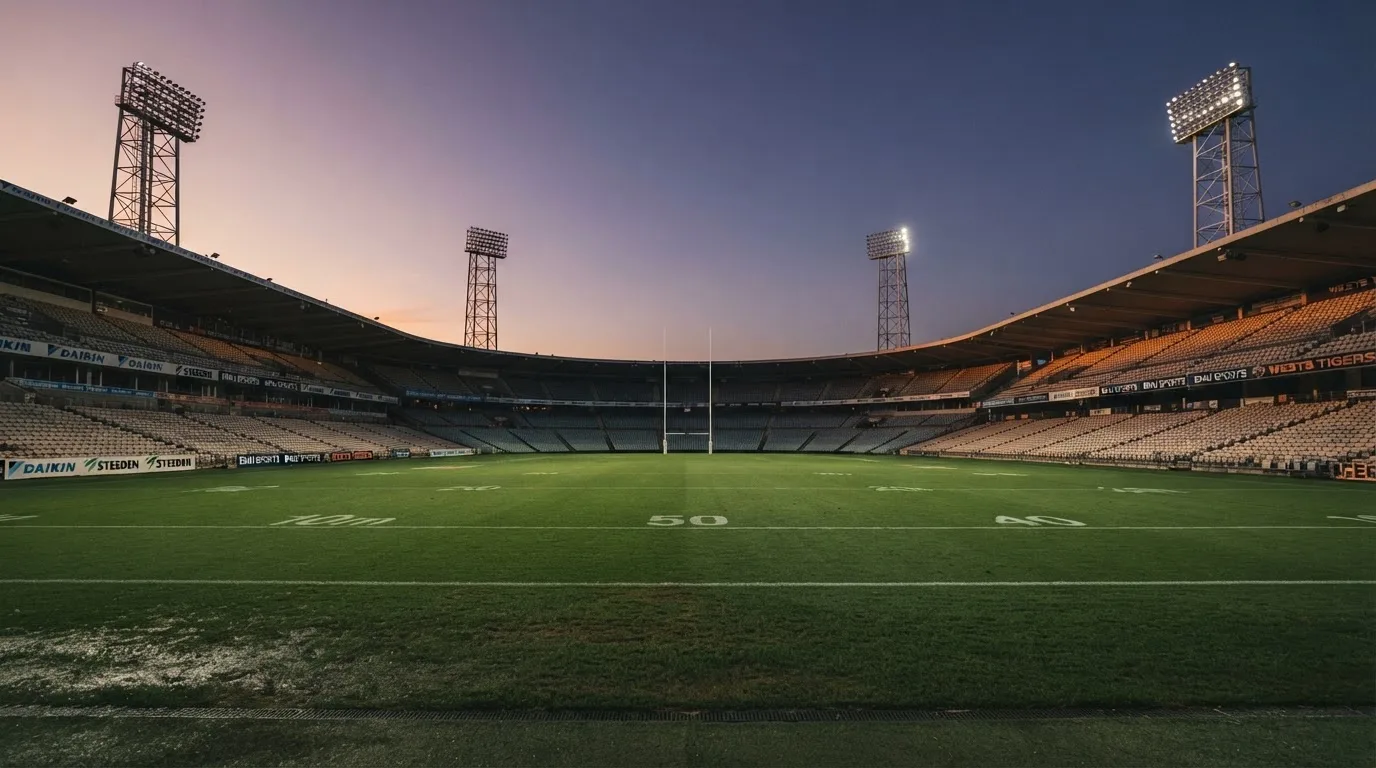
The picture underneath this section is an empty stadium at dusk, which is the time of week rugby league is played in Britain: Friday nights under the floodlights, the working week finished, the terraces half-full because the bigger grounds have a third of the football capacity. Rugby league scoring is what the picture suggests — high scores, regular possession changes, the scoreboard ticking over every ten minutes. A typical Super League game finishes 24-18, the kind of scoreline that drives totals betting and handicap betting in equal measure, with the head-to-head settled by the smaller of the two margins.
The picture at the foot of this page is an empty courtroom in morning light, which is the place the British gambling regulatory framework is enforced from. The Gambling Commission’s public register is the whole test of who holds a licence to take bets in Great Britain, and the register is the route a punter checks before signing up to a new bookmaker. The register is the courtroom’s modern equivalent: the place the law meets the punter’s first deposit.
Frequently asked questions
How do I bet on rugby league in Great Britain?
Open an account with a bookmaker licensed by the Gambling Commission, deposit by debit card or bank transfer (credit cards are banned for gambling in Great Britain, including credit-card-funded e-wallet deposits), pick a Super League or NRL fixture from the sportsbook, choose a market from the menu (head-to-head, handicap, totals or tryscorer), enter a stake and confirm the bet. The bet is settled when the match finishes, with most markets settling on the official result and the head-to-head and handicap settling on eighty minutes of play, with extra time ignored. The first deposit triggers the identity check the operator is required to run before any gambling is allowed.
How can I check a bookmaker holds a Gambling Commission licence?
Use the Commission’s public register, searchable by business name, trading name, domain or account number. The licence number on the register is the whole test of who holds a licence. The brand names in this comparison are all on the register against the licence numbers listed in each review. A brand not on the register is not licensed to take bets in Great Britain and is one the punter should avoid.
How is the return on a bet worked out from the stake and the odds?
For a single bet at decimal odds, the return is the stake multiplied by the odds. A £10 bet at decimal 3.00 returns £30 if it wins. The net profit is the stake multiplied by the odds minus one, which is the return minus the stake. The same maths on a combination bet — a double, a treble or an accumulator — uses the multiplied odds of the legs, with each leg’s odds multiplied into the next. A £5 double at decimal 2.00 and 3.00 returns £5 multiplied by 6.00, which is £30, and the net profit is £25.
What is the bookmaker’s margin and how can I see it in the odds?
The margin is what the book keeps, on average, of every pound bet on a market. It is the overround above 100% on the implied probabilities of every outcome of the market. A two-way market at decimal 1.90 against decimal 1.90 prices each side at an implied 52.6%, which adds to 105.3% (an overround of 5.3%) and gives a margin of 5.0%. The bigger the margin, the more the punter pays to bet on the market. Margins on a Super League head-to-head are usually 3% to 8%; on a handicap 5% to 10%; on a tryscorer market 15% to 30%.
How do fractional odds such as 5/1 convert to decimal odds such as 6.00?
Fractional odds of a over b convert to decimal odds of a divided by b plus one. Five over one is five plus one, which is decimal 6.00. Eleven over four is 2.75 plus one, which is decimal 3.75. Evens (1/1) is one plus one, which is decimal 2.00. The conversion goes the other way too: decimal odds minus one is the cash form of the fractional. The two are the same price in different notation, and the punter can use whichever is easier.
Which safer-gambling tools does a licensed bookmaker have to offer?
Every UK-licensed online bookmaker offers GAMSTOP registration (the multi-operator self-exclusion scheme), deposit limits the punter can set on a fixed time frame, timeouts (a short break of twenty-four hours to six weeks), product-specific blocking (a punter can block themselves from the casino while keeping the sportsbook open), and links to GamCare, GambleAware and the NHS gambling clinics. The £150 rolling-thirty-day deposit-minus-withdrawals threshold triggers a financial vulnerability check. None of these tools is optional for the operator, and none of them costs the punter anything to use.
Rugby, cricket & Gaelic – Best Betting Tips
Content created by the «Best Betting Tips» team
